

Can Dogs Eat Celery for Weight Loss? Benefits & Portion Guide 2026
You are making a snack, a salad, or just crunching on a celery stick, and your dog looks up with that familiar curious expression. Celery is one of those vegetables that seems almost impossibly healthy — crunchy, fresh, nearly zero calories — and you wonder if your dog might benefit from it too. Can dogs eat celery? Is it actually safe? What about celery leaves, celery root, or celery salt?
Great news — celery is one of the safest, most dog-friendly vegetables available, and it comes with an impressive list of health benefits. This complete guide answers every question dog owners ask about celery — every form, every part of the plant, every related product, and everything you need to know to share this crunchy vegetable with your dog confidently and safely.
Can Dogs Eat Celery?
Yes — dogs can eat celery, and it is one of the most recommended vegetables for dogs across veterinary and nutritional communities. The American Kennel Club (AKC) specifically lists celery as a safe and healthy vegetable for dogs, noting that it is low in fat and cholesterol, and contains vitamins A, C, and K, folate, potassium, and manganese.
Celery is also notably credited with the ability to freshen dogs’ breath — an appealing bonus for owners of dogs with less-than-fresh breath.
The preparation rules are simple: wash thoroughly, remove strings (the fibrous threads along the stalks), cut into small appropriately sized pieces, and serve plain. No dip, no peanut butter sauce, no seasoning. Just plain celery — one of the easiest and most beneficial vegetable treats you can give your dog.
Is Celery Good for Dogs?
Yes — celery is genuinely good for dogs. It ranks among the top veterinarian-recommended vegetables for dogs for several compelling reasons, and the combination of nutritional value, minimal calories, and practical health benefits makes it genuinely exceptional.
Celery is approximately 95% water — making it one of the most hydrating food choices available. It is extremely low in calories (roughly 6 to 10 calories per stalk), contains virtually no fat, and provides a satisfying crunch that most dogs find enjoyable.
The nutritional profile is impressive for such a low-calorie vegetable: Vitamin K for blood clotting and bone health, Vitamin C for immune function and antioxidant protection, Vitamin A for vision and skin health, folate for cellular health, potassium for heart and muscle function, and manganese for bone formation and metabolism. Celery also contains various antioxidant plant compounds including apigenin, luteolin, and phthalides that provide anti-inflammatory and cellular protective benefits.
For dogs that need a low-calorie, high-volume treat — particularly overweight dogs — celery is close to an ideal choice.
Benefits of Celery for Dogs
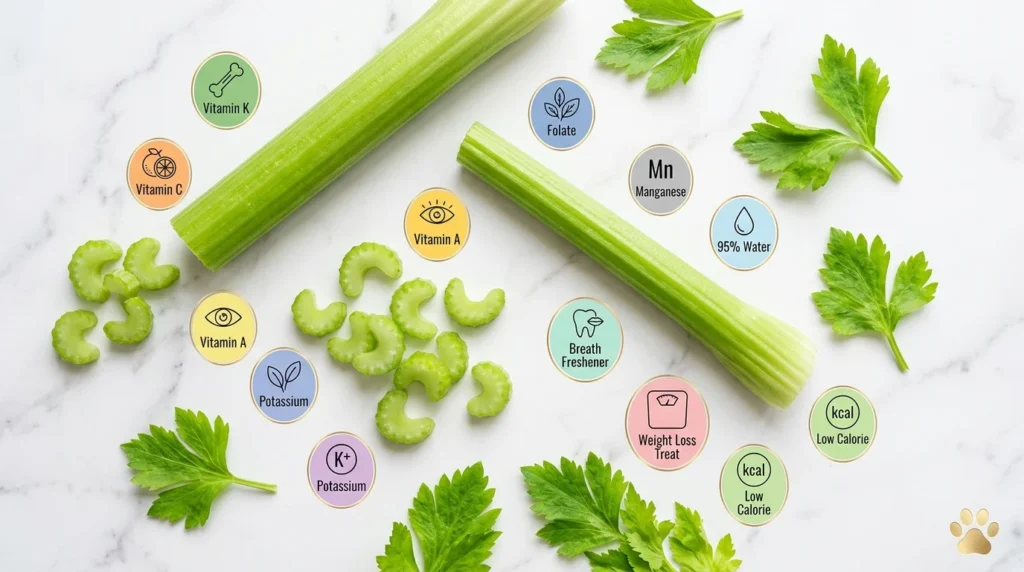
Let’s examine each specific health benefit celery provides to dogs in detail.
Vitamin K — Blood Clotting and Bone Health Celery is one of the richer plant sources of Vitamin K available in common vegetables. Vitamin K is essential for proper blood clotting — without adequate Vitamin K, wounds do not heal normally and bleeding can be prolonged. It also plays a critical role in bone metabolism, supporting bone density and reducing fracture risk. This is particularly valuable for senior dogs, large breeds prone to bone density issues, and dogs recovering from injuries or surgery.
Vitamin C — Immune Defense and Antioxidant Celery provides meaningful amounts of Vitamin C — a major antioxidant that neutralizes free radicals, supports immune system function, and contributes to collagen production for healthy joints, skin, and wound healing. While dogs synthesize their own Vitamin C, additional dietary C supports immune resilience. For older dogs, stressed dogs, or those recovering from illness, extra Vitamin C from celery provides beneficial immune support.
Vitamin A (from Beta-Carotene) — Vision and Skin Celery contains beta-carotene, which the body converts to Vitamin A as needed. Vitamin A supports healthy vision (particularly night vision), immune function, proper cell growth, and healthy skin and coat. For dogs with skin issues or declining vision, the beta-carotene in celery contributes to targeted nutritional support.
Potassium — Heart and Muscle Function Potassium is an essential electrolyte that regulates heart rhythm, supports proper muscle contraction, and maintains healthy fluid balance throughout the body. Celery provides a meaningful contribution of potassium that supports cardiovascular and muscular health — particularly beneficial for active dogs and working breeds.
Folate — Cellular Health and DNA Folate (Vitamin B9) supports DNA synthesis, cell division, and red blood cell production. It is particularly important for pregnant dogs and growing puppies, but plays an ongoing role in healthy cell function throughout every life stage.
Manganese — Metabolism and Joint Health Manganese supports healthy bone formation, fat and carbohydrate metabolism, and collagen production — essential for joint and connective tissue health. For dogs with joint concerns or those prone to joint disease, manganese from dietary sources like celery provides modest targeted support.
Hydration Support At approximately 95% water content, celery is one of the most hydrating foods available. For dogs that are not enthusiastic water drinkers — particularly senior dogs or those in hot climates — celery provides meaningful fluid intake through food. On hot summer days, cold celery sticks are a refreshing, hydrating treat that most dogs enjoy.
Breath Freshening This is one of celery’s most famous and practically valuable benefits for dogs. The AKC specifically mentions that celery freshens dogs’ breath — a benefit appreciated by owners of dogs with persistent bad breath. The mechanical chewing action combined with celery’s high water content and natural compounds help clean the mouth, reduce bacteria, and leave fresher breath. While not a replacement for brushing, regular celery treats make a meaningful difference.
Dental Benefit — Mechanical Cleaning The firm, fibrous texture of celery provides mechanical scrubbing of tooth surfaces as dogs chew. This helps remove plaque and tartar buildup and stimulates healthy gum tissue. Combined with the breath-freshening properties, celery is one of the better natural dental health contributors among vegetable treats.
Weight Management — Nearly Zero Calories At only 6 to 10 calories per stalk, celery is one of the lowest-calorie treats available. For overweight dogs, dogs on calorie-restricted diets, or any dog where caloric management is a consideration, celery provides volume, crunch, satisfaction, and flavor with virtually no caloric cost. This makes it one of the most useful weight management tools in the dog-treat toolkit.
Risks of Feeding Celery to Dogs
While celery is one of the safest vegetables for dogs, there are still some specific risks and considerations to understand for responsible feeding.
Choking Risk from Strings and Large Pieces The fibrous strings that run along celery stalks are the most significant practical risk. These strings can potentially wrap around the throat or become lodged in the digestive tract, particularly for smaller dogs or enthusiastic gulpers. Always remove celery strings before serving by running a vegetable peeler along the stalk or pulling strings off manually. Also cut celery into appropriately small pieces — large chunks of celery stalk are a choking hazard for small dogs.
Digestive Upset from Overconsumption Too much celery at once can cause digestive upset in dogs — gas, bloating, or loose stools from the high fiber and water content overwhelming the digestive system. This is not a toxic concern but is genuinely uncomfortable. Stick to appropriate portion sizes for your dog’s size.
Excessive Urination Celery has natural diuretic properties — it promotes urine production. For most dogs, the extra hydration from celery is beneficial. But for dogs with existing urinary issues, kidney concerns, or incontinence, the diuretic effect may not be desirable. Consult your vet if your dog has urinary health concerns before adding celery as a regular treat.
Pesticide Residue Commercially grown celery is among the produce items with meaningful pesticide residue. Always wash celery thoroughly under cold running water before serving to your dog. Scrub stalks gently to remove surface residue. Organic celery reduces this concern when sharing with your dog regularly.
Celery Salt — Do Not Confuse with Plain Celery Celery salt (a seasoning made from ground celery seed mixed with salt) is not the same as plain celery and is not safe for dogs. The high sodium content of celery salt makes it inappropriate for dogs. This distinction is important — the vegetable is safe, the salt-based seasoning is not.
Allergic Reactions Celery allergies in dogs are uncommon but possible. Signs include itching, hives, swelling, digestive upset, or unusual lethargy after eating. Introduce celery slowly the first time and watch for any reaction over 24 hours.
Can Dogs Eat Celery Raw?
Yes — raw celery is not only safe but is the best form to give your dog. Raw celery retains its full complement of vitamins, minerals, antioxidants, and water content at maximum potency. The mechanical chewing benefit — dental cleaning and gum stimulation — is most pronounced in the raw, firm form.
The crunch of raw celery is also genuinely satisfying for most dogs, and the chewing process itself provides mental stimulation and engagement. Many dogs treat a celery stick like a chew toy — working on it happily for several minutes.
Preparation for raw celery: wash thoroughly under cold running water, use a vegetable peeler to remove the fibrous strings along the outer surface of each stalk, and cut into small pieces appropriate for your dog’s size. For large breeds, 2 to 3 inch pieces are manageable. For small breeds, much smaller pieces reduce choking risk.
Can Dogs Eat Cooked Celery?
Yes — cooked celery is safe for dogs, though it is less nutritionally optimal than raw. Cooking softens celery significantly, which can be beneficial for dogs with dental sensitivities, older dogs with weaker teeth, or dogs that find raw celery too hard to chew comfortably. The softer texture after cooking also reduces the string concern.
The nutritional tradeoff with cooking is real — heat-sensitive vitamins like Vitamin C are reduced through cooking, and the crisp texture that provides dental and chewing benefits is lost. But the basic safety of cooked plain celery is the same as raw.
The essential rule for cooked celery: cook plain with no added salt, butter, oil, garlic, onion, or other seasonings. Celery is almost never cooked alone in human cuisine — it typically goes into soups, stews, and stir-fries with lots of other ingredients. Set aside plain portions of raw celery for your dog before adding celery to any seasoned dish you are cooking for yourself.
See Also: Can Dogs Eat Popcorn? Buttered, Kettle Corn & Every Type Covered
Can Dogs Eat Celery Sticks?
Yes — celery sticks are the ideal format for sharing celery with dogs. A celery stick is simply a portion of the celery stalk cut into a manageable length — typically 3 to 5 inches for a snacking piece. This is the most common way celery is served as a snack for humans, and it works well for dogs with appropriate size adjustments.
For large dogs, a full celery stick (properly strung and washed) is a satisfying chew that provides extended engagement. For medium dogs, cut into shorter sections. For small dogs, cut into very small pieces — half-inch to one-inch sections — to completely eliminate choking risk.
Celery sticks are particularly useful as training treats for dogs because they are low calorie, easy to carry, break easily into smaller pieces, and most dogs find them sufficiently motivating for training purposes — particularly dogs that love crunchy textures.
Can Dogs Eat Celery Leaves?
Yes — celery leaves are safe for dogs and are actually quite nutritious. The leafy green tops of celery stalks contain concentrated amounts of Vitamin C, Vitamin K, and various antioxidant compounds — often more concentrated per gram than the stalks themselves because the leaves are where many plant compounds are most abundant.
Celery leaves have a more intense, slightly bitter flavor than the stalks, which some dogs find very appealing while others may be less enthusiastic. The texture of celery leaves is soft and easy to chew, making them suitable for dogs of all sizes without the string concerns of the stalks.
Wash celery leaves thoroughly before serving — the feathery, complex structure of the leaves can trap more dirt and pesticide residue than smooth stalks. Tear or cut into smaller pieces for small dogs. Serve plain with no dressing or dip.
Can Dogs Eat Celery and Carrots?
Yes — celery and carrots make one of the best vegetable combinations you can share with a dog. Both are safe, low-calorie, crunchy, and nutritious. They complement each other nutritionally: celery adds Vitamin K, folate, potassium, and breath-freshening compounds, while carrots add beta-carotene, Vitamin A, and natural sweetness that many dogs find irresistible.
The combination of textures — the crisp snap of celery and the slightly denser crunch of carrot — creates a varied, satisfying chewing experience that many dogs engage with for longer than either vegetable alone. This makes the combination particularly good for mental stimulation through food.
Combine raw celery pieces (strings removed, cut small) with raw carrot rounds or sticks for a colorful, nutritious mixed vegetable treat. All plain, no dip, no seasoning. This combination works excellently in Kong toys, lick mats, puzzle feeders, or simply as a training treat mix.
Can Dogs Eat Celery with Peanut Butter?
This requires careful consideration of the peanut butter component. Celery itself with a small amount of peanut butter can be safe — but the peanut butter must be xylitol-free and given in a very small amount.
The classic human snack “ants on a log” (celery filled with peanut butter and raisins) is absolutely not appropriate for dogs — raisins are highly toxic to dogs. But plain celery with a thin smear of xylitol-free peanut butter is a combination many dog owners use as a high-value treat or training reward.
The xylitol check is non-negotiable. Many “natural,” “light,” “reduced sugar,” and “no sugar added” peanut butter brands contain xylitol — an artificial sweetener that is acutely toxic to dogs and can cause rapid hypoglycemia and liver failure even in small amounts. Always read the ingredient list every time before using any peanut butter product with your dog.
If xylitol-free peanut butter is confirmed, use only a thin scrape on celery — not a generous filling. The peanut butter adds fat and calories; keeping the amount minimal preserves the low-calorie benefit of the celery.
Can Dogs Eat Celery Safely?
Yes — celery is one of the safest vegetables you can give your dog. The complete safety checklist for celery is shorter and simpler than for most other vegetables.
Complete safety checklist for celery:
- Wash thoroughly under cold running water — scrub stalks to remove pesticide residue and dirt
- Remove the fibrous strings — use a vegetable peeler along the outer surface of each stalk
- Cut into appropriately small pieces for your dog’s size
- Serve completely plain — no dip, no peanut butter sauce, no ranch dressing, no seasoning
- Never use celery salt — this is a high-sodium seasoning, not a vegetable
- Celery leaves are safe — wash well before serving
- Celery root (celeriac) is safe when cooked and plain — see that section below
- Celery seed and celery salt — not appropriate for dogs due to concentration and sodium
- Introduce slowly the first time — just one or two small pieces, watch for 24 hours
- Keep portions within appropriate limits for your dog’s size (see table below)
- Dogs with urinary issues or kidney conditions — consult vet before regular celery feeding
Can Dogs Eat Celery Root?
Celery root (also called celeriac) is the root bulb of a specific celery variety grown for its root rather than its stalks. Celeriac is safe for dogs when cooked and served plain, though it requires specific preparation.
Raw celeriac is very dense and hard — significantly harder than celery stalks. Giving raw celeriac to dogs is not recommended due to choking risk and digestive difficulty. Cooked celeriac (boiled, steamed, or roasted plain without any seasonings) becomes soft and manageable.
The flavor of celeriac is more intense and earthy than celery stalks — some dogs find it very appealing, others less so. Nutritionally, cooked celeriac provides Vitamin K, phosphorus, potassium, and fiber.
Never give celeriac prepared with human recipe additions — it is commonly roasted with olive oil, garlic, herbs, or made into cream of celeriac soup with butter and cream. Always prepare a plain portion separately if you want to share.
Can Dogs Eat Celery Seed?
Not recommended as a supplement or standalone food for dogs. Celery seeds are small, intensely concentrated seeds with a very strong flavor — much more concentrated in compounds than the stalk or leaves. While small incidental amounts (as might be present in food) are unlikely to cause serious harm, celery seeds should not be deliberately given to dogs as a food item or supplement.
Celery seed contains high concentrations of volatile oils including limonene, selinene, and phthalides that in concentrated amounts can be irritating to the kidneys and digestive system. The seeds are also very small and could potentially be inhaled rather than swallowed — a respiratory risk.
There is no meaningful nutritional benefit from giving celery seeds to dogs that cannot be obtained more safely from plain celery stalks or other vegetables. Skip celery seeds and stick to the fresh vegetable.
Can Dogs Eat Celery Salt?
No — celery salt should never be given to dogs. This is an important distinction that dog owners need to understand clearly. Celery salt is a seasoning product made by combining ground celery seed or dried celery with table salt. It is not a vegetable — it is a concentrated, high-sodium seasoning.
The salt component of celery salt is the primary concern. Regular table salt (sodium chloride) is already problematic for dogs in excess, and celery salt contains significant amounts of it. High sodium causes excessive thirst, increased urination, and in larger amounts, sodium toxicity — a serious condition causing vomiting, tremors, and potentially seizures.
The concentrated celery seed compounds in celery salt add additional concerns. Never give celery salt, celery-flavored salt, or any salt-based seasoning to your dog. The plain vegetable is the only appropriate form of celery for dogs.
Can Dogs Eat Frozen Celery?
Yes — frozen celery is safe for dogs and can be a particularly excellent treat option. Frozen celery has several practical advantages as a dog treat: the cold temperature is soothing and refreshing (particularly useful in summer), the frozen texture is firmer than fresh celery and lasts longer as a chew, and frozen treats generally slow down enthusiastic eaters.
Freezing celery does not add any harmful compounds and preserves most nutritional content well — vitamins, minerals, and fiber are largely maintained through freezing. The texture change is the most significant difference — frozen celery becomes significantly firmer, which actually makes it more satisfying for dogs that enjoy chewing.
Prepare before freezing: wash thoroughly, remove strings, cut into appropriate pieces for your dog’s size, and freeze flat on a parchment-lined tray before storing in a sealed bag. Serve directly from the freezer. For small dogs or dogs with dental sensitivities, let frozen celery thaw for a few minutes before serving to prevent any risk of tooth injury from biting on something very hard.
See Also: Can Dogs Eat Potatoes? Safe Types, Risks & Feeding Guide 2026
Can Puppies Eat Frozen Celery?
Yes — frozen celery is specifically one of the most recommended treats for teething puppies, and this deserves special attention. The teething phase (typically 3 to 6 months for puppies) involves sore, inflamed gums as adult teeth push through. Cold or frozen items significantly soothe this discomfort, making frozen celery a genuinely therapeutic treat during this phase.
Unlike many commercial teething toys, frozen celery is edible, digestible, natural, and nutritious. The cold temperature reduces gum inflammation, the firm texture provides appropriate chewing stimulation, and the celery’s nutrients contribute to the puppy’s developing body.
For teething puppies, cut celery into small, puppy-appropriate pieces, remove all strings carefully, and freeze. Supervise the puppy while they chew frozen celery, particularly very young puppies — the small pieces should be appropriate for their size and development.
Beyond the teething phase, puppies can continue eating plain celery as an occasional treat in small amounts. Always cut into very small pieces for puppies, and ensure primary nutrition comes from complete, age-appropriate puppy food.
Can Dogs Eat Celery Everyday?
Yes — celery is one of the few vegetables where daily feeding is genuinely low-risk for most healthy adult dogs. The nearly zero calorie content, very low sugar, high water content, and absence of any significant concern about daily accumulation make celery one of the better daily treat options available.
Unlike fruits (which have natural sugar that accumulates with daily feeding) or high-calorie vegetables (which add meaningful calories daily), celery adds essentially no caloric load to your dog’s daily intake. A few pieces of celery daily provide hydration, dental benefit, breath freshening, and modest vitamins without any meaningful downside.
Daily celery is particularly beneficial for overweight dogs on calorie-restricted diets who need frequent treat reinforcement during training or behavior modification programs. Celery allows frequent rewarding without caloric impact.
That said, even with celery, rotating different vegetables and treats ensures broader nutritional exposure and prevents your dog from becoming overly fixated on one food. Including celery several times per week alongside other dog-safe vegetables is ideal for long-term dietary variety.
Can Dogs Eat Celery Soup?
No — celery soup as typically prepared is not appropriate for dogs. Celery soup — whether homemade or commercial — contains a range of ingredients that make it problematic for dogs despite the healthy celery base.
Standard cream of celery soup contains: butter or cream (high fat — pancreatitis risk), onion and garlic (both toxic to dogs), salt (excess sodium), chicken broth (typically high sodium and may contain onion powder), cream cheese or heavy cream, and various herbs and spices.
Commercial canned celery soup is extremely high in sodium and typically contains onion and garlic. Even “low sodium” versions usually contain more sodium than is appropriate for dogs and contain problematic ingredients.
If you want to give your dog something celery-based in a soft or liquid form, blend a small amount of plain raw or cooked celery with water or plain low-sodium broth and give a spoonful as a food topper. That is the safe alternative.
Can Dogs Have Celery for Weight Loss?
Yes — celery is one of the most effective weight management tools available in the dog treat toolkit, and this deserves a dedicated discussion because it is genuinely important for the significant portion of dog owners managing overweight dogs.
The statistics are concerning — studies suggest that 50 to 60% of dogs in developed countries are overweight or obese. Treating and managing obesity in dogs is challenging partly because dogs love treats and the training-treat relationship is important for behavior and bonding. Eliminating treats entirely is not realistic or ideal — but replacing higher-calorie treats with celery maintains the treat-giving dynamic without the caloric cost.
A single medium carrot stick (a popular low-calorie treat) contains about 25 calories. A piece of cheese might be 25 to 35 calories. A commercial dog treat can be 30 to 50 calories. A piece of celery: 1 to 2 calories. This difference compounds dramatically across multiple daily treat sessions.
For dogs on weight management programs, celery can be given in much larger amounts than other treats precisely because it has so few calories. A dog can have 5 to 10 pieces of celery as a “treat” and still have consumed fewer calories than one commercial dog biscuit. This makes the dog feel substantially rewarded while staying within the calorie budget.
Combine with appropriate portion-controlled complete dog food, increased exercise, and veterinary guidance for a comprehensive weight management approach.
Can Dogs Be Allergic to Celery?
Yes — celery allergies in dogs are possible, though they are not common. Celery belongs to the Apiaceae plant family (also called Umbelliferae), which includes carrots, parsley, parsnip, dill, fennel, and cilantro. Dogs with allergies to any of these related plants may also react to celery — this is called cross-reactivity.
Signs of celery allergy in dogs:
- Itchy skin, particularly around the face, paws, and belly
- Hives or raised bumps on the skin
- Swelling around the mouth, face, or throat
- Vomiting or diarrhea after eating celery
- Excessive drooling or pawing at the mouth
- Lethargy or unusual behavior after celery consumption
What to do if you suspect a celery allergy: Stop giving celery immediately. Contact your veterinarian to discuss the symptoms and whether allergy testing is appropriate. For severe reactions — particularly swelling around the throat or difficulty breathing — seek emergency veterinary care immediately.
For most dogs: The risk of celery allergy is low, and introducing celery slowly (one or two small pieces the first time, wait 24 hours) is sufficient precaution. The vast majority of dogs tolerate celery without any issues.
See Also: Can Dogs Eat Raw Eggs or Fried Eggs? Full Safety Guide 2026
How to Feed Celery to Your Dog
Feeding celery safely to your dog is simple when you follow a consistent preparation process.
Step 1 — Choose fresh celery: Select crisp, firm celery with bright green color and tightly packed stalks. Avoid celery that is wilted, yellowing, or has any visible mold. Fresh celery is more nutritious and more appealing to dogs than older celery.
Step 2 — Wash thoroughly: Rinse under cold running water, scrubbing each stalk with a gentle vegetable brush or your fingers. The grooves in celery stalks can trap dirt and pesticide residue — wash well.
Step 3 — Remove strings: Run a vegetable peeler along the outer surface of each stalk to remove the fibrous strings. Alternatively, use your fingers to pull strings off from one end. This is the most important preparation step for dog safety.
Step 4 — Cut to appropriate size: For large dogs: 2 to 3-inch pieces. For medium dogs: 1 to 2-inch pieces. For small and toy breeds: half-inch pieces or thin slices. Always err on the side of smaller pieces.
Step 5 — Serve plain: No peanut butter unless confirmed xylitol-free and in tiny amounts. No ranch dip. No seasoning. No salt. Just clean, plain celery.
Step 6 — Introduce slowly: First time: just one or two pieces. Wait 24 hours. If no reaction, gradually increase to normal portions.
How to Serve Celery to Your Dog
There are several creative ways to incorporate celery into your dog’s treat routine beyond just handing over a plain piece.
Raw celery sticks: The simplest approach. Wash, string, cut, serve. Most dogs love the satisfying crunch.
Celery leaves: Wash thoroughly and serve as a separate leafy treat or mix with pieces of stalk.
Frozen celery pieces: String, cut, freeze flat on a tray, store in a sealed bag. Excellent for hot days and teething puppies.
Celery in a Kong toy: Cut into small pieces and stuff into a Kong with a small amount of xylitol-free peanut butter. Freeze overnight for a long-lasting, mentally engaging treat.
Celery lick mat: Blend celery with a small amount of water into a thin paste, spread on a lick mat, and freeze for 20 to 30 minutes. A calming, slow-feeding enrichment activity.
Celery and carrot mix: Combine celery pieces with carrot rounds for a colorful, nutritious mixed vegetable treat bowl.
Celery as food topper: Finely chop celery and sprinkle over your dog’s regular meal for added hydration, vitamins, and flavor interest.
Training treats: Small celery pieces work well as frequent, low-calorie training rewards — particularly for dogs managing weight.
How Much Celery Can Dogs Eat?
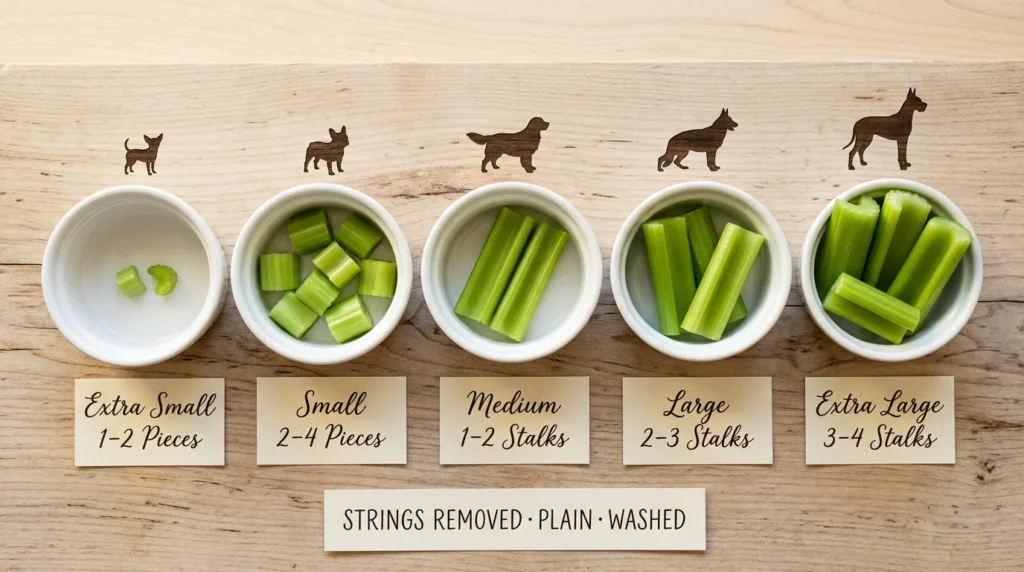
Celery is so low in calories and so safe that the standard 10% treat guideline rarely becomes a practical constraint. However, practical portion guidelines help prevent digestive upset from too much fiber and water at once.
How Much Celery Can Dogs Eat? — Portion Guide by Dog Size
| Dog Size | Weight Range | Daily Celery Amount (Max) | Serving Format | Frequency |
|---|---|---|---|---|
| Extra Small | Under 10 lbs | 1–2 small pieces (half-inch each) | Tiny pieces, strings removed | Daily or a few times per week |
| Small | 10–20 lbs | 2–4 small pieces (1 inch each) | Small pieces or thin sticks | Daily or a few times per week |
| Medium | 20–50 lbs | 1–2 stalks cut into pieces | Medium pieces or short sticks | Daily or a few times per week |
| Large | 50–90 lbs | 2–3 stalks cut into pieces | Full stalk sections or pieces | Daily or a few times per week |
| Extra Large | 90 lbs + | 3–4 stalks cut into pieces | Full stalk sections | Daily or a few times per week |
Important notes on this table:
- These are maximum daily amounts for plain celery — washed, strings removed, plain with no additions.
- Celery is so low in calories that the 10% treat guideline is almost never a limiting factor — portion guidance here is more about digestive comfort than caloric management.
- For weight management dogs: celery can be given more generously than the minimums above since it is essentially calorie-free.
- Remove all fibrous strings regardless of dog size — this is the most important preparation step.
- Dogs with urinary issues, kidney conditions, or on diuretic medications — consult your vet before daily celery feeding due to celery’s natural diuretic effect.
- Celery leaves can be given in similar amounts — they are safe and nutritious.
- Celery root (cooked plain) should be in smaller amounts due to higher calorie density than the stalk.
Also Read: Can Dogs Eat Mustard? Risks, Symptoms & Safe Alternatives
Frequently Asked Questions
Can dogs eat celery?
Yes. Celery is one of the safest, most recommended vegetables for dogs. It is non-toxic, very low in calories, high in water content, and provides vitamins K, C, and A, folate, potassium, and manganese. Wash thoroughly, remove strings, cut into small pieces, and serve plain.
Can dogs eat celery raw?
Yes — raw celery is the best form. It retains full nutritional value, provides dental cleaning benefit from chewing, freshens breath, and most dogs enjoy the satisfying crunch. Remove strings and cut into appropriate-sized pieces.
Can dogs eat cooked celery?
Yes — plain cooked celery is safe. It is a good option for dogs with dental sensitivities. Cook without any salt, butter, garlic, onion, or seasoning. Note that cooking reduces Vitamin C content and removes the dental and breath-freshening benefits of raw celery.
Can dogs eat celery sticks?
Yes. Celery sticks are an ideal serving format — easy to portion, satisfying to chew, and low calorie. Remove strings, wash well, and cut to an appropriate size for your dog. Large breeds can handle full sticks; small breeds need very small pieces.
Can dogs eat celery leaves?
Yes. Celery leaves are safe and nutritious — often more concentrated in vitamins and antioxidants than the stalks. Wash thoroughly (leaves trap more dirt and residue) and serve plain. Some dogs love the slightly more intense flavor.
Can dogs eat celery and carrots together?
Yes. Both are safe, low-calorie, crunchy vegetables that complement each other nutritionally. Combine plain celery pieces and carrot rounds for a mixed vegetable treat. Excellent in Kong toys, puzzle feeders, or as a training treat mix.
Can dogs eat celery with peanut butter?
Only with xylitol-free peanut butter in a very small amount. Always read the ingredient label — many peanut butter brands contain xylitol, which is acutely toxic to dogs. Never “ants on a log” style with raisins — raisins are extremely toxic to dogs.
Can dogs eat celery root (celeriac)?
Yes — when cooked plain. Raw celeriac is too hard and dense. Boiled or steamed plain celeriac (no salt, butter, garlic, or other additions) is safe. Never share celeriac prepared with human recipe seasonings.
Can dogs eat celery seed?
Not recommended. Celery seeds are concentrated in volatile oils and compounds that can be irritating in the amounts needed to give as a supplement. Stick to plain celery stalks and leaves.
Can dogs eat celery salt?
Never. Celery salt is a high-sodium seasoning — not a vegetable. The salt content makes it completely inappropriate for dogs. Do not confuse the seasoning with the plain vegetable.
Can dogs eat frozen celery?
Yes. Frozen celery is safe and excellent — particularly for teething puppies (soothes gum pain) and as a summer cooling treat for adult dogs. String, cut, freeze flat, and serve directly from the freezer.
Can puppies eat frozen celery?
Yes — frozen celery is specifically recommended for teething puppies. The cold soothes sore gums, the chewing provides stimulation, and the celery is safe to eat. Cut into very small puppy-appropriate pieces, remove all strings, and supervise while the puppy chews.
Can dogs eat celery soup?
No. Celery soup contains butter, cream, onion, garlic, salt, and other ingredients harmful to dogs. Never give celery soup — serve plain raw or cooked celery instead.
Can dogs eat celery every day?
Yes — celery is one of the few treats where daily feeding is genuinely low-risk. The nearly zero calories, low sugar, and absence of cumulative concerns make daily celery acceptable for most healthy dogs. Rotating with other vegetables is still good practice.
Can dogs have celery for weight loss?
Yes. With only 1–2 calories per piece, celery is one of the most effective weight management tools for dogs. It can replace higher-calorie treats without reducing the treat-giving experience. Excellent for overweight dogs on calorie-controlled programs.
Can dogs be allergic to celery?
Yes, though uncommon. Signs include itching, hives, swelling, vomiting, or diarrhea after eating. Introduce slowly and watch for 24 hours. Dogs allergic to related Apiaceae plants (carrots, parsley, dill) may cross-react with celery.
How much celery can a dog eat?
See the portion table above. Extra small dogs: 1–2 tiny pieces. Small dogs: 2–4 small pieces. Medium dogs: 1–2 stalks cut into pieces. Large dogs: 2–3 stalks. Extra large: 3–4 stalks. All plain, strings removed, daily or a few times per week.
What should I do if my dog ate too much celery?
Expect temporary gas, bloating, or loose stools from the high fiber and water content. Not a toxic emergency. Ensure water access, reduce the next meal, and monitor for 24 hours. Contact your vet if symptoms are severe or prolonged.
Conclusion
Celery is one of the most unambiguously excellent vegetables you can share with your dog. It is safe, nutritious, nearly calorie-free, naturally hydrating, breath-freshening, dentally beneficial, and genuinely enjoyed by most dogs. In a world where many “human foods” require extensive caveats and careful portion management, celery is a straightforward, worry-free choice.
The complete summary:
Safe and beneficial forms of celery for dogs:
- Raw celery stalks (strings removed, cut to appropriate size) — best form
- Celery leaves (washed well) — nutritious and safe
- Cooked plain celery — good for dogs with dental sensitivity
- Frozen celery pieces — excellent for teething puppies and summer treats
- Celery with a tiny amount of xylitol-free peanut butter — acceptable
Never give these celery-related items:
- Celery salt — high sodium seasoning, not a vegetable
- Celery seed as a supplement — concentrated compounds, not appropriate
- Celery soup — contains toxic ingredients (onion, garlic) and high sodium
- Raw celery root/celeriac — too hard, choking risk
- Celery with any dip, dressing, or seasoning
- “Ants on a log” with raisins — raisins are extremely toxic to dogs
The rules to always follow:
- Wash celery thoroughly before every serving — pesticide residue is a real concern
- Remove fibrous strings from every stalk before serving — this is the most critical step
- Cut into appropriately small pieces for your dog’s size
- Serve completely plain — no additions
- Introduce slowly the first time and watch for any reaction
- Dogs with urinary issues or kidney conditions — consult your vet about frequency
Also Read: Can Dogs Eat Corn? Cobs, Chips, Candy Corn & Every Form Covered


