

Can Dogs Eat Carrots? Benefits, Safety & Feeding Guide 2026
Yes — dogs can eat carrots, and they are one of the most recommended vegetables for dogs across veterinary
and nutritional communities. The American Kennel Club (AKC) specifically lists carrots as a dog-safe food and notes that they are low in calories and high in fiber and vitamins, making them an excellent treat choice.
You are snacking on carrots or prepping vegetables for dinner and your dog trots over, nose going, eyes on every carrot in your hand. It is one of those moments where sharing feels completely natural — after all, carrots seem like one of the most wholesome, harmless things imaginable. But are they actually safe for dogs? Can dogs eat raw carrots? What about cooked carrots, baby carrots, frozen carrots, or canned carrots?
Great news — carrots are one of the most dog-friendly vegetables available, and this is one guide where the answers are overwhelmingly positive. But there are still details worth knowing about preparation, portions, different varieties, and what to watch out for.
This complete guide answers every question dog owners ask about carrots — every form, every variety, every preparation method, and all the nutritional information you need to feel confident sharing this orange superfood with your dog.
Carrots are one of many dog-safe vegetables — see our what vegetables can dogs eat hub for the full safe, caution and never lists.
Can Dogs Eat Carrots?
Carrots are non-toxic, naturally sweet, satisfying to chew, and genuinely nutritious. They provide beta-carotene (which converts to Vitamin A), Vitamin K, potassium, fiber, and various antioxidants. They can be served raw, cooked, frozen, or steamed — all forms are safe when served plain.
The only practical rules: wash thoroughly, cut into appropriately sized pieces to prevent choking, and serve plain without added salt, butter, sugar, or seasonings. That truly is all there is to it.
Are Carrots Good for Dogs?
Yes — carrots are genuinely good for dogs, not just safe. They rank among the top vegetable treat choices recommended by veterinary nutritionists for several compelling reasons.
Carrots are exceptionally low in calories — roughly 25 calories per medium carrot — making them one of the most calorie-efficient treat options available. They are naturally sweet, which most dogs love, without the high sugar content of fruit options. The satisfying crunch of a raw carrot provides real dental benefit as dogs chew. And the nutritional profile — Vitamin A from beta-carotene, Vitamin K, potassium, fiber, and antioxidants — makes every carrot treat a genuinely nutritious contribution to your dog’s diet.
The combination of low calories, natural sweetness, dental benefit, nutritional density, and universal availability year-round makes carrots one of the very best everyday treat choices for dogs of any size, age, or breed.
Can Dogs Have Carrots?
Yes — dogs can absolutely have carrots. This question sometimes comes up from owners wondering whether there is any hidden concern that makes carrots less safe than they seem. There is not.
Carrots contain no compounds that are toxic to dogs. They are not on any veterinary toxic food list. They do not interact with common medications. They are not known to cause allergic reactions in the vast majority of dogs. Every part of a carrot — including the skin and the green top leaves — is non-toxic, though the leafy green tops are generally removed before serving for palatability and digestive ease.
For healthy dogs of all sizes, breeds, and life stages, carrots are a completely appropriate and genuinely beneficial treat choice. From Chihuahuas to Great Danes, from puppies to senior dogs — carrots work for virtually everyone.
Health Benefits of Carrots for Dogs
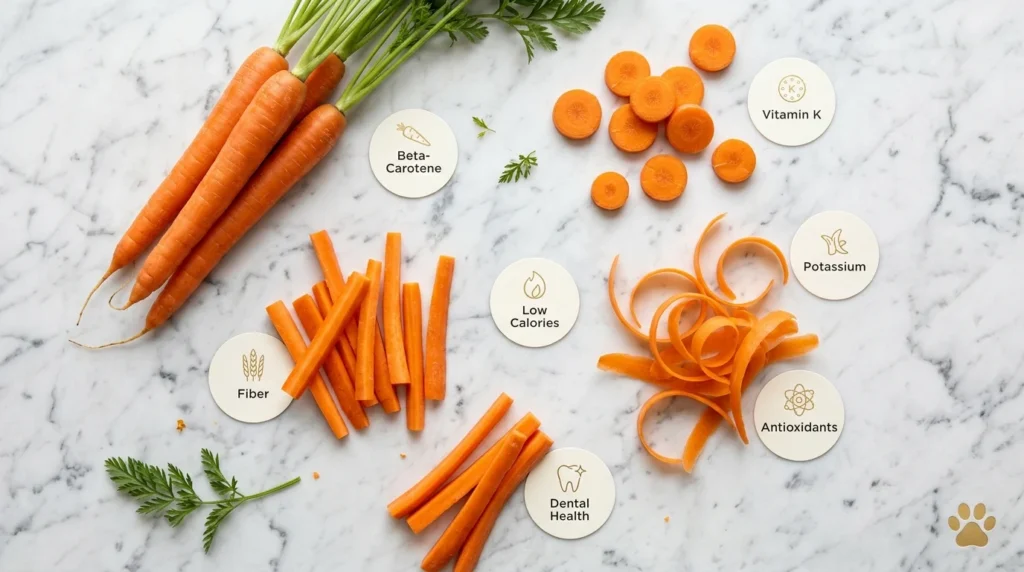
Let’s go deep on the specific health benefits carrots provide, because the nutritional case for carrots as a dog treat is genuinely strong.
Beta-Carotene and Vitamin A — Vision, Immunity, and Skin Carrots are one of the richest natural sources of beta-carotene available in any common food. Beta-carotene is converted by the body to Vitamin A as needed — a fat-soluble vitamin that plays critical roles in healthy vision (particularly night vision and the maintenance of healthy eyes as dogs age), immune system function, skin and coat health, and cell growth and reproduction. For senior dogs where vision changes are common, and for dogs with skin or coat issues, the beta-carotene in carrots provides real, meaningful nutritional support.
Vitamin K — Blood Clotting and Bone Health Carrots contain Vitamin K, which is essential for proper blood clotting and bone metabolism. Adequate Vitamin K means wounds heal properly and bones maintain healthy density. This is particularly relevant for senior dogs and large breeds more prone to bone health concerns as they age.
Potassium — Heart and Muscle Health Potassium is an essential electrolyte that regulates heart rhythm, supports proper muscle contraction, and maintains fluid balance throughout the body. Carrots provide a useful dietary contribution of potassium that supports cardiovascular and muscular health — beneficial for all dogs but particularly active and working breeds.
Dietary Fiber — Digestive Health Carrots are a good source of dietary fiber — both soluble and insoluble. Soluble fiber slows digestion and helps regulate blood sugar levels. Insoluble fiber adds bulk to stool and helps maintain regular, healthy bowel movements. The fiber in carrots also feeds beneficial gut bacteria, supporting the microbiome that underpins immune function and overall health. For dogs with occasional digestive irregularity, a few carrots can help normalize bowel function gently and naturally.
Antioxidants — Cellular Protection and Anti-Aging Beyond beta-carotene, carrots contain various antioxidant compounds including lutein, zeaxanthin, and various polyphenols. These compounds protect cells from oxidative damage caused by free radicals — the cellular damage linked to aging, cancer, and chronic disease. Regular inclusion of antioxidant-rich foods like carrots in a dog’s diet supports healthy aging and cellular protection.
Dental Health — The Carrot Advantage Raw carrots provide one of the most significant dental benefits of any treat food. The firm, crunchy texture of a raw carrot requires sustained chewing that mechanically scrubs the surfaces of teeth, helping to remove plaque and tartar buildup. The fibrous texture also stimulates gum tissue. Many veterinarians specifically recommend raw carrots as a dental chew alternative that is safe, natural, and digestible — unlike some synthetic dental chews. Cold or frozen carrots can also soothe teething discomfort in puppies.
Weight Management — Low Calories, High Satisfaction At roughly 25 calories per medium carrot, carrots are among the lowest-calorie treat options available. Yet they are bulky, filling, satisfying to chew, and naturally sweet — meaning dogs find them genuinely rewarding. For overweight dogs on calorie-restricted diets, carrots can replace higher-calorie commercial treats while still giving dogs something they genuinely look forward to.
When Are Carrots Bad for Dogs?
Carrots are rarely bad for dogs — but there are specific situations where they become less ideal or genuinely problematic.
Served in too-large pieces to small dogs: Large whole carrots or large chunks can be choking hazards, particularly for small and toy breeds. Always cut carrots into appropriately sized pieces for your dog’s size.
Given in excessively large amounts: While carrots are very low in calories, they do contain natural sugars (primarily sucrose and glucose). Very large amounts regularly could contribute to unnecessary sugar intake, particularly for diabetic dogs. The fiber in large amounts can also cause digestive upset — gas, bloating, loose stools.
Prepared with seasonings: Carrots cooked with butter, salt, garlic, onion, brown sugar glaze, or other human recipe ingredients become problematic. Garlic and onion are toxic to dogs. High salt causes sodium-related issues. Always prepare dog portions plain.
Canned carrots with added sodium: Many commercially canned carrots contain added salt as a preservative. High-sodium canned vegetables are not appropriate for dogs. If using canned carrots, choose only no-salt-added varieties.
Dogs with diabetes: While carrots are relatively low in sugar and high in fiber (which slows sugar absorption), diabetic dogs should have any dietary addition approved by a veterinarian. Even modest natural sugar from frequent carrot treats should be factored into blood sugar management.
As a meal replacement: Carrots are a treat and a supplement, not a complete food. They should never replace a balanced, complete dog food. Dogs fed excessive amounts of carrots at the expense of their proper food may develop nutritional deficiencies over time.
Can Dogs Eat Raw Carrots?
Yes — raw carrots are not only safe but are arguably the best form to give your dog. Raw carrots retain their full complement of vitamins, minerals, enzymes, and antioxidants — nothing is lost to heat or processing. Beta-carotene, Vitamin K, potassium, and all the beneficial plant compounds are present at maximum potency in raw carrots.
The dental benefit of raw carrots is also most pronounced in the raw form. The firm, crunchy texture of a raw carrot requires genuine chewing effort, which mechanically cleans tooth surfaces and stimulates gum tissue far more effectively than soft or cooked carrot pieces.
Raw carrots are also satisfying to chew — many dogs treat a whole raw carrot like a chew toy, working on it happily for several minutes. This provides mental stimulation and engagement alongside the physical and nutritional benefits.
Wash raw carrots thoroughly, peel optionally (the skin is safe), and cut into appropriately sized pieces for your dog. For large breeds, whole or halved carrots are great. For small breeds, thin rounds or thin sticks prevent choking.
Can Dogs Eat Baby Carrots?
Yes — baby carrots are completely safe for dogs and are one of the most convenient carrot formats for sharing with dogs. Baby carrots are small, pre-washed, pre-cut, and uniformly sized — no preparation needed beyond opening the bag.
The small size of baby carrots makes them naturally appropriate for medium and large dogs without any cutting required. For very small dogs, baby carrots can be halved or cut into quarters to reduce choking risk.
Baby carrots have the same nutritional profile as regular carrots — same vitamins, same minerals, same beta-carotene content. The “baby” designation refers to their small size (either immature carrots or machine-cut pieces of larger carrots), not to any difference in nutritional composition.
Baby carrots are particularly popular as training treats for dogs because they are easy to handle, naturally portioned, and most dogs find them highly motivating without the caloric cost of higher-fat treats.
Can Dogs Eat Cooked Carrots?
Yes — cooked carrots are safe for dogs and are a good option for dogs with dental issues, older dogs with sensitive teeth, or dogs that find raw carrots hard to chew. The soft texture of cooked carrots is easier for these dogs to manage than the firm crunch of raw.
One nutritional note: cooking changes the nutritional profile of carrots. The good news is that beta-carotene actually becomes more bioavailable when carrots are cooked — the heat breaks down the cell walls that contain the carotenoids, making them easier for the body to absorb. However, heat-sensitive vitamins like Vitamin C are reduced through cooking.
Overall, cooked carrots retain most of their nutritional value and are a perfectly nutritious treat format.
The critical rule: cook plain. Carrots cooked for human recipes typically include butter, salt, honey glaze, garlic, onion, herbs, or other seasonings — none of which are appropriate for dogs. Always set aside plain, unseasoned carrot portions before adding your own flavoring.
Can Dogs Eat Carrots Cooked?
Same as the section above — yes, cooked carrots are safe for dogs when prepared plain. This question is often searched separately from “cooked carrots” by dog owners, so the answer bears repeating clearly.
Whether you boil, steam, bake, or microwave carrots — as long as no salt, butter, oil, garlic, onion, sugar, or other seasonings are added, the resulting cooked carrot is safe for dogs. Allow cooked carrots to cool completely before giving to your dog — hot food can burn a dog’s mouth.
For dogs that are transitioning to vegetables in their diet, starting with lightly steamed carrot (which is softer and milder than raw) can be a gentler introduction before moving to raw if desired.
Can Dogs Eat Peas and Carrots?
Yes — both peas and carrots are safe for dogs, and together they make a nutritious vegetable combination. Peas (green peas, sugar snap peas, snow peas — all fresh or frozen, not canned with added salt) provide protein, fiber, Vitamins A, B, C, and K, plus minerals including zinc, potassium, and magnesium. Combined with the beta-carotene, Vitamin K, and fiber from carrots, this combination provides a broad nutritional profile.
The peas and carrots combination is popular because many dogs enjoy both and the contrast of textures and flavors. Both can be served raw (for larger pieces) or lightly steamed for a softer texture.
One important note on peas: there is ongoing research into a potential link between legume-heavy diets and dilated cardiomyopathy (DCM) in dogs. This concern is primarily about diets where legumes are a primary ingredient — not about a few peas given as treats. As occasional treats alongside a complete balanced dog food, peas are safe for most dogs. If you have concerns, consult your veterinarian.
See Also: Can Dogs Eat Cucumbers? Benefits, Safety & Feeding Guide 2026
Can Dogs Eat Canned Carrots?
It depends on the type of canned carrot product. Most commercially available canned carrots contain added salt as a preservative — and this added sodium is the primary concern for dogs.
Canned carrots with added salt: Not recommended. The sodium content from the brine can be significant, and regular feeding of high-sodium foods causes excessive thirst, increased urination, and in larger amounts, sodium-related health issues.
No-salt-added canned carrots: These are safer for dogs. Look for canned carrots that list only carrots (and water) in the ingredients, with no added salt, sugar, or preservatives. Drain and rinse even no-salt-added carrots before serving to further reduce any residual sodium from the canning process.
Even with no-salt-added canned carrots, the canning process reduces some nutritional content compared to fresh. Fresh or frozen carrots are always the preferable choice for dogs if available.
Can Dogs Eat Boiled Potatoes and Carrots?
This is a question about a specific combination — and the answer depends on how both vegetables were prepared.
Plain boiled carrots (no seasoning): Yes, completely safe as covered above.
Plain boiled potatoes (no seasoning): Plain boiled potatoes are generally safe for dogs in small amounts. Potatoes provide potassium, Vitamin C, and B vitamins. However, potatoes are higher in carbohydrates and calories than carrots, so they should be given in smaller amounts. Raw potatoes should be avoided — raw potatoes contain solanine, a compound that can be harmful.
Boiled potatoes and carrots together (plain, no butter, no salt, no seasoning): Safe and can be a nutritious treat combination.
The concern: Boiled potatoes and carrots are almost never prepared plain in human cooking — they are typically cooked with butter, salt, garlic, and herbs. Always set aside plain portions for your dog before adding any human seasonings.
Can Dogs Eat Carrots Everyday?
Yes — carrots are one of the few treats where daily feeding is genuinely low-risk for most healthy adult dogs. Their very low calorie content (roughly 25 calories per medium carrot), low sugar compared to fruit options, high fiber content, and broad nutritional benefits make them an excellent choice for daily treat inclusion.
Many veterinarians and pet nutritionists specifically recommend carrots as a daily treat option — particularly for dogs managing their weight, as the low caloric cost means they can have a satisfying treat without impacting their weight management goals.
The dental benefit of raw carrot also accumulates with regular feeding — consistent gentle mechanical cleaning through chewing supports healthier teeth and gums over time.
The only dogs for whom daily carrot feeding should be vet-approved first are diabetic dogs (natural sugars need monitoring) and dogs with specific digestive conditions. For all other healthy dogs, a few carrot pieces daily is a nutritious, beneficial habit.
Can Dogs Eat Purple Carrots?
Yes — purple carrots are safe for dogs and are actually nutritionally superior to standard orange carrots in some important ways. Purple carrots contain all the same beta-carotene and nutritional compounds as orange carrots, plus significantly higher levels of anthocyanins — the same powerful antioxidant pigments found in blueberries, blackberries, and other dark-colored fruits and vegetables.
Anthocyanins are among the most studied natural anti-inflammatory compounds in nutritional science, linked to reduced inflammation, cardiovascular protection, improved brain health, and potential anticancer properties. For dogs — particularly aging dogs or breeds prone to inflammatory conditions — purple carrots offer an antioxidant upgrade over standard orange varieties.
Purple carrots are becoming more widely available in grocery stores and farmers markets. Prepare them the same way as regular carrots — wash, peel optionally, cut into appropriate pieces, serve plain raw or cooked.
Can Dogs Eat Yellow Carrots?
Yes — yellow carrots are safe for dogs. Yellow carrot varieties get their color from xanthophylls — antioxidant compounds in the same carotenoid family as beta-carotene. While yellow carrots contain less beta-carotene than orange varieties, they provide a different antioxidant profile that is still genuinely beneficial.
Yellow carrots tend to be milder and slightly sweeter than orange carrots, which some dogs find particularly appealing. The nutritional content remains excellent — fiber, potassium, Vitamin K, and various antioxidant compounds are all present.
Prepare yellow carrots exactly as you would orange carrots — wash, cut into appropriate pieces, and serve plain. Yellow carrots are an interesting variety to rotate into your dog’s vegetable treat routine for nutritional diversity.
Can Dogs Eat Celery and Carrots?
Yes — both celery and carrots are safe for dogs and make a great combination vegetable treat. Celery is another excellent low-calorie dog-safe vegetable that provides Vitamin A, Vitamin C, Vitamin K, folate, potassium, and fiber — a similar profile to carrots with some overlap and some complementary nutrients.
Celery also has the interesting property of containing compounds that may help freshen dogs’ breath — a welcome bonus for owners of dogs with less-than-fresh breath.
When combining celery and carrots, cut both into small, appropriately sized pieces. Celery strings can be slightly troublesome for some dogs — running a vegetable peeler along the celery stalk removes the outer strings before cutting, making it easier to eat. Serve both plain, no dressing, no seasoning, no dip.
Can Dogs Eat Frozen Carrots?
Yes — frozen carrots are safe for dogs and are actually one of the best carrot treat formats, particularly for puppies and summer treat use. Frozen carrots are firm and cold — ideal for teething puppies whose gums are sore and inflamed. The cold temperature soothes gum discomfort while the chewing provides appropriate stimulation during the teething phase.
For adult dogs, frozen carrots make excellent summer treats — refreshing, long-lasting, and satisfying to chew on. The frozen texture keeps dogs engaged for longer than room-temperature pieces, providing mental stimulation alongside the physical and nutritional benefits.
Commercially frozen carrots are generally safe — just check that they contain no added salt, butter, or seasonings. Plain frozen carrots with one ingredient (carrots) are the best choice. Alternatively, freeze fresh carrot sticks or rounds at home for complete control over the product.
Can Dogs Eat Steamed Carrots?
Yes — steamed carrots are a great option for dogs, particularly for senior dogs or those with dental sensitivities who find raw carrots too hard to chew comfortably. Steaming is one of the gentlest cooking methods — it softens the carrot while preserving more of the nutritional content than boiling (since water-soluble vitamins do not leach out into cooking water).
Steamed carrots should always be prepared plain — no butter, no salt, no seasoning of any kind. Steam until just tender (not mushy) for the best texture. Allow to cool completely before serving.
The bioavailability of beta-carotene improves with light steaming, meaning steamed carrots may actually deliver more accessible Vitamin A precursor than raw carrots. This is a modest nutritional advantage of the steamed form over raw for this specific nutrient.
Can Dogs Eat Carrots Skin?
Yes — carrot skin is completely safe for dogs. The skin of a carrot is not toxic and does not present any significant digestive concern for most dogs. In fact, the skin contains a concentrated layer of nutrients and fiber — peeling a carrot actually removes some of its nutritional value.
The main reason some people peel carrots before giving them to dogs is pesticide residue — conventionally grown carrots can carry pesticide residue on their skin from farming. If this concerns you, either wash the carrot very thoroughly under cold running water (scrubbing the skin with a vegetable brush removes most surface residue) or buy organic carrots when you plan to share them with your dog.
For organic carrots or thoroughly washed conventional carrots, leaving the skin on is perfectly fine and slightly more nutritious than peeling.
See Also: Can Dogs Eat Raw Shrimp or Shrimp Shells? Full Safety Guide
Can Dogs Eat Carrot Sticks?
Yes — carrot sticks are one of the best formats for sharing carrots with dogs, particularly for training treats or interactive snacking. Carrot sticks — long, thin cuts of carrot — give dogs something satisfying to hold with their paws and work on, providing extended engagement and chewing time.
For large and medium dogs, full-length carrot sticks (like the kind you might dip in hummus for yourself) are an ideal size — long enough to be satisfying, thin enough to be safe. For small dogs, cut sticks shorter and thinner.
Carrot sticks are a particularly popular format for training because they can be broken into smaller pieces during a session while still providing the same nutritional benefits as thicker cuts. They are easy to handle, do not leave greasy residue on hands, and most dogs find them highly motivating.
Can Dogs Eat Carrot Shavings?
Yes — carrot shavings (thin ribbons of carrot created with a vegetable peeler or grater) are safe for dogs. The thin, ribbon-like texture of shaved carrot is easy for dogs to eat and digest, and the light, airy format can be particularly good for small dogs or for dogs being introduced to carrots for the first time.
Carrot shavings can also be sprinkled over your dog’s regular food as a nutritional topper — the thin pieces blend into the food easily, adding beta-carotene, fiber, and flavor variety without dramatically changing the texture of the meal.
Grated carrot is similarly safe — finely grated carrot can be mixed into homemade dog treats, stirred into food as a topper, or formed into small balls as training treats. The grating process makes the carrot very easy to eat for dogs of any size.
How to Serve Carrots to Dogs
There are numerous safe and enjoyable ways to incorporate carrots into your dog’s treat routine. Here is a comprehensive guide to the best serving methods.
Raw carrot pieces or rounds: The simplest approach. Wash, peel optionally, cut into rounds or pieces appropriate for your dog’s size. Serve immediately. Excellent crunchy, satisfying treat.
Raw carrot sticks: Cut carrots into long, thin sticks. Great for large dogs to hold and chew on. Can be broken into smaller pieces for training rewards.
Baby carrots straight from the bag: Pre-washed, pre-cut, no preparation needed. Halve or quarter for small dogs.
Frozen carrot rounds or sticks: Slice or cut into sticks, freeze flat on a tray, store in a sealed bag. Excellent for teething puppies and summer cooling treats.
Steamed or boiled plain carrot: Soft option for senior dogs or those with dental issues. Cool completely before serving, cut into small pieces.
Grated carrot as food topper: Finely grate fresh carrot and sprinkle one to two tablespoons over your dog’s regular food for a nutritional boost.
Carrot in a Kong toy: Stuff carrot pieces into a Kong toy, optionally with a small amount of xylitol-free peanut butter. Freeze overnight for a long-lasting, engaging treat.
Carrot and other safe vegetables mixed: Combine carrot pieces with cucumber slices, broccoli florets, green beans, and celery for a colorful, nutritious veggie treat bowl. All plain, no seasoning.
Homemade carrot dog treats: Combine grated carrot with oat flour, egg, and a mashed banana. Form into small balls or cut into shapes. Bake at 350°F for 15 minutes. Cool completely before serving.
How Many Carrots Can a Dog Eat?
The standard treat guideline applies — treats should not exceed 10% of your dog’s daily caloric intake. Given how low in calories carrots are (roughly 25 calories per medium carrot, 5 calories per baby carrot), you can give a meaningful number of carrot pieces while staying within this guideline.
The practical limiting factor is more about digestive comfort than calories — too many carrots at once can cause gas or loose stools due to the fiber content. Below is a practical guide.
How Much Carrot Can My Dog Eat?
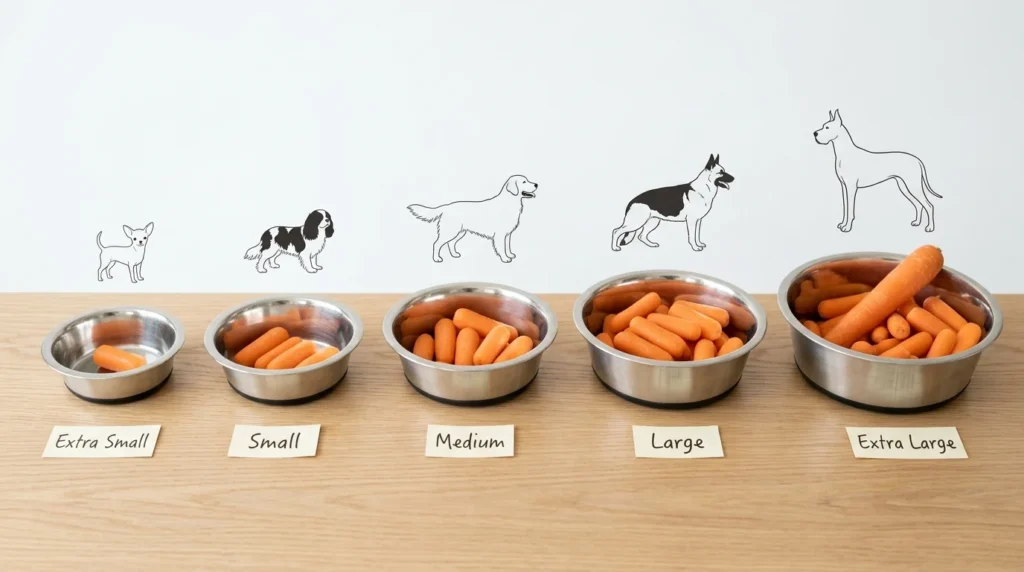
| Dog Size | Weight | Daily Carrot Amount | Format Suggestion |
|---|---|---|---|
| Extra Small | Under 10 lbs | 1–2 baby carrots OR 2–3 thin rounds | Cut into small pieces, thin rounds or halved baby carrots |
| Small | 10–20 lbs | 2–3 baby carrots OR 4–5 thin rounds | Baby carrots whole or halved, thin round slices |
| Medium | 20–50 lbs | 3–5 baby carrots OR half a medium carrot | Baby carrots or carrot sticks, medium pieces |
| Large | 50–90 lbs | 1 medium carrot OR 6–8 baby carrots | Whole or halved medium carrot, baby carrots whole |
| Extra Large | 90 lbs + | 1–2 medium carrots OR 10–12 baby carrots | Whole carrots, large sticks, or baby carrots |
Important notes on this table:
- These are daily maximum amounts — not targets. Less is always fine.
- These figures assume carrots are the only treat given that day. If your dog receives other treats, reduce the carrot portion accordingly.
- These amounts apply to plain, fresh, raw or plain-cooked carrots only.
- Dogs with diabetes, digestive conditions, or kidney disease should consult a vet for personalized amounts.
- For training sessions, break the daily carrot allowance into many small pieces rather than giving in one sitting.
Can Puppies Eat Carrots?
Yes — puppies can eat carrots, and carrots are one of the most recommended treats for puppies specifically. The reasons are compelling.
First, cold or frozen carrot pieces are excellent for teething puppies. The cold temperature soothes inflamed, sore gums during the teething phase (which typically occurs between 3 and 6 months of age). The firm chewing surface provides appropriate stimulation and something satisfying to work on. Unlike some chew toys, a carrot is completely safe to consume.
Second, carrots are nutritious in a way that supports growing puppies — beta-carotene for healthy development, Vitamin K for bone health, and fiber for digestive development.
Third, introducing carrots early in a puppy’s life helps establish positive associations with vegetables as part of a healthy diet — creating a lifelong good habit.
Puppy-specific guidelines: Cut into very small pieces appropriate for the puppy’s age and size. For very young puppies (8 to 12 weeks), very thin rounds or tiny pieces of cooked soft carrot are easier to manage. For older puppies with stronger teeth (12 weeks and beyond), raw carrot pieces are fine.
Always supervise puppies eating any solid food treat, particularly in the early weeks. Start with just one or two small pieces the first time and monitor for any digestive reaction before increasing.
See Also: Can Dogs Eat Avocado? The Truth Every Dog Owner Must Know
Frequently Asked Questions
Can dogs eat carrots?
Yes. Carrots are one of the most recommended vegetables for dogs. They are non-toxic, low in calories, high in vitamins, and most dogs love them. Wash, cut appropriately, and serve plain.
Can dogs eat raw carrots?
Yes. Raw carrots are safe and arguably the best form — they retain full nutritional content and provide the greatest dental cleaning benefit through chewing. Cut into appropriate pieces to prevent choking.
Can dogs eat baby carrots?
Yes. Baby carrots are safe, pre-washed, and perfectly sized for most dogs. Halve or quarter for very small dogs. An excellent convenient treat option.
Can dogs eat cooked carrots?
Yes — as long as they are plain with no butter, salt, garlic, onion, or other seasonings. Plain boiled or steamed carrot is good for dogs with dental sensitivities.
Can dogs eat carrots every day?
Yes — carrots are one of the few treats recommended for daily use given their very low calorie content and genuine health benefits. A few pieces daily is appropriate for most healthy adult dogs.
Can dogs eat purple carrots?
Yes. Purple carrots are safe and actually contain more anthocyanin antioxidants than standard orange carrots — making them nutritionally superior in some ways. Prepare the same as regular carrots.
Can dogs eat yellow carrots?
Yes. Yellow carrots are safe and provide a different antioxidant profile from orange varieties. Good for variety in the treat rotation.
Can dogs eat frozen carrots?
Yes. Frozen carrot pieces are safe and excellent — particularly for teething puppies (soothes gum pain) and as summer cooling treats. Check that frozen products contain no added salt.
Can dogs eat steamed carrots?
Yes. Plain steamed carrots are safe and a good option for dogs with sensitive teeth. Steam plain with no seasonings and cool completely before serving.
Can dogs eat canned carrots?
Only if no-salt-added. Most canned carrots contain added sodium that is too high for dogs. Choose only no-salt-added varieties, drain, and rinse before serving. Fresh is always preferable.
Can dogs eat carrot shavings?
Yes. Shaved or grated carrot is safe and easily digestible. Works well as a food topper or mixed into homemade dog treats.
Can dogs eat carrot sticks?
Yes. Carrot sticks are an excellent treat format for medium and large dogs — satisfying to hold and chew on. Cut shorter and thinner for small dogs.
Can dogs eat peas and carrots together?
Yes. Both are safe vegetables and nutritious in combination. Serve plain with no added salt, butter, or seasoning.
Can dogs eat celery and carrots together?
Yes. Both are safe and nutritious low-calorie vegetables. Remove celery strings before serving by running a peeler along the stalk. Cut both into appropriate pieces and serve plain.
Can dogs eat carrots with the skin on?
Yes. Carrot skin is safe. Wash thoroughly to remove pesticide residue or buy organic. The skin contains additional fiber and nutrients.
What happens if a dog eats too many carrots?
Temporary gas, bloating, or loose stools from the fiber content. Not a toxic emergency. Ensure water access, monitor for 24 hours. Contact vet if symptoms are severe or prolonged.
Can puppies eat carrots?
Yes. Carrots are one of the best treats for puppies. Frozen carrot pieces soothe teething pain. Cut into very small appropriate pieces. Start with just one or two pieces the first time.
How many carrots can a dog eat daily?
See the portion table above. In general: small dogs 1-3 baby carrots, medium dogs 3-5 baby carrots or half a medium carrot, large dogs 1 medium carrot. These are daily maximums.
Conclusion
Carrots are one of the most unambiguously excellent treats you can share with your dog. This is one of the rare food topics where the answer is an enthusiastic yes — carrots are safe, nutritious, low-calorie, naturally sweet, satisfying to chew, great for dental health, and loved by most dogs of every size and age.
The case for making carrots a staple in your dog’s treat rotation is strong from every angle:
- Very low in calories — roughly 25 per medium carrot
- Rich in beta-carotene (Vitamin A precursor), Vitamin K, potassium, and fiber
- Raw form provides genuine mechanical dental cleaning benefit
- Frozen form soothes teething puppies and cools overheated adult dogs in summer
- Appropriate for daily feeding — unlike most other treats
- Available year-round in every grocery store, inexpensive, and easy to prepare
- Works for all sizes from Chihuahuas to Great Danes
- No toxic parts, no dangerous seeds or pits, no complicated preparation
- Multiple variety options — orange, purple, yellow, baby, mini — all safe
The complete rules — simple and easy to follow:
- Wash thoroughly every time before serving
- Cut into appropriately sized pieces for your dog’s size — choking prevention
- Serve plain always — no butter, no salt, no garlic, no sugar, no seasonings
- Raw, steamed, boiled plain, or frozen — all forms are safe
- Canned carrots only if no-salt-added — drain and rinse before serving
- Carrot skin is safe — leave on for more nutrition or peel if concerned about pesticides
- Seeds are safe — no removal needed
- Daily feeding is appropriate for most healthy adult dogs
- Puppies love frozen carrot pieces during teething
- Consult your vet for diabetic dogs or those with specific health conditions
Whether you hand over a raw baby carrot as a quick reward, freeze carrot sticks for a summer treat, steam a few pieces for a senior dog, grate over dinner as a nutritional topper, or stuff into a Kong toy for enrichment — carrots are one of the most versatile, valuable, and worry-free foods in your dog’s life.
For more complete guides on what dogs can and cannot eat — covering dozens of vegetables, fruits, proteins, and everyday human foods — visit Dogs Bread. It is one of the most trusted and comprehensive pet nutrition resources available, providing clear, honest, research-backed answers for dog owners who want to make genuinely good choices for their dogs every single day. From quick food safety checks to complete nutritional breakdowns, breed-specific guides, and life-stage feeding advice, Dogs Bread has everything you need in simple, accessible language. For the master reference, see our complete list of safe human foods.
Also Read: Can Dogs Eat Mango? Benefits, Risks & Safe Serving Guide 2026
For another crunchy veggie option, see our guide to can dogs eat cabbage.


