

Can Dogs Eat Cucumbers? Benefits, Safety & Feeding Guide 2026
You slice a fresh cucumber for your salad and your dog looks up — curious, hopeful, nose twitching at the cool, clean smell. It is one of those moments where sharing feels completely natural. After all, cucumbers seem about as harmless as food gets. But is it actually safe? Can dogs eat cucumbers? What about the skin, the seeds, cucumber salad, or pickled cucumbers?
Cucumbers are actually one of the most dog-friendly vegetables available — but like everything, the details matter. This complete guide covers every question dog owners ask about cucumbers, from raw slices to cucumber water, mini cucumbers to English cucumbers, seeds to skin, and every preparation you can think of.
Can Dogs Eat Cucumbers?
Yes — dogs can eat cucumbers, and they are one of the safest and most appropriate vegetables you can share with your pet. The American Kennel Club (AKC) specifically recommends cucumbers as one of the best vegetable treat options for dogs, particularly for overweight dogs or those that need a low-calorie snack option.
Cucumbers are non-toxic, very low in calories, extremely high in water content, and provide a satisfying crunch that most dogs enjoy. They contain Vitamin K, Vitamin C, potassium, magnesium, and various antioxidants — real nutritional value in a nearly zero-calorie package.
The preparation is minimal: wash, slice or cube, and serve. The skin and seeds are both fine for most dogs. No cooking needed, no dangerous parts to remove. Cucumbers are one of the simplest and most worry-free vegetable treats you can give your dog.
Are Cucumbers Good for Dogs?
Yes — cucumbers are genuinely good for dogs. They sit at the top of the dog-safe vegetable list for a reason. Beyond just being safe and non-toxic, cucumbers offer a combination of qualities that make them particularly valuable as a dog treat.
The most impressive quality of cucumber as a dog treat is its caloric profile — roughly 16 calories per cup of sliced cucumber. This is extraordinarily low compared to any commercial dog treat, and even lower than most other fruit and vegetable options. For dogs managing their weight, cucumbers give you a high-volume, satisfying, crunchy treat that delivers almost nothing to the calorie count.
The nutritional content is also genuinely useful. Vitamin K supports blood clotting and bone health. Vitamin C provides antioxidant protection and immune support. Potassium and magnesium support heart and muscle function. The high water content of 95-96% provides meaningful hydration. And various antioxidants including beta-carotene, flavonoids, and tannins provide cellular protection.
For a vegetable with almost no calories, cucumber punches well above its weight nutritionally.
Can Dogs Have Cucumbers?
Yes — dogs can absolutely have cucumbers. This question sometimes comes up as a way of asking whether there is any hidden reason cucumbers might be problematic despite seeming harmless. There is not.
Cucumbers are not on any veterinary toxic food list. They contain no compounds that are harmful to dogs. They do not interfere with any common medications. They are not known to cause allergic reactions in the vast majority of dogs. They have no part — seeds, skin, flesh, or stem — that is seriously toxic.
The only practical limitations on cucumber feeding are general ones that apply to all treats — keep portions within the 10% daily calorie guideline, introduce any new food slowly the first time, and avoid cucumber preparations that contain salt, vinegar, garlic, or onion (like pickles or seasoned salads).
For healthy dogs of all sizes and breeds, cucumbers are a completely appropriate and genuinely beneficial treat choice.
Is Cucumber Bad for Dogs?
No — cucumber is not bad for dogs when served plain and in appropriate amounts. This is one of the few foods where the honest answer is an almost unqualified no. Plain, fresh cucumber presents essentially no toxicity risk, no dangerous components, and very low risk of digestive upset even in larger amounts compared to higher-fiber or higher-sugar vegetables and fruits.
However, cucumber becomes problematic in specific situations. Cucumbers prepared for human consumption — in salads with dressing, in sushi with soy sauce and seasoning, as pickles in brine — contain added ingredients that can be harmful. Salt in excess causes sodium-related issues. Garlic and onion are toxic to dogs. Vinegar in large amounts irritates the digestive system. The cucumber itself is never the problem — it is always the preparation and added ingredients.
Plain cucumber — fresh, washed, sliced — is one of the least likely vegetable treats to cause any negative effects in dogs.
Health Benefits of Cucumbers for Dogs
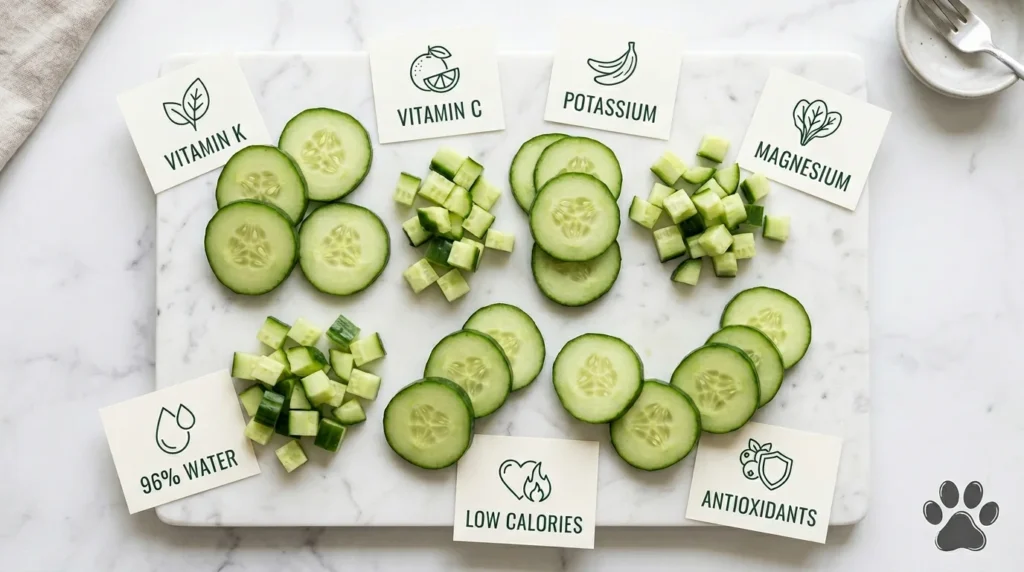
Let’s break down the specific health benefits cucumbers provide to dogs, because there are more than most owners realize for such a simple, humble vegetable.
Exceptional Hydration Support Cucumbers are approximately 95 to 96% water — among the highest water content of any common food. This makes cucumbers an outstanding hydration-supporting treat. For dogs that are not great water drinkers (which is more common than most owners realize, particularly in senior dogs), cucumbers provide meaningful fluid intake through food. On hot summer days, cold cucumber slices are one of the best refreshing, hydrating treats you can give a dog.
Vitamin K — Blood and Bone Health Cucumbers are one of the better plant sources of Vitamin K. This fat-soluble vitamin is essential for proper blood clotting — without adequate Vitamin K, wounds do not heal normally and bleeding episodes can be prolonged. Vitamin K also plays an important role in bone metabolism, supporting bone density and reducing the risk of bone fractures. For aging dogs and large breeds more prone to bone density issues, dietary Vitamin K sources like cucumber are genuinely valuable.
Vitamin C — Antioxidant and Immune Support Cucumber provides Vitamin C, a powerful antioxidant that neutralizes free radicals, supports immune system function, and contributes to collagen production for healthy joints, skin, and wound healing. While dogs synthesize their own Vitamin C, additional dietary sources support immune resilience — particularly in older dogs, dogs under stress, or those recovering from illness.
Potassium — Heart and Muscle Function Potassium is an essential electrolyte that regulates heart rhythm, supports proper muscle contraction, and maintains healthy fluid balance throughout the body. Cucumbers provide a useful dietary contribution of potassium, supporting cardiovascular and muscular health — particularly beneficial for active and working dogs.
Magnesium — Metabolic and Bone Support Magnesium is involved in hundreds of enzymatic reactions in the body. It supports energy production, bone formation, protein synthesis, and muscle and nerve function. Cucumbers provide a small but meaningful contribution of magnesium, complementing other dietary sources.
Antioxidant Plant Compounds Cucumbers contain various beneficial plant compounds including beta-carotene (converted to Vitamin A), flavonoids (quercetin, apigenin, luteolin), tannins, and lignans. These compounds have antioxidant, anti-inflammatory, and potentially anticancer properties that support cellular health and reduce oxidative damage.
Weight Management — Extremely Low Calories At approximately 16 calories per cup, cucumbers are one of the lowest-calorie treats available — lower than almost any commercial treat, and even lower than many other vegetables. For dogs on calorie-restricted diets or those needing to lose weight, cucumber fills the “treat” role without adding meaningful calories. The high water and fiber content also creates a satisfying fullness that helps dogs feel satisfied.
Dental Freshening The crunchy texture of raw cucumber provides a mild mechanical scrubbing effect on teeth surfaces and gums as dogs chew. The high water content also helps rinse the mouth. While not a replacement for brushing, crunchy vegetables like cucumber support oral health as a complementary habit.
Can Dogs Eat Cucumbers Raw?
Yes — raw cucumber is not only safe but is actually the best form to give your dog. Raw cucumbers retain their full nutritional content — all vitamins, minerals, and antioxidant compounds at maximum potency. Vitamin C in particular is heat-sensitive and better preserved raw than cooked.
The crunch of raw cucumber is also one of the primary appeals for dogs. The satisfying snap and texture when biting through a cucumber slice provides both a sensory experience and mild dental benefit. Most dogs enjoy the cool, fresh texture, particularly on a warm day.
Raw cucumber requires minimal preparation. Wash under cold running water, remove the stem end, slice or cube, and serve. The skin can be left on or removed based on your preference. Seeds are fine to leave in for most dogs. That is truly all there is to it.
For first-time introductions, start with just one or two small pieces of raw cucumber and wait 24 hours before giving more, to confirm your dog tolerates it well. Most do, easily.
Can Dogs Eat Cucumbers with Seeds?
Yes — cucumber seeds are completely safe for dogs. This is one of the most common questions dog owners ask about cucumbers, and the answer is reassuring — there is no need to remove cucumber seeds before serving.
Cucumber seeds are soft, small, and fully digestible. They contain no toxic compounds, no cyanide-releasing substances (unlike apple or cherry seeds), and pose no choking risk. They simply pass through the digestive system without causing any harm or irritation.
The seeds in cucumber are actually part of the most nutritious, hydrating section of the fruit — the inner flesh surrounding the seeds contains a large portion of the water content. Removing seeds would actually reduce some of the hydration benefit while adding unnecessary preparation time.
Simply wash, slice, and serve — seeds included. Your dog will never notice them, and they will do no harm.
Can Dogs Eat Mini Cucumbers?
Yes — mini cucumbers (also called baby cucumbers or cocktail cucumbers) are completely safe for dogs and are actually one of the most convenient cucumber formats for sharing with dogs. Their small size makes them naturally portion-friendly and easy to handle.
Mini cucumbers are simply smaller versions of standard cucumbers, typically harvested earlier for a more tender skin and smaller size. They have the same nutritional profile as full-sized cucumbers — same water content, same vitamins and minerals, same antioxidants.
For small dogs, a mini cucumber can be sliced into rounds and given as individual treats. For medium and large dogs, a mini cucumber can be cut in half or served whole (after removing the stem end). Their small size and thin, tender skin make them particularly easy for dogs to eat and digest.
See Also: Can Dogs Eat Raw Shrimp or Shrimp Shells? Full Safety Guide
Can Dogs Eat English Cucumbers?
Yes — English cucumbers (also called long cucumbers, hothouse cucumbers, or seedless cucumbers) are completely safe for dogs. They are one of the most popular cucumber varieties in grocery stores and are actually an excellent choice for dogs specifically.
English cucumbers have several qualities that make them particularly good for dogs: they have thinner, more tender skin than standard field cucumbers (easier to digest), they are “seedless” or nearly so (though the small soft seeds in English cucumbers are safe for dogs anyway), and they tend to be less bitter than some other varieties.
The thin skin of English cucumbers means it does not need to be peeled before serving to dogs — the skin is thin enough to be easily digestible for most dogs. Slice or cube and serve plain.
Can Dogs Eat Persian Cucumbers?
Yes — Persian cucumbers are safe for dogs. Persian cucumbers are small, sweet, thin-skinned cucumbers that are similar to mini cucumbers but with a slightly different flavor profile. They are typically 5 to 6 inches long, seedless or nearly so, and have a naturally sweet, mild flavor.
Persian cucumbers are an excellent choice for dogs because of their thin skin, mild flavor, low bitterness, and small size. Their natural sweetness (compared to some more bitter cucumber varieties) tends to make them particularly appealing to dogs.
The thin, tender skin does not need to be removed before serving. The virtually seedless flesh makes preparation even simpler. Wash, slice, serve. Persian cucumbers are one of the most dog-friendly cucumber varieties available.
Can Dogs Eat Cucumbers Skin?
Yes — cucumber skin is safe for most dogs. This is a common concern among dog owners, but cucumber skin does not contain any toxic compounds or significantly harder-to-digest material that would make it dangerous.
Conventional cucumber skin is slightly firmer than the inner flesh, but it is still soft enough that most dogs can chew and digest it without difficulty. The skin contains a portion of the vegetable’s fiber and certain concentrated antioxidants.
The main reason some people peel cucumbers before giving them to dogs is pesticide residue — conventionally grown cucumbers may have pesticide residue on their waxy outer skin. If you are concerned about this, either buy organic cucumbers or peel the cucumber before serving. If you wash the cucumber thoroughly under cold running water and scrub the skin gently, this removes most surface residue.
For organic cucumbers or thoroughly washed conventional cucumbers, leaving the skin on is perfectly fine and even slightly more nutritious.
Can Dogs Eat Cucumbers Safely?
Yes — cucumbers are among the safest vegetables you can give your dog. The safety checklist for cucumbers is short and simple compared to many other foods.
Complete safety checklist:
- Wash the cucumber thoroughly under cold running water before serving
- Remove the stem end — the very tip of the cucumber where it was attached to the vine
- Cut into small, appropriately sized pieces for your dog’s size — slices or cubes
- Serve plain — no salt, no vinegar, no dressing, no dip, no seasonings
- Leave skin on or peel based on your preference — both are fine for most dogs
- Seeds can be left in — they are completely safe
- Introduce slowly the first time — just one or two pieces, wait 24 hours
- Keep portions within the 10% daily calorie guideline — though this is rarely a concern given how low-calorie cucumbers are
- Never give pickled cucumbers — the brine contains salt and vinegar at levels unsafe for dogs
- Never give cucumber from salads with dressing, garlic, or onion
That is genuinely the entire safety checklist. Cucumbers require less preparation caution than almost any other food in this series.
Can Dogs Eat Cucumbers Everyday?
Yes — cucumbers are actually one of the few treats where daily feeding is relatively low-risk compared to most other foods. Because cucumbers are so exceptionally low in calories, sugar, and fat, the usual concerns about daily treat feeding (cumulative sugar, excess calories) apply much less strongly to cucumbers than to fruits or higher-calorie vegetables.
A few slices of plain cucumber given daily as a treat is unlikely to cause any problems for most healthy adult dogs. The hydration benefit of daily cucumber is actually a practical positive — particularly for dogs that do not drink enough water on their own.
That said, even with cucumber, variety in the treat rotation is a good principle. Rotating different dog-safe vegetables and fruits across the week ensures exposure to a broader range of micronutrients and keeps your dog’s palate interested. Including cucumber most days is fine — making it the only treat every single day indefinitely is less ideal from a dietary variety standpoint.
Can Dogs Eat Cucumbers Slices?
Yes — cucumber slices are actually the ideal serving format for dogs. Slices are easy to portion, easy to size appropriately for different dog breeds, easy for dogs to chew and eat, and visually clear in terms of how much you are giving.
Round cross-section slices of cucumber work well for medium and large dogs. For small dogs, slice thinner or cut rounds into halves or quarters for a more manageable piece size. For very small toy breeds, very thin slices cut into small pieces are the safest option.
Cucumber slices can be served fresh at room temperature, chilled from the refrigerator (many dogs particularly enjoy cold cucumber), or frozen for a summer treat. All three temperature options are safe and enjoyable for most dogs.
Can Dogs Eat Cucumber Sushi?
No — dogs should not eat cucumber sushi. While the cucumber component of sushi is safe, sushi combines cucumber with several ingredients that are not appropriate for dogs.
Sushi rice is seasoned with rice vinegar, sugar, and salt — none of these seasonings are dog-appropriate in the concentrated forms used in sushi rice. Soy sauce, which accompanies virtually all sushi, is extremely high in sodium — a single tablespoon contains around 900mg of sodium, far exceeding what is safe for dogs. Wasabi is intensely spicy and causes significant digestive discomfort in dogs. Raw fish in sushi carries food safety concerns similar to raw meat.
The cucumber in sushi is perfectly fine on its own, but surrounded by all these problematic ingredients in the sushi context, it is not appropriate to share sushi with your dog. Give them a plain cucumber slice separately instead.
Can Dogs Eat Cucumber Salad?
No — cucumber salad as typically served to humans is not appropriate for dogs. The issue is never the cucumber itself — it is the dressing and additional ingredients that make salad unsafe.
Standard cucumber salad preparations include vinegar (acidic, irritating in concentrated form), salt (too much sodium), sugar (unnecessary calories), garlic (toxic to dogs), onion (toxic to dogs), dill (in large amounts can be irritating), sour cream or mayo (high fat, dairy concerns), and various herbs and spices.
Even the most “simple” cucumber salad — just cucumber slices in vinegar and salt — contains salt and vinegar at levels that are not appropriate for dogs as a regular treat.
If you want to share some of the cucumber from your salad with your dog, pull out plain, undressed cucumber slices before adding any dressing or other ingredients. Plain cucumber from the cutting board — yes. Cucumber from the dressed salad bowl — no.
See Also: Can Dogs Eat Avocado? The Truth Every Dog Owner Must Know
Can Dogs Eat Cucumber Stems?
The stem end of a cucumber — the small, slightly tougher tip where the cucumber was attached to the vine — is technically not toxic, but is worth removing before serving. The stem end is firmer, less palatable, and sometimes slightly more bitter than the main body of the cucumber. It adds nothing nutritionally and can be slightly harder to digest than the flesh.
Removing the stem end is simple and takes one second — just cut off the top half-inch of the cucumber before slicing. This leaves only the fresh, tender flesh and skin that makes cucumber such a great treat for dogs.
The cucumber vine itself — the actual plant stem that the cucumber grew on — is tougher and more fibrous than the fruit. While not acutely toxic, giving dogs cucumber vine material is not recommended. Stick to the cucumber fruit only.
See Also: Can Dogs Eat Broccoli? Raw, Cooked, Stems & Every Form Covered
Can Dogs Eat Pickled Cucumbers?
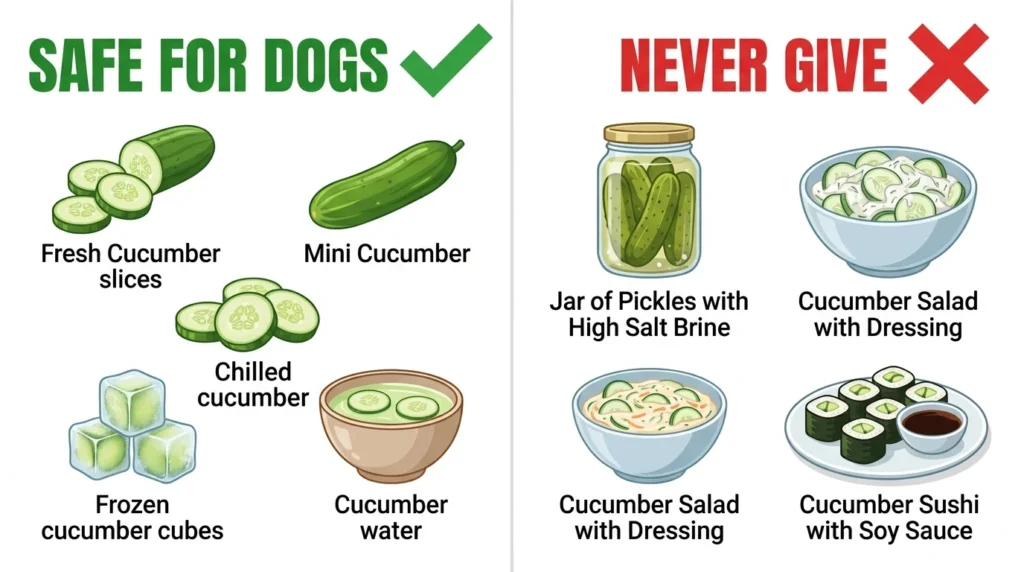
No — pickled cucumbers (pickles) should never be given to dogs. Despite being made from cucumbers (which are safe), the pickling process transforms cucumbers into something that is genuinely problematic for dogs.
Pickled cucumbers are preserved in a brine made primarily of salt, vinegar, and water — with the addition of garlic, onion, dill, spices, and sometimes sugar. The combination of these ingredients creates multiple concerns.
The sodium content of pickles is extreme — a single medium dill pickle can contain 700 to 1500mg of sodium. Dogs should have no more than around 100mg of sodium per day for a 33-pound dog (and proportionally less for smaller dogs). A single pickle could deliver 7 to 15 times a medium dog’s appropriate daily sodium intake in one serving. High sodium causes excessive thirst, increased urination, and in larger amounts, sodium toxicity — symptoms of which include vomiting, diarrhea, tremors, seizures, and potentially death.
Garlic and onion are commonly added to pickle brines and are independently toxic to dogs. Vinegar in concentrated form is acidic and irritating to the digestive tract.
Never give your dog pickles, pickle juice, or any pickle-flavored product. The cucumber base does not make them safe.
How to Offer Cucumber to Dogs
There are several ways to offer cucumber to your dog that are safe, enjoyable, and provide different textures and experiences.
Plain fresh slices: The simplest approach. Wash, remove stem end, slice into rounds appropriate for your dog’s size. Serve immediately. Most dogs love the fresh, cool crunch.
Chilled cucumber slices: Keep prepared cucumber slices in an airtight container in the refrigerator. Cold cucumber slices are particularly refreshing on warm days and most dogs enjoy the cool temperature.
Frozen cucumber slices or cubes: Slice or cube cucumber, spread on a parchment-lined tray, freeze until solid, then store in a sealed bag. Serve frozen pieces as a summer cooling treat. Excellent for hot weather.
Cucumber sticks: Cut cucumber into long, thin sticks rather than round slices. Cucumber sticks work well as training treats and give dogs a satisfying thing to crunch on.
Cucumber in a lick mat or puzzle feeder: Cut cucumber into very small pieces or blend and spread onto a lick mat. Freeze for 20 to 30 minutes for a calming, slow-feeding activity.
Cucumber Kong stuffing: Stuff small cucumber pieces into a Kong toy, optionally with a thin spread of xylitol-free peanut butter. Freeze overnight for a long-lasting summer treat.
Mixed vegetable treat bowl: Combine plain cucumber pieces with other dog-safe vegetables like carrot slices, broccoli florets, and green beans for a colorful, nutritious veggie snack mix. All plain, no dressing.
How Many Cucumber Slices Can Dogs Eat?
Cucumbers are so low in calories that the standard 10% treat guideline is rarely a practical constraint — it would take an enormous amount of cucumber to reach 10% of most dogs’ daily caloric intake. That said, portion guidelines are still useful for digestive comfort and to maintain treat as supplemental, not staple.
Practical serving guide by dog size:
Extra small dogs (under 10 lbs): 3 to 5 thin slices per day.
Small dogs (10 to 20 lbs): 5 to 10 slices per day — roughly a few tablespoons of chopped cucumber.
Medium dogs (20 to 50 lbs): A small handful — roughly a quarter cup of sliced cucumber per day.
Large dogs (50 lbs and above): Up to half a cup of sliced cucumber per day.
These guidelines are generous compared to many other treats — precisely because cucumbers are so low in calories and so safe. Even giving somewhat more than these amounts occasionally is unlikely to cause any serious problem for healthy adult dogs. The main risk from too much cucumber is mild digestive upset from the high water and fiber content — soft stools or loose stool — which resolves on its own.
What Happens If Dogs Eat Too Much Cucumber?
If your dog eats a large amount of cucumber — say, half a cucumber or more in one sitting — the most likely outcome is temporary digestive upset. This is not a toxic emergency, but it is worth understanding what to expect and what to do.
What to expect: The high water content of cucumber (95-96%) means that a large amount consumed at once creates a significant fluid load in the digestive system. Combined with the fiber content, this can cause loose stools, diarrhea, or gas within a few hours of eating too much. Some dogs may also vomit if they eat very large amounts quickly.
These symptoms are caused by the sheer volume of water and fiber — not by any toxic compound — and typically resolve on their own within 12 to 24 hours without treatment.
What to do: Remove access to more cucumber. Ensure fresh water is available — even though cucumber is hydrating, diarrhea still causes fluid and electrolyte loss. Skip or reduce the next meal if your dog seems uncomfortable. Monitor for 24 hours.
When to contact your vet: Symptoms are severe or not improving after 24 hours. Your dog is very small or has existing health conditions. Persistent vomiting and inability to keep water down. Any signs of extreme lethargy or unusual behavior.
Cucumber overconsumption is one of the most minor food overindulgence situations in dog ownership — the consequences are temporary and mild compared to overindulgence in higher-sugar, higher-fat, or toxic foods.
Can Dogs Drink Cucumber Water?
Yes — plain cucumber water is safe for dogs and can be a great way to encourage better hydration. Cucumber water is simply water infused with sliced fresh cucumber, and dogs that find plain water uninteresting may be more attracted to the subtle flavor of cucumber-infused water.
The nutritional contribution from cucumber water is minimal — most of the vitamins and minerals remain in the cucumber flesh rather than infusing into the water. However, any benefit from encouraging better water intake in a reluctant drinker outweighs this minor point.
How to make cucumber water for dogs: Simply add a few thin slices of clean, plain cucumber to a bowl of fresh water. Let sit for 15 to 30 minutes to allow mild infusion. Remove cucumber pieces before serving to prevent the dog from eating them out of the bowl (or leave them in if they are appropriately sized — they are safe to eat too).
Never use cucumber water that has been infused with mint, lemon, lime, ginger, or other human flavorings — these additives can be harmful to dogs. Plain cucumber and water only.
Also Read: Can Dogs Eat Bananas? Everything You Need to Know Before Feeding
Frequently Asked Questions
Can dogs eat cucumbers?
Yes. Cucumbers are one of the safest vegetables for dogs. They are non-toxic, very low in calories, and high in water and vitamins. Wash, slice, and serve plain. Seeds and skin are both fine for most dogs.
Can dogs eat cucumber skin?
Yes. Cucumber skin is safe for most dogs. It is not toxic and is digestible for most healthy dogs. If concerned about pesticides, wash thoroughly or buy organic. Peeling is optional.
Can dogs eat cucumber seeds?
Yes. Cucumber seeds are completely safe — they contain no toxic compounds, pose no choking risk, and are fully digestible. No need to remove them before serving.
Can dogs eat pickled cucumbers or pickles?
No. Pickles contain extremely high levels of sodium and often garlic and onion — both toxic to dogs. A single pickle can contain many times a dog’s appropriate daily sodium intake. Never give pickles to dogs.
Can dogs eat mini cucumbers?
Yes. Mini cucumbers are safe and actually very convenient for dogs given their small size. Same preparation as regular cucumbers — wash, remove stem end, slice or serve whole.
Can dogs eat English cucumbers?
Yes. English cucumbers have thin tender skin and few seeds, making them particularly dog-friendly. Wash and slice — no need to peel.
Can dogs eat Persian cucumbers?
Yes. Persian cucumbers are small, sweet, thin-skinned, and virtually seedless — an excellent choice for dogs. Wash and serve sliced.
Can dogs eat cucumber salad?
No. Cucumber salad contains dressings with salt, vinegar, garlic, onion, and spices — all problematic for dogs. Set aside plain undressed cucumber before mixing salad if you want to share.
Can dogs eat cucumber sushi?
No. Sushi rice is seasoned with salt and vinegar, soy sauce contains extremely high sodium, and wasabi is spicy and irritating. The cucumber itself is fine but the sushi context is not.
Can dogs eat cucumbers every day?
Yes — cucumbers are one of the few treats where daily giving is relatively low risk. Their extremely low calorie and sugar content mean they are less of a concern than daily fruit treats. A few slices daily is appropriate for most healthy adult dogs.
Can dogs drink cucumber water?
Yes. Plain cucumber-infused water is safe and can help encourage better hydration in dogs that do not drink enough. Use plain cucumber only — no mint, lemon, or other human flavorings.
How many cucumber slices can a dog eat?
Very generous amounts are possible given how low-calorie cucumbers are. Small dogs: 3-5 slices. Medium dogs: 5-10 slices. Large dogs: up to half a cup. These are daily guidelines — much more generous than most other treats.
What happens if a dog eats too much cucumber?
Temporary loose stools or diarrhea from the high water and fiber content. Not a toxic emergency. Ensure water access, monitor for 24 hours. Contact vet if symptoms are severe or prolonged.
Can puppies eat cucumbers?
Yes, in small amounts. Puppies can eat plain cucumber slices — introduce slowly with just one or two small pieces the first time. Cut into very small pieces to prevent choking risk.
Is cucumber bad for dogs with kidney disease?
Cucumber is generally considered a kidney-friendly vegetable because it is low in phosphorus and potassium compared to many other foods. However, always get veterinary guidance for dogs with kidney disease before adding any new foods.
Conclusion
Cucumbers are one of the most genuinely dog-friendly foods available — a rare case where “can my dog eat this” gets an almost unqualified yes with minimal preparation concerns and genuine health benefits to back it up.
Plain, fresh cucumber is safe for virtually all healthy dogs. It is low in calories, high in water, rich in Vitamin K, Vitamin C, potassium, magnesium, and antioxidants. It is satisfying to eat, easy to prepare, readily available year-round, and most dogs enjoy the cool, crunchy texture. For overweight dogs especially, cucumber is close to the perfect treat — genuinely filling and satisfying with almost no caloric cost.
The rules are simple — simpler than almost any other food in this series:
- Wash thoroughly every time to remove pesticide residue
- Remove the stem end before slicing
- Cut into appropriately sized pieces for your dog’s size
- Serve plain — no salt, no vinegar, no dressing, no seasoning of any kind
- Skin and seeds are both safe to include — no need to remove either
- Never give pickles or pickled cucumber — extreme sodium and garlic/onion concerns
- Never give cucumber from dressed salads or sushi — the added ingredients are the problem
- Daily feeding is lower risk than with most treats given the extremely low calorie content
- Even large amounts cause only temporary mild digestive upset, not toxicity
- Cucumber water is safe and can encourage better hydration in reluctant drinkers
Whether you slice fresh rounds as a training treat, freeze cubes for a summer snack, chill slices in the refrigerator for a refreshing reward, or mix with other safe vegetables for a colorful veggie bowl — cucumber is one of the most versatile, accessible, and worry-free treats in your dog’s repertoire.
For more complete guides on what dogs can and cannot eat — covering dozens of vegetables, fruits, proteins, dairy products, and everyday human foods — visit Dogs Bread. It is one of the most comprehensive and trusted pet nutrition resources for dog owners who want clear, honest, research-backed answers they can use with confidence every day. From quick food safety checks to complete nutritional guides for specific breeds and life stages, Dogs Bread provides the information you need — written simply, accurately, and with your dog’s best interests always at the center.
Also Read: Can Dogs Eat Strawberries? Here’s Everything You Need to Know


