
Can Dogs Eat Corn? Cobs, Chips, Candy Corn & Every Form Covered
It is summer barbecue season, you are serving corn on the cob, and your dog is circling the table with that unmistakable hopeful look. Or maybe you dropped some popcorn during movie night and your dog scooped it up before you could react. Or you are checking a dog food label and wondering why corn is listed as an ingredient. Can dogs eat corn? Is it actually safe? What about corn cobs, corn tortillas, candy corn, or canned corn?
Corn is one of the most debated ingredients in the dog food world, and one of the most commonly encountered human foods dogs get access to. This complete guide answers every question dog owners ask about corn — every form, every preparation, every product, and everything you need to know to make smart decisions about corn and your dog.
Can Dogs Eat Corn?
Yes — dogs can eat corn, and plain cooked or raw corn kernels are safe for most healthy dogs in moderate amounts. The American Kennel Club (AKC) confirms that corn is not toxic to dogs and is in fact one of the most commonly used ingredients in commercial dog foods.
However, corn comes with critical safety rules that vary dramatically by form. Plain corn kernels — yes. Corn on the cob — absolutely not (life-threatening obstruction risk). Candy corn — no. Corn chips — no. Corn nuts — no. The form of corn matters enormously.
The key rules: only plain corn kernels (cooked or raw), never the cob, never flavored or processed corn products, and always in moderate amounts. Corn is a treat and supplement, never a meal replacement.
Can Dogs Have Corn?
Yes — dogs can have plain corn kernels, and this is confirmed safe by veterinary sources. What makes corn a nuanced topic is not the kernel itself but the enormous variety of corn-based products — most of which are not safe for dogs.
Plain corn kernels provide carbohydrates for energy, dietary fiber for digestive health, and small amounts of protein, vitamins, and minerals. Corn also contains antioxidant compounds including lutein and zeaxanthin — carotenoids that support eye health.
The reason corn appears in so many commercial dog foods is precisely because it is digestible, nutritious in modest ways, and well-tolerated by most dogs. The controversy around corn in dog food is largely about whether it is an optimal ingredient, not about whether it is safe — it is safe.
What is never safe is the corn cob, which we will address in its own section with the emphasis it deserves.
Are Corn Good for Dogs?
Corn provides modest but real nutritional value for dogs. It is not a superfood like blueberries, and it is not a nutritionally dense vegetable like broccoli, but it does offer genuine contributions to canine health when consumed in appropriate amounts.
The primary nutritional value of corn comes from its carbohydrate content — a source of readily available energy. Corn also contains linoleic acid, an omega-6 fatty acid that supports healthy skin and coat. Beta-carotene, lutein, and zeaxanthin in corn are antioxidants that support vision health and cellular protection. Corn provides B vitamins including thiamine and folate, and contains protein, iron, magnesium, and phosphorus in modest amounts.
Corn is also highly palatable to dogs — most dogs find the natural sweetness of corn very appealing, which is why it works well as an occasional treat or food topper. When kept in appropriate portions, corn is a reasonable addition to a varied diet.
Are Corn Bad for Dogs?
Plain corn kernels are not bad for dogs in appropriate amounts. However, corn becomes bad for dogs in several specific and important situations.
The cob is genuinely dangerous. Corn cobs are one of the most common causes of life-threatening gastrointestinal obstruction in dogs. The cob does not break down in the digestive system, can wedge in the intestines, and often requires emergency surgery to remove. This is not a minor concern — it is a genuine emergency risk.
Processed corn products are problematic. Corn chips, kettle corn, candy corn, corn nuts, and most commercial corn-based snacks contain high salt, sugar, artificial flavoring, and fat — none of which are appropriate for dogs.
High amounts cause digestive upset. Too much corn at once — due to its carbohydrate and fiber content — can cause gas, bloating, and loose stools.
Corn with allergies. While true corn allergies in dogs are not as common as some believe, dogs with confirmed corn sensitivity should avoid it entirely.
The take-home message: corn kernels in moderation are not bad. Corn cobs, processed corn products, and excessive amounts are genuinely problematic.
Is Corn Poisonous to Dogs?
No — plain corn is not poisonous to dogs. Corn does not contain any compounds that are acutely toxic to dogs in the way that grapes, xylitol, or certain medications are toxic. There is no “corn toxin” that makes dogs sick.
The safety concerns with corn are not about poisoning but about physical hazards (the cob causing obstruction), inappropriate ingredients in processed corn products (salt, sugar, artificial additives), and digestive issues from overconsumption.
Some specific corn-related products do contain genuinely problematic ingredients. Candy corn contains large amounts of sugar and potentially artificial sweeteners. Corn chips contain high salt. These products are problematic because of their added ingredients, not because corn itself is poisonous.
If you are asking this question because your dog ate plain corn kernels — they are not poisoned. Monitor for digestive upset from the fiber content and contact your vet if symptoms are severe.
Is Sweetcorn Healthy for Dogs?
Sweetcorn — the fresh, tender, sweet variety of corn most people enjoy eating directly — is one of the better corn forms for dogs. It contains higher levels of natural sugars than field corn (which is why it tastes sweet), but it also contains meaningful amounts of vitamins, minerals, and antioxidants.
The antioxidants in sweetcorn include lutein and zeaxanthin, which support eye health, and beta-carotene, which converts to Vitamin A and supports immune function and skin health. Sweetcorn also provides Vitamin C, folate, thiamine, and potassium — a decent nutritional package for a modest calorie food.
For dogs, the sweetness of sweetcorn makes it particularly appealing. A few kernels of plain cooked sweetcorn as a treat a few times per week is a reasonable and nutritious choice for most healthy adult dogs. The key word is plain — no butter, no salt, no seasoning of any kind.
Health Benefits of Corn for Dogs
Let’s break down the specific nutritional contributions corn makes to canine health.
Carbohydrates for Energy Corn is primarily a carbohydrate food. The carbohydrates in corn — predominantly starch — provide readily digestible energy that supports your dog’s daily activity. For active and working dogs, carbohydrates from foods like corn provide efficient fuel. While dogs do not require dietary carbohydrates the way humans do, carbohydrates from whole food sources like corn kernels are well-utilized by the canine digestive system.
Linoleic Acid for Skin and Coat Corn contains linoleic acid — an omega-6 essential fatty acid that plays a critical role in maintaining healthy skin and a shiny, well-conditioned coat. Essential fatty acids cannot be produced by the body and must come from dietary sources. For dogs with dry, dull coats or skin issues, adequate linoleic acid intake from food sources supports improvement. This is one of the reasons corn is included in many commercial dog food formulas.
Lutein and Zeaxanthin for Eye Health Yellow corn contains meaningful amounts of lutein and zeaxanthin — carotenoid antioxidants that are particularly concentrated in the eyes. Research links adequate lutein and zeaxanthin intake with protection against age-related macular degeneration and cataracts. For aging dogs whose vision naturally declines, these antioxidants from food sources like corn provide valuable protective support.
Beta-Carotene and Vitamin A Beta-carotene gives corn its yellow color and converts to Vitamin A in the body. Vitamin A supports healthy vision, immune function, skin and coat health, and proper cell growth and reproduction. While carrots and sweet potatoes are richer sources, corn contributes to the overall beta-carotene intake as part of a varied diet.
B Vitamins for Metabolism Corn provides thiamine (Vitamin B1), folate (Vitamin B9), and small amounts of other B vitamins. These vitamins support energy metabolism, nervous system function, red blood cell production, and healthy cell division — foundational processes that keep your dog’s body running properly.
Fiber for Digestive Health Corn contains dietary fiber that supports healthy digestion and regular bowel movements. The fiber in corn contributes to the feeding of beneficial gut bacteria, supporting the microbiome that underpins immune function and overall health.
Can Corn Make Dogs Sick?
Yes — in specific situations, corn can make dogs sick. Understanding these situations allows you to avoid them.
The corn cob — most serious: If a dog eats a corn cob or a significant portion of one, gastrointestinal obstruction is a real and serious risk. Symptoms include persistent vomiting, loss of appetite, abdominal pain, lethargy, and inability to defecate. This is a veterinary emergency. Contact your vet immediately if you suspect your dog ate a corn cob.
Too many kernels at once: A large amount of corn kernels causes digestive upset from the high carbohydrate and fiber content — gas, bloating, loose stools, and discomfort. Not a toxic emergency, but genuinely uncomfortable.
Processed corn products with harmful ingredients: Corn chips with high salt, candy corn with sugar or xylitol, kettle corn with sugar and salt, corn dogs with processed meat — all can cause digestive issues and in some cases more serious reactions depending on the specific ingredients.
Corn allergy in sensitive dogs: Dogs with confirmed corn allergies will show symptoms — skin itching, hives, ear infections, digestive upset — when corn is consumed. For these dogs, even small amounts of corn cause a reaction.
Corn syrup in large amounts: High fructose corn syrup and corn syrup are concentrated sugar sources that cause blood sugar spikes and digestive issues.
Is Corn Bad for Dogs With Allergies?
This is a genuinely important question that requires a careful answer. Corn allergies in dogs do exist, but they are less common than many dog owners believe — grain-free diet marketing has significantly overstated the prevalence of corn and grain allergies in dogs.
True food allergies in dogs most commonly involve proteins — chicken, beef, dairy, and eggs are the most frequent culprits, not grains. However, corn sensitivity and true corn allergies do occur in some dogs.
Signs that your dog may have a corn sensitivity or allergy include: chronic itchy skin, recurrent ear infections, hot spots, paw licking, recurring digestive upset (gas, diarrhea, vomiting) particularly after meals containing corn, and general skin inflammation.
If you suspect your dog has a corn allergy, the proper diagnostic approach is an elimination diet under veterinary guidance — removing all corn from the diet for 8 to 12 weeks and monitoring for symptom improvement. If symptoms resolve during elimination and return when corn is reintroduced, a corn allergy or sensitivity is confirmed.
For dogs with confirmed corn allergies, all corn and corn-derived products should be avoided — including many commercial dog foods that contain corn as an ingredient. Read all labels carefully.
Can Dogs Eat Corn Cobs?
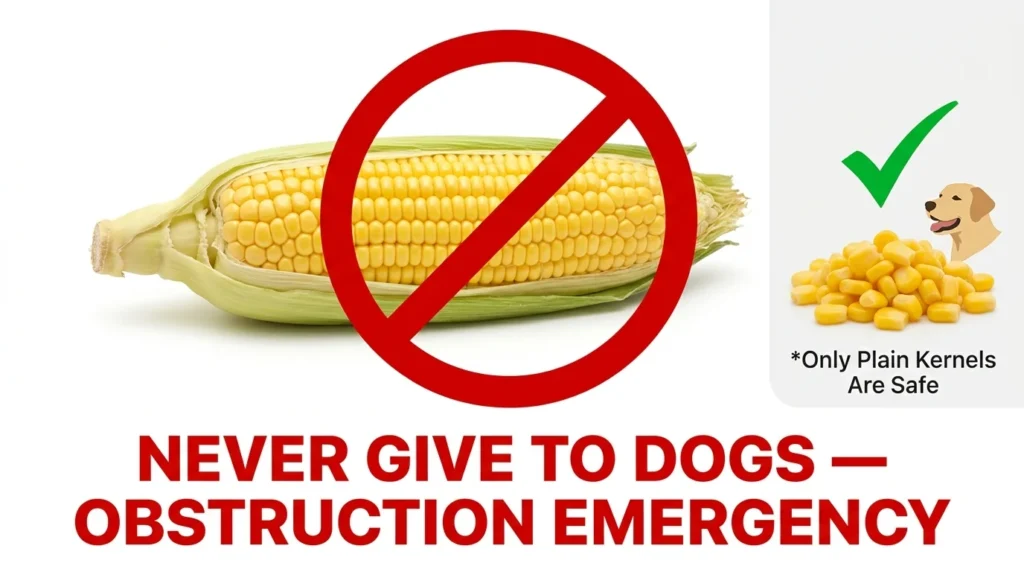
No — this is one of the most important safety warnings in this entire guide. Corn cobs are one of the most common causes of life-threatening gastrointestinal obstruction in dogs. This is not a mild concern — it is a genuine emergency situation that kills dogs every year.
The corn cob does not digest. Unlike the kernels, the fibrous inner core of a corn cob is essentially indigestible by the canine digestive system. When swallowed — which dogs do because cobs smell irresistibly of corn — the cob can become lodged in the esophagus, stomach, or intestines, causing a complete or partial obstruction that blocks all normal digestive function.
Signs of corn cob obstruction include: persistent vomiting (often within hours of eating), loss of appetite, lethargy, abdominal pain, restlessness, inability to defecate, and abdominal swelling. Without treatment, an obstruction worsens and becomes life-threatening. Treatment typically requires emergency surgery.
Never give a dog a corn cob, never leave corn cobs accessible after a barbecue (in open trash bags, on tables, or on the ground), and never assume your dog “only chewed on it a little.” If you know or suspect your dog ate any portion of a corn cob, contact your vet immediately — do not wait for symptoms.
Can Dogs Eat Corn Tortillas?
Corn tortillas are made from masa harina — a specially processed corn flour — and are generally not toxic to dogs in small amounts. A tiny piece of plain corn tortilla is unlikely to cause serious harm. However, corn tortillas are not a recommended treat for dogs.
Corn tortillas are high in carbohydrates and provide little nutritional value that a dog needs beyond what their regular food provides. They are often made with added salt. And in any serving context — tacos, burritos, enchiladas — corn tortillas are accompanied by ingredients that are problematic or toxic for dogs: garlic, onion, spicy seasoning, cheese, and various sauces.
If your dog snagged a small plain corn tortilla from the counter, monitor for digestive upset but this is unlikely to be a medical emergency. Intentionally giving corn tortillas as a treat is not recommended — there are far better, more nutritious options available.
Can Dogs Eat Kettle Corn?
No — kettle corn is not appropriate for dogs. Kettle corn is popcorn made with sugar and salt — two additions that make it problematic beyond regular popcorn concerns.
The sugar content of kettle corn adds unnecessary calories and contributes to blood sugar fluctuations. The salt content adds sodium at levels not appropriate for dogs. And the sugar-salt coating can stick to teeth, contributing to dental decay.
Plain air-popped popcorn without any seasoning or topping is sometimes considered acceptable in very small amounts as an occasional treat for dogs. But any flavored popcorn — including kettle corn, butter popcorn, cheese popcorn, or any other variety — contains additives that make it inappropriate. Always stick to plain if giving popcorn at all, and keep amounts tiny.
Can Dogs Eat Canned Corn?
Canned corn requires careful evaluation. The corn kernels themselves are safe, but the canning process introduces concerns.
Canned corn with added salt: Most commercially available canned corn contains added sodium as a preservative. The sodium levels in salted canned corn are too high for dogs. Regular feeding of high-sodium foods causes excessive thirst, increased urination, and in larger amounts, sodium-related health issues.
No-salt-added canned corn: This is the only canned corn format that is acceptable for dogs. Look for canned corn that lists only corn and water in the ingredients — no salt, no sugar, no preservatives. Even then, drain and rinse the corn thoroughly before serving to remove residual processing liquid.
The bottom line: Fresh or frozen corn kernels are always preferable to canned. If canned corn is your only option, choose no-salt-added, drain completely, and rinse well before giving a small amount to your dog.
Can Dogs Eat Corn Chips?
No — corn chips are not appropriate for dogs. Corn chips (tortilla chips, corn crisps, and similar products) are made with corn but processed with significant amounts of salt, oil, and often artificial flavoring, garlic powder, onion powder, and other seasonings.
The high sodium content of corn chips is the primary concern — a single serving of chips can contain 200 to 400mg or more of sodium, far exceeding what is appropriate for a dog. Regular exposure to high-sodium foods causes health issues over time.
The oil and fat content from deep frying can cause digestive upset and, with regular feeding, contributes to pancreatitis. Flavored varieties (ranch, nacho cheese, lime, barbecue) add spices and flavor compounds that further increase the risk of digestive irritation.
If your dog grabbed a single chip off the floor, this is unlikely to cause serious harm. But corn chips should never be given intentionally as a dog treat.
Can Dogs Eat Sweet Corn?
Yes — plain cooked or raw sweet corn kernels are safe for dogs and are actually a good form of corn to share. Sweet corn is the fresh, tender variety with naturally high sugar content that makes it delicious for humans and appealing to dogs.
Sweet corn provides the full nutritional profile of corn — carbohydrates for energy, linoleic acid for coat health, lutein and zeaxanthin for eye health, beta-carotene, B vitamins, and fiber — in a palatable, natural form.
Serve only the kernels — never the cob. Cut or scrape kernels off the cob before serving, or buy pre-cut sweet corn. Cook plain (steam or boil in water with no salt or butter) or serve raw. A tablespoon or two of plain sweet corn kernels a few times per week is a nutritious, enjoyable treat for most healthy dogs.
Can Dogs Eat Cooked Corn?
Yes — plain cooked corn kernels are safe for dogs. Boiling, steaming, or microwaving corn kernels (without any seasoning) makes them soft, easy to digest, and safe to serve. The cooking process does not add any harmful compounds and makes the corn slightly easier to digest for some dogs.
The critical rule: cook plain. Corn cooked for human consumption is almost universally prepared with butter, salt, herbs, or other seasonings. Set aside plain portions for your dog before adding any human seasonings.
Allow cooked corn to cool completely before serving — hot food can burn a dog’s mouth and throat. Cut or scrape kernels off the cob before cooking if serving corn on the cob for yourself, or cook pre-cut kernels directly. Serve a tablespoon or two as a treat depending on your dog’s size.
Can Dogs Eat Candy Corn?
No — candy corn is one of the clearest “never” answers in this guide. Candy corn is not real corn in any meaningful sense — it is a sugar candy shaped to look like corn kernels, containing refined sugar, corn syrup, confectioner’s glaze, artificial coloring, and artificial flavoring.
The refined sugar content alone makes candy corn completely inappropriate for dogs. A single serving of candy corn contains an enormous amount of pure sugar with zero nutritional value. Some candy corn products also contain artificial sweeteners in “sugar-free” versions — and any product containing xylitol is acutely toxic to dogs.
If your dog ate a single piece of candy corn accidentally, this is unlikely to cause a serious emergency beyond possible digestive upset. But candy corn should never be intentionally given to dogs, and sugar-free versions containing xylitol require immediate veterinary attention if consumed.
Can Dogs Eat Corn Bread?
Corn bread is not toxic to dogs in small amounts, but it is not recommended as a regular treat. Corn bread contains cornmeal along with flour, eggs, butter, sugar, baking powder, salt, and sometimes milk — a combination that makes it a high-calorie, high-carbohydrate product with significant fat and sugar content.
The sugar and butter in corn bread add calories without meaningful nutritional benefit. The salt content is higher than what is appropriate for dogs as a treat. And commercially prepared corn bread products often contain additional preservatives and artificial ingredients.
A small piece of plain homemade corn bread without excess sugar or salt given very occasionally is unlikely to cause serious harm in a large healthy dog. But it offers nothing that plain corn kernels do not provide more safely and nutritiously. Skip the corn bread and give plain kernels instead.
Can Dogs Eat Corn Husks?
No — corn husks (the outer leaves wrapped around a fresh ear of corn) should not be given to dogs. Corn husks are extremely fibrous and indigestible, similar in some ways to the cob itself — though the obstruction risk from husks is somewhat lower than from the dense cob.
Corn husks can cause gastrointestinal irritation and may contribute to partial digestive blockage if consumed in quantity, particularly in smaller dogs. They have no nutritional value that justifies the digestive risk. Dogs that chew on corn husks out of curiosity after a barbecue should be monitored for any signs of digestive upset.
Always discard corn husks and cobs in sealed bins that dogs cannot access. Corn debris from summer gatherings is one of the more common accidental hazard scenarios for dogs.
Can Dogs Eat Baby Corn?
Yes — baby corn (the miniature corn used in Asian cuisine and available canned or fresh) is safe for dogs in small amounts. Baby corn is harvested before maturation and has a much softer, fully edible texture including the cob — unlike mature corn cobs which are extremely dangerous. This is an important distinction.
Because baby corn is harvested so young, the entire tiny cob is edible and digestible — not just the kernels. This makes baby corn fundamentally different from mature corn cobs in terms of safety.
Baby corn is very low in calories and provides modest fiber and nutrients. Fresh or plain canned baby corn (no added salt) can be given as an occasional treat. Cut into small pieces for smaller dogs. As with all corn products, serve plain without any added sauce, salt, or seasoning.
Can Dogs Eat Corn Kernels?
Yes — plain corn kernels are the safest and best form of corn to share with dogs. Whether raw or cooked, fresh corn kernels separated from the cob are easy to portion, easy to digest, and provide the nutritional benefits of corn without any of the cob-related hazards.
Corn kernels can be served raw directly from the cob (scraped off after washing), boiled or steamed plain, or used from thawed plain frozen corn. They work well as a food topper mixed into your dog’s regular meal, as small treat pieces, or mixed with other dog-safe vegetables.
Keep portions appropriate for your dog’s size — see the portion table in the “How Much Corn Can a Dog Have” section below. For all dogs, kernels only — the cob stays completely out of reach at all times.
Can Dogs Eat Corn Nuts?
No — corn nuts are not appropriate for dogs. Corn nuts are dehydrated corn kernels that have been deep fried or roasted to create a very hard, crunchy snack. The preparation process and added ingredients create multiple concerns.
First, corn nuts are extremely hard — harder than regular corn kernels after cooking. This hardness creates a real risk of cracking or chipping teeth, particularly for dogs that bite down aggressively on hard treats. Dental fractures are painful and expensive to treat.
Second, corn nuts are heavily seasoned with large amounts of salt and often additional flavorings including garlic and onion powder — both of which are toxic to dogs. Third, they are high in fat and calories from the frying process, creating pancreatitis risk with regular feeding.
Never give corn nuts to your dog. Plain cooked corn kernels provide the same basic corn nutrition without any of these risks.
Can Dogs Eat Corn Flakes?
Corn flakes are not toxic to dogs in small amounts, but they are not recommended as a regular treat. Corn flakes are processed corn that has been cooked, rolled flat, and toasted. The processing removes most of the nutritional value of the original corn while concentrating the carbohydrates.
Most commercial corn flake cereals contain added sugar and salt, and some contain additional vitamins and minerals at concentrations formulated for humans — not dogs. The high glycemic index of corn flakes (which spike blood sugar rapidly) is not ideal for dogs.
A few plain corn flakes accidentally eaten are unlikely to cause harm. But corn flakes are not an appropriate treat choice — the processing removes what little nutritional benefit corn offers dogs, and the added sugar and salt make them less suitable than plain corn kernels.
Can Dogs Eat Popcorn?
Plain air-popped popcorn without any seasoning, butter, salt, or flavoring is generally considered safe for dogs in very small amounts. The AKC notes that plain popcorn contains riboflavin, thiamine, magnesium, and phosphorus — modest nutritional contributions in a light, airy snack.
The concerns with popcorn are two-fold. First, unpopped or partially popped kernels (the hard pieces at the bottom of the bowl) are a choking hazard and can damage teeth. Always ensure your dog only gets fully popped pieces. Second, virtually all commercially prepared or movie-theater popcorn is heavily buttered, salted, or flavored — none of which are appropriate for dogs.
If you want to share a small handful of popcorn with your dog during movie night, use only plain, air-popped popcorn with no toppings. Remove any unpopped kernels first. Keep the amount to just a few pieces for small dogs, a small handful for large dogs.
Can Dogs Eat Corn Starch?
Plain corn starch in very small amounts is not toxic to dogs. Corn starch is a highly refined powder made from the starchy part of corn kernels and is a common thickening agent in cooking. Small amounts used incidentally in cooking are unlikely to cause any harm.
However, corn starch as a standalone food item provides no meaningful nutrition for dogs — it is essentially pure refined carbohydrate with no fiber, no protein, no vitamins, and no beneficial compounds. Eating a significant amount of corn starch could cause digestive upset from the concentrated carbohydrate load.
Dogs should not be given corn starch as a treat or dietary supplement. There is nothing it provides that is beneficial and nothing to recommend its intentional feeding. The small amounts present in foods prepared with corn starch as a thickener are generally not a concern.
Can Dogs Eat Raw Corn?
Yes — raw corn kernels are safe for dogs. Raw corn harvested fresh from the cob and served as loose kernels is a nutritious, natural treat that most dogs enjoy. Raw corn retains all its natural nutrients including vitamins, minerals, antioxidants, and fiber without any heat-related nutrient degradation.
The crunchy texture of raw corn kernels is satisfying for many dogs, and the natural sweetness of fresh raw sweet corn is very appealing. Raw kernels can be scraped or cut directly from a fresh corn cob and given as a treat or food topper.
The same rules apply as always: kernels only — never allow your dog access to the raw cob itself. Wash the corn before cutting kernels off. Serve plain without any seasoning. Introduce slowly the first time and monitor for any digestive reaction.
Can Dogs Eat Corn Beef?
Corned beef is not appropriate for dogs, despite the name having nothing to do with actual corn. Corned beef is beef that has been cured with large rock salt crystals (historically called “corns” of salt — hence the name) and various pickling spices including bay leaves, mustard seeds, coriander, and sometimes garlic.
The extremely high sodium content of corned beef is the primary concern. Corned beef is one of the saltiest processed meats available — a single serving can contain 800mg or more of sodium, many times a dog’s appropriate daily intake. High sodium causes excessive thirst, increased urination, and in significant amounts, sodium toxicity.
The pickling spices and garlic sometimes used in corned beef preparation add further concerns. Plain, unseasoned cooked beef is safe for dogs in moderate amounts — but corned beef with its salt cure and spice mixture is not appropriate.
Can Dogs Eat Corn Flour?
Plain corn flour (finely ground cornmeal) is not toxic to dogs in small amounts and appears as an ingredient in some commercial dog treats. However, corn flour as a standalone food item provides mostly refined carbohydrates with limited nutritional benefit.
Corn flour used as an ingredient in homemade dog treats — combined with other nutritious ingredients like egg, pumpkin, or peanut butter — is perfectly acceptable. Many dog biscuit recipes use corn flour or cornmeal as a safe, gluten-free binder.
The concern with corn flour arises when it is used in human baked goods that also contain sugar, salt, butter, and other ingredients not appropriate for dogs. Plain corn flour used in dedicated dog treat recipes is fine. Commercial human products made with corn flour are subject to evaluation of all other ingredients they contain.
Can Dogs Eat Corn Syrup?
No — dogs should not be given corn syrup. Corn syrup is a concentrated sugar product made from cornstarch and consists primarily of glucose and other sugars. It provides essentially pure sugar with no nutritional value.
Regular corn syrup causes rapid blood sugar spikes, contributes to weight gain, and with regular exposure, contributes to dental decay. For diabetic dogs, any concentrated sugar source is particularly dangerous.
High-fructose corn syrup (HFCS) — found in many processed human foods — is even more concerning. HFCS is associated with obesity, metabolic syndrome, and other health issues even in humans, and is entirely inappropriate for dogs.
Note: In emergency situations, a small amount of corn syrup or honey is sometimes recommended by veterinarians to raise blood sugar in hypoglycemic dogs. This is a specific medical use under veterinary guidance — not a general feeding recommendation.
Can Dogs Eat Corn Stalks?
No — corn stalks (the tall green plant stalk that corn grows on) should not be given to dogs. Corn stalks are extremely fibrous, tough, and essentially indigestible. They present a real choking hazard and, if swallowed in pieces, can cause gastrointestinal blockage.
Beyond the physical hazard, corn stalks in agricultural settings may have been treated with pesticides or herbicides that are harmful to dogs. Even organic corn stalks have no nutritional value for dogs and present only digestive risk.
Dogs that have access to corn fields or garden-grown corn may be tempted to chew on stalks. This should be discouraged and access restricted. Only the corn kernels — properly prepared and served separately from the plant — are appropriate for dogs to eat.
Can Dogs Eat Corn Dogs?
Corn dogs (hot dogs coated in cornmeal batter and deep fried) are not appropriate for dogs. Despite the name, corn dogs combine multiple problematic ingredients for dogs in one food item.
The hot dog component is a processed meat product extremely high in sodium, fat, and preservatives. Hot dogs often contain garlic and onion powder as flavorings — both toxic to dogs. The cornmeal batter is fried in oil, adding significant fat. And the entire product is high in calories relative to nutritional value.
A small accidental bite of corn dog is unlikely to cause an emergency, but intentional feeding of corn dogs to dogs is not appropriate. The combination of high salt, high fat, processed meat, and potential garlic/onion content makes it a multi-problem food regardless of the appealing name.
Can You Eat Corn Dogs While Pregnant?
This is a human health question rather than a dog feeding question — but it appears frequently in searches related to this topic so a brief answer is useful. Whether humans can eat corn dogs during pregnancy depends on food safety practices. Corn dogs should be cooked to the proper internal temperature (165°F for the hot dog component) to ensure they are safe. Pregnant women should avoid undercooked processed meats. A properly cooked corn dog from a reliable source is generally considered acceptable in moderation during pregnancy, but individual medical guidance from an OB-GYN is always the appropriate source for pregnancy dietary questions.
Can Dogs Eat Corn Safely?
Yes — plain corn kernels can be given to dogs safely when the following guidelines are followed consistently.
Complete safety checklist for corn:
- Serve kernels only — never the cob, husks, stalks, or any part of the corn plant other than the kernel
- Cook plain (boiling, steaming, or raw) — no butter, no salt, no seasoning whatsoever
- Remove all kernels from the cob before serving — never give a partial cob or let your dog chew kernels off a cob
- Keep portions appropriate for your dog’s size (see table below)
- Introduce slowly the first time — just a teaspoon of kernels, wait 24 hours
- Never give processed corn products — chips, candy corn, corn nuts, corn dogs, kettle corn, corn bread
- Canned corn only if no-salt-added, drained and rinsed
- Dogs with confirmed corn allergies should not eat any corn
- Dogs with diabetes should have vet approval before adding any starchy food
- Always discard corn cobs in sealed bins after barbecues and outdoor events
How Much Corn Can a Dog Have?
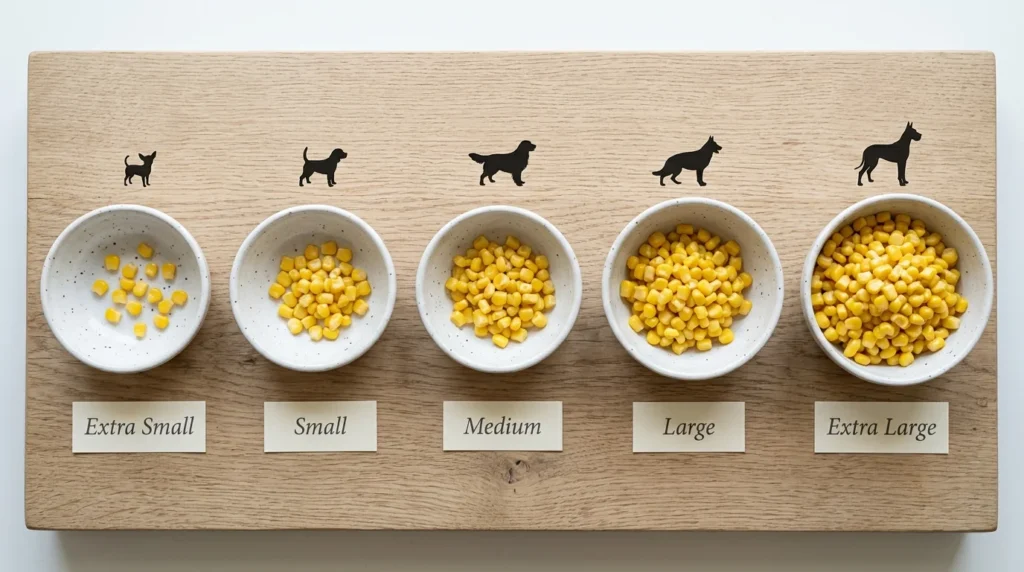
The standard treat guideline applies — treats should not exceed 10% of your dog’s total daily caloric intake. Corn is a moderate-calorie food compared to many fruits and vegetables, so portions need to be appropriate for your dog’s size.
How Much Corn Can a Dog Have? — Portion Guide by Dog Size
| Dog Size | Weight Range | Plain Corn Kernels Per Day | Serving Format | Frequency |
|---|---|---|---|---|
| Extra Small | Under 10 lbs | 1 teaspoon (about 10 kernels) | Kernels scattered on food or given as treats | 2–3 times per week |
| Small | 10–20 lbs | 1–2 teaspoons (15–25 kernels) | Small handful of kernels as a treat | 2–3 times per week |
| Medium | 20–50 lbs | 1–2 tablespoons (30–50 kernels) | Tablespoon of kernels as treat or food topper | A few times per week |
| Large | 50–90 lbs | 2–3 tablespoons (50–80 kernels) | Generous tablespoon as treat or food topper | A few times per week |
| Extra Large | 90 lbs + | 3–4 tablespoons (80–100 kernels) | Several tablespoons as treat or mixed into meal | A few times per week |
Important notes on this table:
- These are maximum amounts for plain corn kernels only — cooked without any seasoning, or raw kernels only.
- Reduce amounts if your dog is overweight, diabetic, or has digestive sensitivities.
- Factor corn into the total daily treat budget alongside any other treats given that day.
- These amounts should not be given if the dog is also eating a commercial dog food that already contains corn as an ingredient — the combined corn intake should be considered.
- Dogs with confirmed corn allergies: zero corn in any amount.
- Corn cob is never appropriate regardless of dog size or amount.
Can Puppies Eat Corn?
Yes — puppies can eat small amounts of plain corn kernels, but with extra caution compared to adult dogs. Puppies have developing digestive systems that are more sensitive to new foods and higher-carbohydrate items than fully developed adult dogs.
The preparation rules are the same but even more strictly applied: kernels only (never any access to the cob), cooked plain or raw, no seasoning, cut into very small amounts. The choking risk from individual corn kernels is low for most puppies, but very young puppies under 12 weeks should have very soft foods only — lightly cooked, mashed corn kernels would be safer than raw firm kernels for the very young.
Start with just a teaspoon of plain corn kernels as a first introduction and wait 48 hours before giving more. Watch for any digestive reaction — gas, diarrhea, or vomiting. Primary nutrition must come entirely from a complete, age-appropriate puppy food. Corn is supplemental only.
My Dog Ate Too Much Corn — What Do I Do?
The appropriate response depends entirely on what form of corn was eaten.
If your dog ate too many plain corn kernels: Expect temporary digestive upset — gas, bloating, and possibly loose stools from the high carbohydrate and fiber content. This is uncomfortable but not a toxic emergency for most healthy dogs. Ensure fresh water access, skip or reduce the next meal, monitor for 24 hours. Contact your vet if symptoms are severe or prolonged.
If your dog ate a corn cob or part of one: This is a potential emergency. Contact your veterinarian immediately — do not wait for symptoms. Gastrointestinal obstruction from a corn cob can develop quickly and become life-threatening. The vet may recommend inducing vomiting if very recent ingestion, or may need to examine for signs of obstruction. Signs of obstruction include repeated vomiting, loss of appetite, lethargy, and straining without producing stool.
If your dog ate candy corn, corn chips, or flavored corn products: Assess the ingredients. If xylitol was present, contact your vet immediately. If high-salt products were eaten in significant amounts, monitor for excessive thirst and urination. Digestive upset from high fat or sugar is likely — monitor and provide water access.
If your dog ate corn products with garlic or onion: Contact your vet promptly. Garlic and onion are toxic to dogs and can cause hemolytic anemia with regular exposure. A small accidental amount may not be an emergency, but your vet should be consulted.
Frequently Asked Questions
Can dogs eat corn?
Yes — plain corn kernels (raw or cooked without seasoning) are safe for most healthy dogs in moderate amounts. Corn is not toxic and appears in many commercial dog foods. The critical rule is kernels only — the corn cob is never safe.
Can dogs have corn?
Yes, in the form of plain corn kernels. Dogs cannot safely have corn cobs, corn husks, corn stalks, or most processed corn products. Plain kernels are the only safe form of corn for dogs to eat.
Are corn good for dogs?
Corn offers modest but real nutritional benefits — carbohydrates for energy, linoleic acid for skin and coat health, lutein and zeaxanthin for eye health, B vitamins, and fiber. It is not a superfood, but it is not harmful in appropriate amounts.
Are corn bad for dogs?
Plain corn kernels in moderation are not bad. Corn cobs are genuinely dangerous. Processed corn products (chips, candy corn, corn nuts, kettle corn) are not appropriate. And dogs with corn allergies should avoid all corn.
Is corn poisonous to dogs?
No. Plain corn is not poisonous to dogs. There is no corn toxin. The dangers associated with corn come from the physical hazard of the cob, not from any poison in the kernels.
Is sweetcorn healthy for dogs?
Yes — plain sweetcorn kernels are one of the better forms of corn for dogs. Sweetcorn contains lutein, zeaxanthin, beta-carotene, Vitamin C, folate, and potassium. Serve kernels only, plain with no seasoning.
Is corn bad for dogs with allergies?
If your dog has a confirmed corn allergy, all corn in any form should be avoided. Corn allergies in dogs are real but less common than often believed. Consult your vet for an elimination diet to properly diagnose corn sensitivity.
Can corn make dogs sick?
Yes, in specific situations — if a dog eats a corn cob (obstruction risk), too many kernels at once (digestive upset), or processed corn products with harmful ingredients (high salt, sugar, garlic, xylitol).
Can dogs eat corn cobs?
No — never. Corn cobs are one of the most common causes of life-threatening gastrointestinal obstruction in dogs. The cob does not digest and can become lodged in the intestines. This is a veterinary emergency. Contact your vet immediately if your dog ate a cob.
Can dogs eat canned corn?
Only no-salt-added canned corn, drained and rinsed. Most commercial canned corn contains added sodium that is too high for dogs. Fresh or frozen plain corn is always preferable.
Can dogs eat corn chips or corn nuts?
No. Both contain high salt, oil, and often toxic seasonings like garlic and onion powder. Corn nuts also present a dental fracture risk from their extreme hardness.
Can dogs eat candy corn?
No. Candy corn is a sugar candy with no real corn and may contain xylitol in sugar-free versions. Never give candy corn to dogs. Xylitol-containing versions are a medical emergency.
Can dogs eat popcorn?
Only plain air-popped popcorn with no butter, salt, or flavoring — and only in tiny amounts. Remove all unpopped kernels. Any flavored variety including kettle corn is not appropriate.
Can dogs eat corn tortillas?
Small amounts of plain corn tortilla are not toxic but are not recommended. Corn tortillas are high in refined carbohydrates with little nutritional value, and in any serving context they are usually accompanied by toxic ingredients.
Can dogs eat baby corn?
Yes. Baby corn is an exception to the cob rule — because it is harvested so young, the entire tiny cob is edible and digestible. Plain baby corn (fresh or no-salt-added canned) can be given in small amounts.
Can dogs eat corn bread?
Small amounts of plain, low-sugar corn bread are not toxic, but corn bread is high in carbohydrates, fat, and calories and is not recommended as a regular treat. Plain corn kernels are a better choice.
Can dogs eat corn syrup?
No — corn syrup is concentrated sugar with no nutritional value. It causes blood sugar spikes and contributes to weight gain. Sugar-free versions may contain xylitol, which is acutely toxic. Only give corn syrup under veterinary guidance for hypoglycemia.
Can dogs eat corn beef?
No. Corned beef is extremely high in sodium (it is salt-cured) and contains pickling spices that are not appropriate for dogs. Plain unseasoned cooked beef is safe, but corned beef is not.
Can puppies eat corn?
Yes, in very small amounts of plain cooked corn kernels. Start with just a teaspoon and wait 48 hours. Never give puppies access to corn cobs. Primary nutrition must come from complete puppy food.
How much corn can a dog eat?
See the portion table above. In general: extra small dogs one teaspoon, small dogs one to two teaspoons, medium dogs one to two tablespoons, large dogs two to three tablespoons of plain kernels — a few times per week.
My dog ate a corn cob — what do I do?
Contact your veterinarian immediately. Do not wait for symptoms. Corn cob obstruction is a veterinary emergency. The vet may induce vomiting if ingestion was very recent or may need to assess for and treat obstruction.
Conclusion
Corn is one of the most nuanced foods in the dog-owner’s food safety lexicon — safe in its plain kernel form, potentially life-threatening in its cob form, and ranging from inadvisable to genuinely harmful across its many processed product forms. Getting clear on the distinctions is what makes this topic so important for every dog owner to understand fully.


