

Can Dogs Eat Raw Eggs or Fried Eggs? Full Safety Guide 2026
Last updated: 15 October 2026
Yes, dogs can eat eggs, and cooked eggs are genuinely one of the best foods you can share with your dog. Boiled, scrambled or poached, served plain with nothing added, eggs give your dog complete protein, B vitamins, selenium and healthy fats in one cheap, easy package. Raw eggs are a different story: the Salmonella risk and a compound called avidin that blocks biotin make them a poor choice, cooked or nothing.
The short version: Cook eggs fully, serve them plain (no butter, oil, salt or seasoning), and match the amount to your dog's size. Most dogs do best with egg as a treat or food topper, not a meal. Start with a small piece the first time and watch for any reaction over the next day.
How Many Eggs Can Dogs Have?
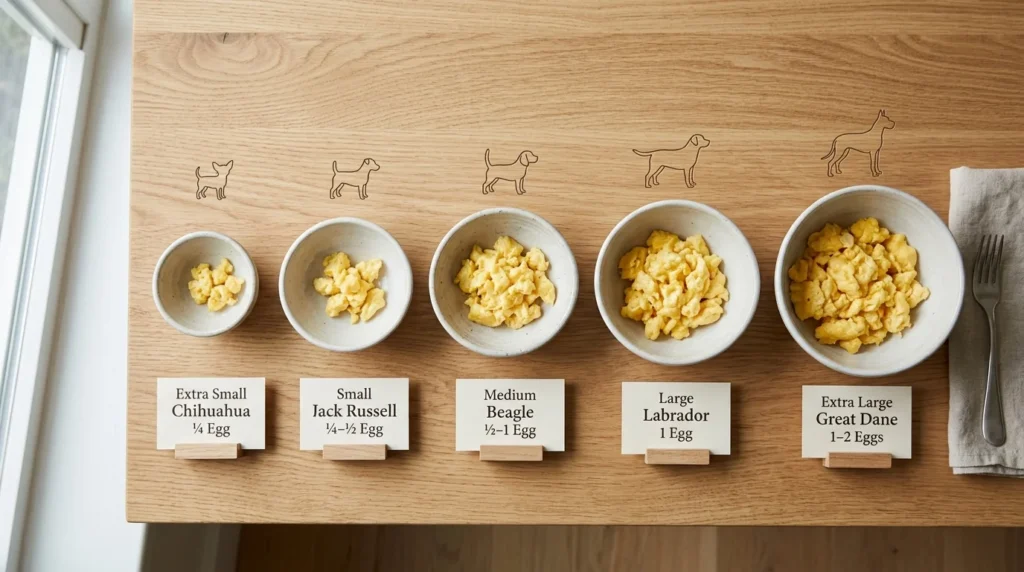
Portion size is the part most guides skip, and it matters more than almost anything else in this article. A whole egg is a lot of calories for a Chihuahua and barely a snack for a Great Dane. Canine nutritionist Dr Emma Scales-Theobald published a clear per-day and per-week guide through Rover, and it is the most practical framework available. PetMD agrees on the same principle: count eggs as treats, and keep all treats within about 10% of daily calories.
| Dog size | Weight | Max per day | Max per week |
|---|---|---|---|
| Toy | Up to 6 kg | 1/4 egg | 1/2 to 1 egg |
| Small | 6 to 10 kg | 1/2 egg | 1 egg |
| Medium | 11 to 25 kg | 1 egg | 1 to 2 eggs |
| Large | 26 to 45 kg | 1 egg | 2 to 3 eggs |
| Giant | Over 45 kg | 2 eggs | 3 eggs |
Three notes go with that table. First, these are maximums, not targets. Less is always fine. Second, they assume your dog also eats a complete, balanced dog food; if you home-cook your dog's meals, work the egg into a plan with your vet or a veterinary nutritionist rather than freelancing. Third, even two eggs at once can upset a small dog's stomach, and five can upset a large dog's, so spread portions out rather than loading one meal.
Why Eggs Are Good for Dogs
Eggs earn their reputation honestly. Purina's senior nutritionist Jan Dempsey has called them close to the gold standard of protein, and the nutrient list backs that up. Here is what a plain cooked egg actually delivers and what each nutrient does for your dog.
| Nutrient | What it does for dogs |
|---|---|
| Complete protein and essential amino acids | Builds and repairs muscle, supports the immune system; eggs are one of the most digestible protein sources available |
| Vitamin B12 | Supports nerve function and red blood cell production |
| Riboflavin and folate | Help turn food into energy and support healthy cell growth |
| Vitamin A | Supports vision, immunity, bone health and reproduction |
| Vitamin D (yolk) | Supports bone and heart health; dogs with calcium oxalate stones should be cautious with yolks |
| Iron | Needed for energy production and carrying oxygen in the blood |
| Selenium | Antioxidant support and healthy thyroid function |
| Fatty acids (yolk) | Omega-6 fats like linoleic acid support skin and a shiny coat |
One large egg carries roughly 70 to 80 calories and about 5 grams of fat, so the nutrition comes in a genuinely useful package as long as portions stay sensible. Eggs also show up as an ingredient in many commercial dog foods for exactly this reason: manufacturers do not add expensive ingredients without a purpose.
How to Cook Eggs for Dogs
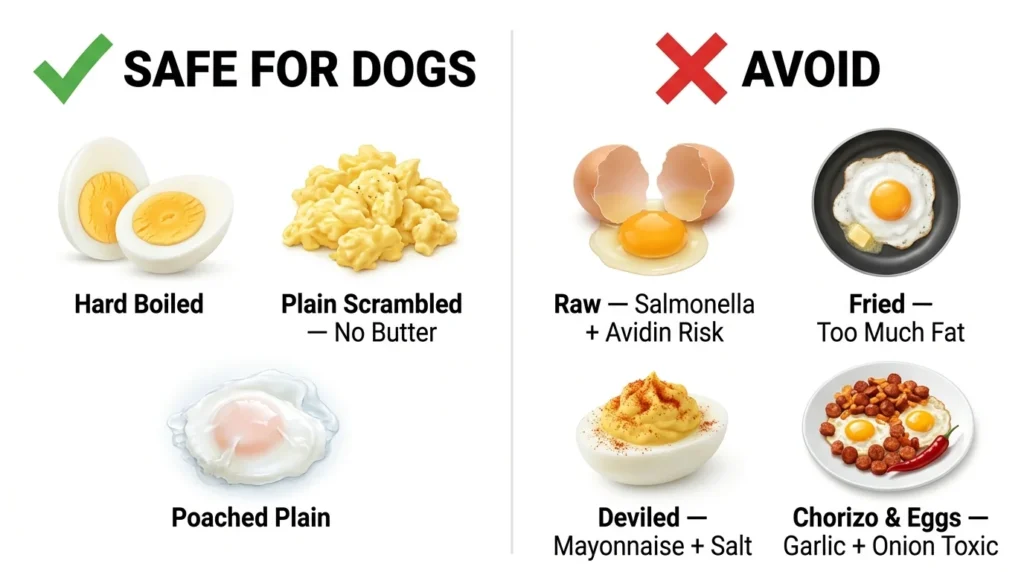
Cooking method is where eggs go right or wrong. The rule is simple: fully cooked and completely plain. PetMD lists boiled, scrambled and poached as the safe options, and Purina adds that cooking actually makes egg protein more digestible. Anything runny, fried or dressed up for humans belongs to you, not your dog.
| Method | Safe for dogs? | Notes |
|---|---|---|
| Boiled | Yes, best choice | No additions at all; easy to portion, slice or mash; keep refrigerated up to four days |
| Scrambled | Yes | Non-stick pan, no butter, oil, milk or seasoning; cook until fully set |
| Poached | Yes | Plain water only, white and yolk fully set |
| Baked | Yes | Plain dish, no salt or seasoning, until fully set |
| Fried | No | Oil or butter adds fat and calories; raises pancreatitis risk |
| Sunny side up | No | The yolk stays raw, so the bacterial risk stays too |
| Deviled eggs, egg salad | No | Mayonnaise, mustard, salt and sometimes onion make the dish, not the egg, the problem |
Practically speaking: crack the egg into a non-stick pan or a pot of plain water, cook it through, let it cool to room temperature, and cut it into pieces sized for your dog. If your dog has never had egg before, start with a quarter of a scrambled egg or a few slices of boiled egg and wait 24 hours before offering more. Most dogs love egg as a food topper for fussy eaters, a high-value training treat cut into tiny pieces, or mixed with plain cooked rice for a gentle meal.
Raw Eggs: Two Risks, Plainly Explained
Raw eggs are not recommended, and this is not just vets being cautious. There are two separate, well-documented problems. The first is bacteria. Raw eggs can carry Salmonella, which causes vomiting, diarrhoea, fever and lethargy in dogs, and an infected dog can shed the bacteria and pass it to people in the house, including children. The second is avidin, a protein in raw egg white that binds to biotin (vitamin B7) and stops the body absorbing it. One raw egg now and then is unlikely to cause harm, but regular raw egg feeding over weeks gradually depletes biotin and leads to hair loss, skin trouble and general malaise.
Cooking fixes both problems completely: heat kills the bacteria and denatures avidin, freeing the biotin. The nutritional difference between raw and cooked egg is minimal; the safety difference is enormous. We cover the raw-egg question in full detail, including the raw-diet debate, in our guide to raw eggs for dogs. If your dog just licked up a dropped raw egg, do not panic: watch for vomiting or diarrhoea and call your vet if either appears.
Egg White vs Yolk: Which Part Matters?
You do not need to separate them for a healthy dog, but the two halves do different jobs. The white is almost pure protein with barely any fat, which makes cooked egg white one of the best lean protein treats available. The yolk carries the fat-soluble vitamins (A, D, E and K), the choline, the iron and the fatty acids that help skin and coat, along with most of the fat, roughly 4.5 grams per large yolk.
That split matters for dogs with a pancreatitis history, overweight dogs, and dogs on a low-fat diet, who do better with white only. Everyone else can have the whole cooked egg, yolk included, within the portion table above.
Eggshells: Only as a Fine Powder
Eggshells are mostly calcium carbonate, and finely ground shell is sometimes used as a calcium supplement in home-prepared diets. Purina's Jan Dempsey points out that shells do contain calcium and phosphorus, but adds that there are easier ways to supplement those minerals, and your vet can advise whether your dog needs any at all. Our full guide to eggshells for dogs covers preparation: bake the clean shells, grind them to a fine powder, and use only a pinch. Whole or chunky shell pieces are a choking hazard and can scratch the mouth and throat, so never hand those to your dog.
Puppies and Senior Dogs
Puppies can eat cooked eggs, and the choline and complete protein genuinely support growth and brain development. Keep amounts tiny: a teaspoon of scrambled egg is plenty for a young pup, and puppy food must remain at least 90% of the diet. Never give puppies raw egg; their developing immune systems handle Salmonella worse than an adult dog's.
Senior dogs often do well with eggs because they are soft, easy to chew and highly digestible, and the protein helps maintain muscle as dogs age. Serve plain, cut small, keep to the low end of the portion table, and check with your vet first if your senior has kidney disease, a pancreatitis history or a prescribed diet.
When Eggs Are a Bad Idea
Plain cooked eggs suit most healthy dogs, but not every dog. Skip eggs or talk to your vet first in these cases: an active pancreatitis flare-up (no eggs at all until the vet clears them); a pancreatitis history (white only, with vet approval); confirmed egg allergy; diabetes or obesity (count every egg in the daily calories, favour white over yolk); dogs on a prescription diet (no extras without vet approval, per PetMD); and dogs with calcium oxalate urinary stones, where the vitamin D in yolks can be a concern.
Call your vet if: your dog ate raw eggs and develops vomiting, bloody diarrhoea, fever or lethargy; your dog shows itchy skin, ear infections, hives or swelling after eating egg (possible allergy); or your dog with pancreatitis, diabetes or a prescribed diet ate egg without approval. Do not try to treat suspected Salmonella at home.
Egg FAQs
Can dogs eat eggs every day?
It depends on size. Large dogs can often handle one egg a day; small dogs should stick to a quarter to half an egg a few times a week. Keep the 10% treat rule: eggs should not provide more than a tenth of daily calories. If eggs become a daily habit, reduce other treats to balance it out.
Is the cholesterol in eggs bad for dogs?
Not in the way people fear. Purina's Jan Dempsey explains that cholesterol does not affect dogs the way it affects humans, and dogs do not develop the same cholesterol-related diseases. You do not need to feed whites only for cholesterol reasons. If a dog gets too much egg, you will see weight gain from the extra calories long before anything else.
How do I introduce eggs the first time?
Start with a small piece of plain cooked egg, a quarter of a scrambled egg is plenty, and watch for vomiting, soft stool or itchy skin over the next 24 to 48 hours. If all is well, work up to the portion table amounts gradually. This slow start matters most for dogs with sensitive stomachs or a history of food allergies.
Can dogs eat quail or duck eggs?
Yes to both, cooked and plain. Quail eggs are roughly a fifth the size of chicken eggs, which makes them naturally portion-friendly for small dogs; multiply the chicken-egg allowance by five for an equivalent amount. Duck eggs run larger and richer, about one and a half chicken eggs each, so scale portions down.
My dog ate a raw egg. What now?
One raw egg is unlikely to cause serious harm, but watch for vomiting or diarrhoea over the next day or two and call your vet if either appears. The bigger concern with raw eggs is regular feeding, which risks Salmonella exposure and gradual biotin deficiency from avidin. Switch to cooked eggs going forward.
Can dogs share egg dishes like omelettes?
A plain omelette with no filling, oil, butter, cheese or seasoning can be shared in a small portion. Most human egg dishes cannot: deviled eggs and egg salad bring mayonnaise, mustard and salt; fried eggs bring cooking fat; chorizo and eggs bring garlic, onion and heavy seasoning. When in doubt, cook a small plain portion separately for your dog. For the full picture of safe and unsafe foods, see our guide to what dogs can and can't eat.
Sources
Sources actually opened for this article:
- PetMD: Can Dogs Eat Eggs?
- Rover: Can Dogs Eat Eggs: Cooked, Raw or Scrambled?
- Purina: Can Dogs Eat Eggs? A Guide to Safety
The breed-size portion table follows the framework published by canine nutritionist Dr Emma Scales-Theobald through Rover, cross-checked against PetMD's size-based serving guidance and Purina's 10% treat rule.
This article is for information only and is not a substitute for veterinary advice. If your dog shows signs of illness after eating eggs, contact your veterinarian.


