

Can Dogs Eat Cherries? Pits, Toxicity & Complete Safety Guide
Cherry flesh itself is not toxic to dogs, but the pits, stems, and leaves contain cyanide-releasing compounds — so veterinarians and the ASPCA recommend skipping cherries altogether. Fully pitted, destemmed cherry flesh in tiny amounts is the only acceptable form, but safer fruits are always the better choice.
You are snacking on a bowl of fresh cherries, and your dog is right there — nose working, eyes tracking every cherry you pick up. Or maybe your dog already grabbed one off the counter before you could react. Can dogs eat cherries? Are they safe? What about the pits? The stems? What if your dog already swallowed one whole?
Cherries are one of the most important foods to understand when it comes to dog safety — not because the answer is simple, but precisely because it is complicated. Unlike grapes (always toxic) or blueberries (always safe), cherries sit in a nuanced middle ground that requires clear understanding of each component of the fruit.
This complete guide answers every question dog owners ask about cherries — every variety, every form, every part of the fruit, every product, and every emergency scenario. Read this once and you will know everything you need to know about cherries and dogs.
Can Dogs Eat Cherries?
The answer is nuanced — and understanding the nuance could save your dog’s life. The flesh of a ripe cherry is not toxic to dogs, but virtually everything else about the cherry plant is. The pit, stem, leaves, and even the cherry plant itself contain cyanogenic glycosides — compounds that release hydrogen cyanide when metabolized.
The practical recommendation from most veterinarians and the ASPCA is to avoid feeding cherries to dogs entirely, because the risks associated with the pit, stem, and leaves are significant — and separating the flesh cleanly from all these dangerous parts is difficult to do perfectly, especially if your dog grabs a cherry before you can prepare it.
If you insist on sharing cherry flesh with your dog, it must be completely pitted, destemmed, and served in tiny amounts. But the safest answer remains: choose a safer fruit and leave cherries off the dog-sharing list.
Are Cherries Good for Dogs?
The flesh of a cherry — when completely separated from all other parts — does provide some nutritional value. Cherry flesh contains Vitamin C, Vitamin A, fiber, potassium, and antioxidants including anthocyanins (the pigments that give cherries their deep red color and provide powerful anti-inflammatory and cellular protective benefits).
Cherries also contain melatonin — a compound that supports healthy sleep cycles. Some pet supplement products include cherry-derived compounds specifically for this purpose.
However, “the flesh has some nutritional value” does not make cherries a recommended treat for dogs. Every one of these nutritional benefits can be obtained from completely safe fruits — blueberries, strawberries, watermelon, and many others — without any of the risks associated with the cherry plant. The nutritional case for cherries is not compelling enough to justify the risks they carry.
Why Are Cherries Toxic to Dogs?
This is one of the most important questions in this guide, and it deserves a thorough answer. Cherries are toxic to dogs not because of the flesh, but because of specific parts of the cherry plant that contain cyanogenic compounds.
Cyanogenic Glycosides — The Toxic Mechanism Cherry pits, stems, leaves, and the cherry plant itself contain cyanogenic glycosides — specifically amygdalin and prunasin. When these compounds are metabolized by the body (through digestion or when cells are damaged by chewing or crushing), they are converted to hydrogen cyanide — one of the most rapidly acting poisons known.
Hydrogen cyanide works by interfering with cellular oxygen utilization — it essentially prevents cells from using oxygen even when oxygen is present. This causes a form of internal suffocation at the cellular level, affecting the heart and brain most acutely.
How Much Is Dangerous? The amount of cyanide required to cause toxicity depends on the size of the dog and the number of pits consumed. A single cherry pit contains a relatively small amount of amygdalin, and a large dog might not show symptoms from one pit. But several pits in a small dog — or many pits in any dog — can cause real toxicity. The unpredictability of individual dog sensitivity is a major reason why cherry pits should always be treated as a safety emergency when consumed.
Why the Flesh Is Different The flesh of a ripe cherry does not contain significant amounts of cyanogenic glycosides — these are concentrated in the hard seed inside the pit, the stems, and the leaves. This is why “pitted cherry flesh only” is the one scenario where cherry consumption is not immediately toxic. But as noted, practically achieving this safely with a live dog is difficult.
Why Are Cherries Bad for Dogs?
Even beyond the acute cyanide toxicity from the pit, cherries are problematic for dogs on multiple levels.
The Pit — Cyanide and Physical Obstruction Cherry pits present two simultaneous dangers: the chemical risk from cyanogenic glycosides, and the physical risk of gastrointestinal obstruction. A cherry pit can become lodged in the esophagus, stomach, or intestines — particularly in small dogs. Obstruction is a separate and independently serious concern from cyanide toxicity.
The Stem and Leaves — Cyanide Risk Cherry stems and leaves also contain cyanogenic glycosides. A dog that chews on a cherry stem or eats cherry leaves is exposed to the same cyanide risk as from the pit, though in different concentrations.
The Flesh — High Sugar Even setting aside all the toxic parts, cherry flesh is naturally high in sugar — particularly sweet cherry varieties. Regular consumption of high-sugar fruit contributes to blood sugar instability, weight gain, and is particularly problematic for diabetic dogs.
Maraschino and Processed Cherries — Additional Toxic Concerns Maraschino cherries and other processed cherry products contain added sugar, artificial coloring, and preservatives that are not appropriate for dogs. Some cherry-flavored products may also contain artificial sweeteners including xylitol.
The Overall Risk-Benefit Calculation The combination of acute cyanide risk from pits and stems, physical obstruction risk from pits, high sugar in the flesh, and the practical difficulty of perfectly separating safe flesh from all dangerous parts makes cherries a fruit where the risk significantly outweighs the benefit for dogs.
Dangers of Feeding Dogs Cherries
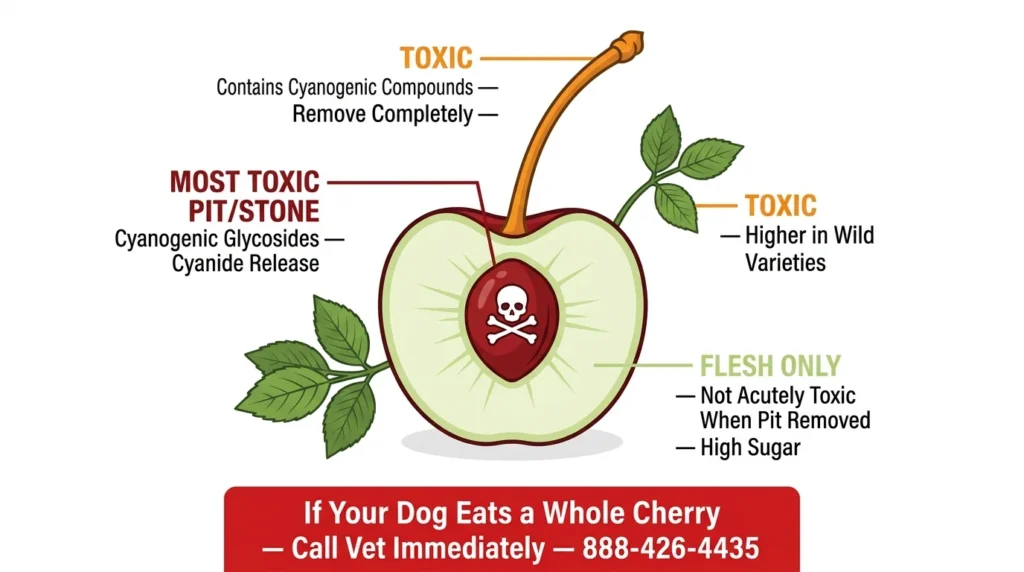
Let’s detail the specific dangers so you understand exactly what the risks are and how seriously they should be taken.
Cyanide Poisoning — Symptoms and Timeline Cyanide poisoning in dogs from cherry pit or stem ingestion typically causes symptoms within 15 to 20 minutes to a few hours after consumption. Signs of cyanide toxicity include:
- Bright red or cherry-red gums (paradoxically, despite cyanide preventing oxygen use, the blood remains oxygenated — leading to unusually red appearance)
- Dilated pupils
- Difficulty breathing, rapid breathing, or gasping
- Panting
- Weakness or collapse
- Vomiting
- Seizures
- Shock
- Death in severe cases if untreated
Gastrointestinal Obstruction from Pits Beyond cyanide, the physical cherry pit can cause obstruction in the gastrointestinal tract. Cherry pits are hard, round, and approximately the right size to become lodged in the throat, stomach opening, or intestines of small to medium dogs. Signs of obstruction include persistent vomiting, loss of appetite, lethargy, abdominal pain, and inability to defecate. Obstruction may require emergency surgery.
Intestinal Irritation Even when a cherry pit passes without causing a complete obstruction, the hard pit can cause irritation and abrasion to the lining of the digestive tract as it moves through.
Can Dogs Have Cherries of Any Kind?
This question has a careful answer. The flesh of pitted, destemmed fresh sweet cherries — with no pit, no stem, no leaves, and no skin concern — is the one scenario where cherry consumption is not immediately toxic. However, the practical recommendation is still to avoid cherries entirely for most dogs, for these reasons:
First, perfectly removing the pit, stem, and all plant material from a cherry that your dog wants to eat is difficult. Dogs eat quickly, and a single cherry with even a small fragment of pit material creates risk.
Second, the flesh is high in sugar, providing limited unique benefit compared to safer fruits.
Third, the potential consequences of a mistake — cherry pit cyanide toxicity — are severe.
If you choose to give cherry flesh to your dog, you must: use only fresh, ripe cherries; remove the pit completely and carefully; remove the stem completely; give only the flesh; give only one or two as a test; and monitor carefully for any reaction.
For the vast majority of dog owners, the safer choice is to select a different fruit. Blueberries, strawberries, watermelon, apple (without seeds), and many other fruits provide excellent nutrition with none of the cherry-associated risks.
See Also: Can Dogs Eat Cantaloupe? Rind, Seeds & Safe Serving Guide 2026
Can Dogs Eat Cherries Without Pits?
This is the critical question — and the answer is yes, with important caveats. Cherry flesh with the pit completely removed and the stem removed is not acutely toxic to dogs. If you carefully pit a fresh cherry, removing all of the hard central seed, and give only the flesh to your dog, the cyanide risk from that specific piece is eliminated.
However, “not acutely toxic” does not mean “safe without any concern.” The flesh still contains natural sugar — cherry flesh is quite sweet, and regular feeding adds sugar to the diet. And the practical challenge of ensuring no pit fragment remains is real — commercial cherry pitters sometimes leave small pit fragments, and hand-pitting requires care.
If you do give pitted cherry flesh to your dog, use a quality cherry pitter, visually inspect each cherry after pitting to confirm no stone fragments remain, remove the stem completely, and give only one or two pieces at a time. Never give to diabetic dogs or dogs with weight concerns without veterinary guidance.
Can Dogs Eat Cherries Without Seeds?
Same as pitted cherries — the “seed” is the cyanide-containing core inside the cherry pit. Cherries without seeds (pits) means cherries where the central hard seed has been removed. Yes, cherry flesh with the seed completely removed and stem removed is not acutely toxic to dogs.
The same practical cautions apply as for pitted cherries: ensure complete removal of all seed material, remove the stem, give only the flesh in tiny amounts, and choose safer fruit alternatives when possible.
Can Dogs Eat Dried Cherries?
Not recommended. Dried cherries present several concerns that make them a poor choice for dogs regardless of whether pits are removed.
First, most commercially available dried cherries contain added sugar. Fruit is sweetened during the drying process to compensate for the natural tartness that intensifies as water is removed. This added sugar makes commercially dried cherries significantly sweeter and higher in sugar than fresh cherries.
Second, dried cherries from commercial sources may also contain preservatives (sulfur dioxide) and artificial flavoring.
Third, the drying process concentrates everything in the cherry — including the natural sugar content. A small amount of dried cherries has significantly more sugar per gram than the same amount of fresh cherries.
Fourth, if any pit material was not completely removed before drying, the concentration of the cherry means the cyanide risk from remaining material is also increased.
If you are specifically looking for a dried fruit treat for your dog, plain dehydrated blueberries (no added sugar, no pit concerns, no stem issues) are a far safer and more appropriate choice.
Can Dogs Eat Pitted Cherries?
As covered above — pitted cherries (with stem also removed) are the one form of cherry where the flesh can be given without immediate cyanide toxicity. The flesh itself is not toxic when the pit and stem are completely removed.
For practical purposes: if you want to give your dog cherry, use only fresh, ripe sweet cherries, pit them carefully, verify no pit fragments remain, remove the stem, and give only one or two pieces. Monitor for any reaction.
This is the only form of cherry that approaches acceptable for dogs, and even then, most veterinary nutritionists would suggest choosing a different fruit with a cleaner safety profile.
Can Dogs Eat Fresh Cherries?
Fresh cherries are the form most people ask about, and the answer depends entirely on preparation. Fresh cherries with pits and stems attached — as they come on the tree or in a bowl — should not be given to dogs. The pit and stem present cyanide risk, and a dog that grabs a whole cherry is likely to swallow the pit.
Fresh cherries that have been carefully pitted and destemmed — with only the flesh remaining — are the one acceptable form of cherry flesh for dogs, as described above.
The practical problem with fresh cherries is that they are typically served whole, with pits and stems attached. In any setting where whole cherries are being eaten (at a table, at a party, outside near a cherry tree), your dog should not have access to them. The risk of accidentally consuming a pit is too high.
Can Dogs Eat Black Cherries?
Black cherries (Prunus serotina — wild black cherry or chokecherry) are a different and more serious concern than sweet cherries. Wild black cherries and their leaves contain higher concentrations of cyanogenic glycosides than cultivated sweet cherries. The leaves of black cherry trees are particularly problematic.
If “black cherries” refers to dark-colored sweet cherry varieties like Bing or Lapins (which have very dark, almost black flesh when ripe) — these are sweet cherries with the same risk profile as other cultivated sweet cherries.
If “black cherries” refers to wild black cherry trees — the entire plant including fruit, leaves, stems, and bark should be kept away from dogs. Wild black cherry toxicity in dogs is a serious risk, particularly if dogs have access to fallen leaves (which concentrate cyanogenic compounds as they wilt).
Can Dogs Eat Maraschino Cherries?
No — maraschino cherries should never be given to dogs. Maraschino cherries are a heavily processed cherry product that presents multiple independent concerns.
What maraschino cherries actually are: Maraschino cherries are fresh cherries that have been soaked in a brine solution, bleached with sulfur dioxide (which removes their natural color and flavor), soaked again in a sugar syrup with artificial red dye (typically Red 40 or Red 3), and flavored with artificial cherry flavoring and almond extract. The result is a candy-sweet, artificially colored, chemically preserved product that has very little in common with a fresh cherry.
Why they are bad for dogs: The extremely high sugar content makes maraschino cherries immediately problematic for dogs — a single maraschino cherry can contain 2 to 4 grams of added sugar. The artificial red food coloring (Red 40) may cause reactions in sensitive dogs. The artificial flavoring contains almond extract — almond extract contains benzaldehyde, which in concentrated amounts can be irritating. The preservative sulfur dioxide can cause digestive irritation.
Some sugar-free maraschino cherry products contain artificial sweeteners including xylitol — which is acutely toxic to dogs.
If your dog ate a single maraschino cherry, monitor for vomiting or digestive upset from the sugar and artificial coloring. A single cherry is unlikely to cause a serious emergency in a large healthy dog (assuming no xylitol). But maraschino cherries should never be given intentionally.
See Also: Can Dogs Eat Celery for Weight Loss? Benefits & Portion Guide 2026
Can Dogs Eat Bing Cherries?
Bing cherries are one of the most popular sweet cherry varieties — large, dark red to nearly black, with a rich, sweet flavor. From a safety perspective, Bing cherries have the same risk profile as any other sweet cherry: the flesh is not acutely toxic when the pit and stem are completely removed, but the pit contains cyanogenic glycosides and is also a physical obstruction hazard.
Never give a whole Bing cherry to your dog. The large pit of a Bing cherry is a significant cyanide and obstruction risk. If you want to give your dog Bing cherry flesh, pit carefully (Bing cherries pit relatively easily due to their size), remove the stem, verify no pit fragments remain, and give only one or two small pieces.
Given Bing cherries’ large size and large pits, they are arguably slightly easier to safely pit than smaller cherry varieties — but the overall recommendation to choose safer fruits still stands.
Can Dogs Eat Rainier Cherries?
Rainier cherries are a premium sweet cherry variety with yellow-red blush skin and very sweet, pale-cream colored flesh. They are known for their exceptional sweetness and low acidity. From a safety standpoint, Rainier cherries have the same risk profile as other sweet cherry varieties.
The pale flesh and thin skin of Rainier cherries means the pit is just as dangerous as any other cherry — the visual difference in the fruit’s appearance does not affect the cyanide content of the pit. Remove pit and stem completely before giving any flesh to your dog.
Rainier cherries are particularly high in natural sugar compared to other cherry varieties — a consideration for portion size even when the pit is removed.
Can Dogs Eat Sweet Cherries?
Sweet cherries (the category including Bing, Rainier, Lapins, Sweetheart, and similar cultivated varieties) are the cherries most people eat as a fresh fruit. The safety assessment for sweet cherries applies to all these varieties: the flesh is not acutely toxic when completely pitted and destemmed, but the pit and stem contain cyanogenic glycosides that are dangerous.
Sweet cherry flesh is higher in sugar than many other fruits — a consideration for regular feeding. For dogs that can safely eat one or two carefully prepared pieces of sweet cherry flesh, the nutritional value includes Vitamin C, anthocyanins, and potassium.
The consistent recommendation remains: for most dogs and most situations, choose a safer fruit. If giving sweet cherry flesh, strict preparation is essential.
Can Dogs Eat Cherries Safely?
The conditional answer is: cherry flesh (pit-free, stem-free, leaf-free) can be given in very small amounts to healthy adult dogs without causing acute toxicity. But “safely” in a broader sense requires acknowledging that:
- The margin for error is low — a missed pit fragment creates serious risk
- The fruit is high in sugar
- Safer alternatives with equivalent or better nutrition exist
- Most dogs should simply not eat cherries given the risk-benefit calculation
If you are determined to give cherry to your dog, the safety checklist is:
- Use only fresh, ripe sweet cherries
- Pit each cherry carefully using a quality cherry pitter
- Visually inspect each pitted cherry to confirm no stone fragments remain
- Remove the stem completely — do not leave even a small piece
- Remove any leaves that were attached
- Give only the flesh — one or two pieces maximum
- Never give whole or pitted cherries where the dog might access additional unpitted ones
- Never give to diabetic dogs, puppies, or very small dogs without vet guidance
- Monitor for 24 to 48 hours after any cherry consumption
Can Dogs Eat Cherries with Pits?
No — absolutely never. Cherries with pits intact should never be given to dogs under any circumstances. This is a firm safety rule with no exceptions.
A whole cherry with its pit presents two simultaneous dangers: the cyanogenic glycosides in the pit create cyanide toxicity risk, and the hard pit itself creates gastrointestinal obstruction risk. Either of these alone would be sufficient reason to avoid — together they make whole unpitted cherries completely unacceptable for dogs.
If your dog grabs a whole cherry off a table or from a bowl, contact your veterinarian or the ASPCA Animal Poison Control Center immediately. One cherry pit in a large healthy dog is unlikely to cause fatal cyanide toxicity (the amount of amygdalin in one pit is relatively small), but it is still a medical situation that warrants prompt professional guidance.
Can Dogs Eat Cherries with Skin?
Cherry skin (the outer flesh of the cherry, not the pit) is not toxic to dogs on its own. The skin of a ripe cherry is soft and digestible. When people ask about cherry skin, they usually want to know if the outer part of the cherry flesh is safe — and yes, the flesh including skin is safe when the pit is completely removed.
The concern is not the skin but everything else attached to a whole cherry. Remove the pit completely, remove the stem, and the remaining cherry flesh including its skin is not toxic.
Can Dogs Eat Cherry Stems?
No — cherry stems should never be given to dogs. Cherry stems contain cyanogenic glycosides — the same compounds found in the pit, leaves, and bark of cherry plants. While the concentration in stems is lower than in the pit, the chemical risk is still present.
Beyond the cyanide concern, cherry stems are also a physical choking hazard. They are thin and flexible in a way that can wrap around the throat or lodge in unexpected places in the digestive tract.
Always remove the stem completely before giving any cherry flesh to your dog. Do not assume stems are safe just because they seem like a simple plant stalk — they contain the same class of toxic compounds as the pit.
Can Dogs Eat Cherry Stones?
Cherry stones are the same as cherry pits — the hard central seed inside a cherry. “Stone” is the botanical term for this type of hard seed found in stone fruits (cherries, plums, peaches, apricots). The answer is the same: never give cherry stones to dogs.
Cherry stones (pits) contain amygdalin — a cyanogenic glycoside that releases hydrogen cyanide when metabolized. They also present a physical obstruction risk. Never give cherry stones to dogs in any form, and if a dog consumes a cherry stone, treat it as a medical situation requiring prompt veterinary contact.
See Also: Can Dogs Eat Popcorn? Buttered, Kettle Corn & Every Type Covered
Can Dogs Eat Cherry Sauce?
No — cherry sauce (cherry jam, cherry preserves, cherry pie filling, or other cherry-based sauces) is not appropriate for dogs.
Commercial cherry sauces contain large amounts of added sugar — sometimes more sugar than cherry content. They often contain corn syrup, artificial flavoring, artificial coloring, and preservatives. Some “no sugar added” or “light” versions contain artificial sweeteners including xylitol, which is acutely toxic to dogs.
Even the cherry component in cherry sauce may not be fully pitted — small pit fragments can survive processing in some products. The combination of high sugar, artificial additives, potential pit fragments, and possible xylitol makes cherry sauce completely inappropriate for dogs.
If your dog ate a tiny lick of cherry jam or sauce, monitor for digestive upset from the sugar and contact your vet if any xylitol was present.
Can Dogs Eat Cherry Syrup?
No — cherry syrup is not appropriate for dogs. Cherry syrup (the liquid used in cocktails, sodas, and desserts, including maraschino cherry syrup) is essentially concentrated sugar with cherry flavoring and artificial coloring. It contains no meaningful nutritional value and delivers a significant sugar load in a small volume.
Cocktail cherry syrup contains alcohol in many recipes — alcohol is toxic to dogs. Commercial cherry syrups contain artificial red coloring, high-fructose corn syrup or refined sugar, and artificial flavoring. Sugar-free versions may contain xylitol.
There is no version of cherry syrup that is appropriate for dogs. If your dog licked a small amount of cherry syrup, monitor for digestive upset. If the syrup contained alcohol or xylitol, contact your vet immediately.
What If Your Dog Swallows a Whole Cherry?
This is one of the most important questions in this guide because it happens frequently. Your dog grabs a cherry before you can stop them. What do you do?
Step 1 — Stay calm and assess: Note the size of your dog and how many cherries were consumed. One whole cherry in a large dog (over 50 lbs) is a different risk level than multiple cherries in a small dog.
Step 2 — Contact your veterinarian or animal poison control immediately: Do not wait for symptoms. Call your vet or the ASPCA Animal Poison Control Center (888-426-4435). Describe the situation — your dog’s size, breed, approximate weight, and how many whole cherries were consumed.
Step 3 — Watch for symptoms: If directed by your vet to monitor at home, watch for signs of cyanide toxicity (bright red gums, difficulty breathing, dilated pupils, weakness, seizures) AND signs of obstruction (persistent vomiting, loss of appetite, lethargy, abdominal pain, inability to defecate).
Step 4 — Do not induce vomiting without veterinary direction: While vomiting can remove a recently consumed pit before it is digested, inducing vomiting incorrectly can cause aspiration. Only induce vomiting if specifically directed to by your vet.
Step 5 — Seek emergency care if symptoms appear: Any signs of cyanide toxicity require immediate emergency veterinary care. The timeline for cyanide poisoning is rapid — within 15 to 20 minutes in severe cases.
The key message: do not watch and wait when your dog eats a whole cherry. Contact your vet or poison control immediately.
Can Dogs Have Maraschino Cherries?
No — as covered in detail in the maraschino cherry section above. Maraschino cherries are a heavily processed, heavily sweetened product with artificial coloring, artificial flavoring, and preservatives. They contain very high amounts of added sugar and may contain xylitol in sugar-free versions.
Beyond the added sugar and artificial ingredients, maraschino cherries are pitted (which removes the cyanide risk from the pit) — this is the one way maraschino cherries differ from whole fresh cherries. However, the massive sugar content and artificial additives make them wholly inappropriate as a dog treat regardless.
Never give maraschino cherries to dogs intentionally. If your dog ate one accidentally, monitor for digestive upset from the sugar and artificial coloring. Check the product label for xylitol — if present, contact your vet immediately.
How Many Cherries Can Dogs Eat?
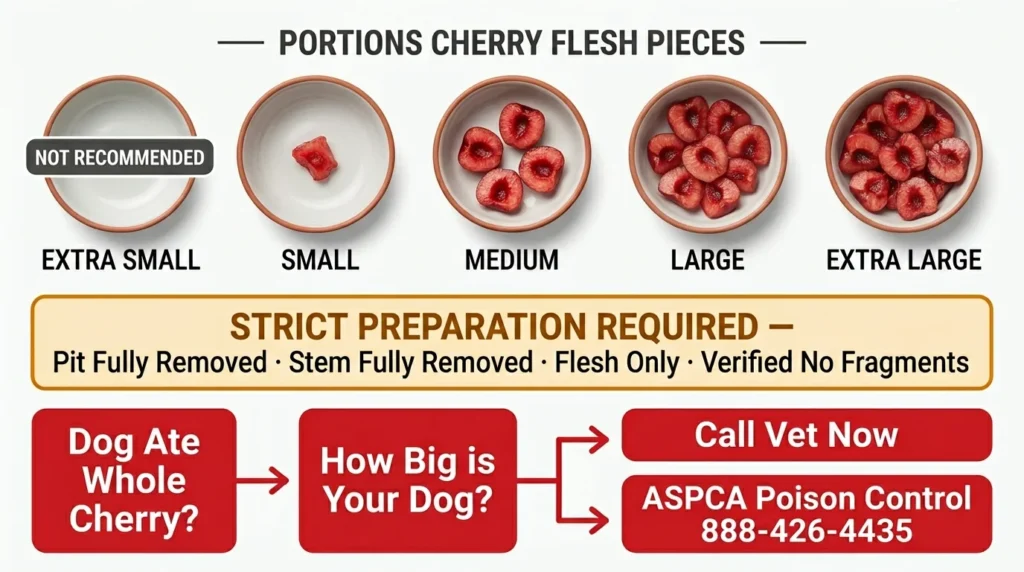
Given the risks associated with cherries, this question requires a very conservative answer. The table below applies only to pitted, destemmed, plain cherry flesh — not whole cherries in any form.
How Many Cherries Can Dogs Eat? — Portion Guide by Dog Size
| Dog Size | Weight Range | Pitted Cherry Flesh (Max) | Per Serving | Frequency | Important Note |
|---|---|---|---|---|---|
| Extra Small | Under 10 lbs | Not recommended | 0 | Never | Too high risk for small dogs |
| Small | 10–20 lbs | 1 pitted cherry flesh only | 1 per serving | Rarely | Pit fully removed and verified |
| Medium | 20–50 lbs | 1–2 pitted cherries flesh only | 1–2 per serving | Rarely | Inspect carefully for pit fragments |
| Large | 50–90 lbs | 2–3 pitted cherries flesh only | 2–3 per serving | Rarely | Stems fully removed, flesh only |
| Extra Large | 90 lbs + | 3–4 pitted cherries flesh only | 3–4 per serving | Rarely | Strict preparation required |
Critical notes on this table:
- This table applies ONLY to fresh cherry flesh with the pit completely removed and stem completely removed — verified clear of all stone fragments.
- “Rarely” means: occasional treat, a few times per month at most — not a regular weekly treat.
- Extra small dogs (under 10 lbs): the risk-benefit ratio makes cherry not recommended for very small dogs even when pitted — choose a safer fruit.
- Diabetic dogs: no cherry in any form — the sugar content affects blood glucose management.
- Never give whole cherries (with pits) to dogs of any size — this table does not apply to whole cherries.
- Any uncertainty about whether pit removal was complete = do not give that cherry to your dog.
- The overall best recommendation remains to choose a safer fruit than cherry for dogs.
Frequently Asked Questions
Can dogs eat cherries?
Cherries require careful understanding. The flesh of a pitted, destemmed fresh cherry is not acutely toxic to dogs. However, cherry pits and stems contain cyanogenic glycosides that release cyanide when metabolized — a serious toxicity risk. Most veterinarians recommend avoiding cherries entirely and choosing safer fruits.
Are cherries good for dogs?
Cherry flesh contains Vitamin C, anthocyanins, potassium, and fiber — real nutritional value. But these benefits can be obtained from completely safe fruits like blueberries and strawberries without any cyanide risk. The nutritional case for cherries does not outweigh the safety risks.
Why are cherries toxic to dogs?
Cherry pits, stems, and leaves contain cyanogenic glycosides (amygdalin and prunasin) that release hydrogen cyanide when metabolized. Cyanide prevents cells from using oxygen, causing rapid toxicity affecting the heart and brain. The flesh does not contain these compounds in significant amounts.
Can dogs eat cherries without pits?
Cherry flesh with the pit completely removed and stem removed is not acutely toxic. However, ensuring complete removal of all pit material is difficult, the flesh is high in sugar, and safer fruit alternatives exist. Use strict preparation if giving any cherry flesh.
Can dogs eat pitted cherries?
Same as above — yes, with strict preparation (pit completely removed and verified, stem removed, flesh only). Not recommended as a regular treat — choose safer fruits.
Can dogs eat maraschino cherries?
No. Maraschino cherries contain large amounts of added sugar, artificial red dye, artificial flavoring, and preservatives. Sugar-free versions may contain xylitol, which is acutely toxic to dogs. Never give maraschino cherries to dogs.
Can dogs eat Bing cherries?
Bing cherry flesh (pit and stem fully removed) is not acutely toxic. The pit of a Bing cherry is large and contains cyanogenic glycosides — never give whole Bing cherries. Strict pitting and inspection required before giving any flesh.
Can dogs eat Rainier cherries?
Rainier cherry flesh (pit and stem fully removed) is not acutely toxic, but Rainier cherries are very high in natural sugar. The pit contains the same cyanogenic risk as any other cherry variety. Choose safer fruits.
Can dogs eat dried cherries?
Not recommended. Commercial dried cherries contain added sugar, sometimes preservatives, and concentrated natural sugar from the drying process. They may also have incomplete pit removal leading to residual cyanide risk from pit fragments.
Can dogs eat cherry stems?
No. Cherry stems contain cyanogenic glycosides — the same class of compounds as in the pits. Always remove stems completely before giving any cherry flesh to your dog.
Can dogs eat cherry stones?
No. Cherry stones (pits) contain amygdalin that releases cyanide when metabolized. They also pose gastrointestinal obstruction risk. Never give cherry pits to dogs.
Can dogs eat cherry sauce or syrup?
No. Both are very high in added sugar, contain artificial coloring and flavoring, and may contain xylitol. Cherry sauce and syrup are not appropriate for dogs in any form.
Can dogs eat black cherries?
Wild black cherries (Prunus serotina) contain higher concentrations of cyanogenic compounds than sweet cherries — the entire plant including leaves is more toxic. Dark sweet cherry varieties (like Bing) have the same risk profile as other sweet cherries.
What if my dog swallowed a whole cherry?
Contact your veterinarian or ASPCA Animal Poison Control (888-426-4435) immediately. Do not wait for symptoms. Describe your dog’s size and how many cherries were consumed. Watch for signs of cyanide toxicity (bright red gums, difficulty breathing, weakness) and obstruction (vomiting, lethargy, abdominal pain).
Can dogs eat cherries with skin?
Cherry skin (the outer flesh layer) is not toxic. The concern is the pit and stem. When the pit is completely removed, the remaining flesh including skin is not toxic.
How many cherries can a dog eat?
See the portion table above. Not recommended for extra small dogs. For other sizes: 1 to 4 pitted cherries flesh only, rarely — only with strict preparation guaranteeing complete pit removal. Better to choose safer fruits.
Can puppies eat cherries?
Not recommended. Puppies are more vulnerable to toxic exposures and have less body mass to buffer any cyanide exposure. The difficulty of safely pitting cherries for a dog that eats quickly makes them particularly inappropriate for curious, fast-eating puppies.
Conclusion
Cherries occupy a unique and genuinely complicated position in dog food safety — not simply toxic like grapes, not simply safe like blueberries, but a fruit where the danger is specific, serious, and practically difficult to eliminate.
The complete summary of everything you need to know:
The core safety rules:
- Cherry pits contain cyanogenic glycosides that release cyanide — never give whole cherries to dogs
- Cherry stems and leaves also contain these toxic compounds — always remove completely
- Cherry flesh (pit and stem completely removed) is not acutely toxic but is high in sugar
- One whole cherry accidentally consumed by a large dog: contact vet immediately, do not wait
- Multiple whole cherries or any consumption by a small dog: emergency vet contact immediately
Forms to never give:
- Whole cherries with pits — cyanide and obstruction emergency
- Cherry stems — cyanide risk
- Cherry leaves — cyanide risk
- Maraschino cherries — sugar, artificial coloring, possible xylitol
- Cherry sauce or syrup — high sugar, artificial additives, possible xylitol
- Dried cherries — added sugar, possible pit fragments
- Wild black cherries — higher cyanide concentration throughout the plant
Also Read: Can Dogs Eat Raw Eggs or Fried Eggs? Full Safety Guide 2026


