
Can Dogs Eat Nutmeg?
Last updated: 14 October 2026
If your dog just ate nutmeg, do this now: 1. Take the nutmeg and any spiced food away. Check your dog's mouth and wipe away anything visible. 2. Call your vet or the Pet Poison Helpline at (855) 764-7661. You can also reach the ASPCA Animal Poison Control Center at (888) 426-4435. 3. Tell them four facts: what your dog ate, how much, when it happened, and your dog's weight. Mention any symptoms you already see. 4. Do not make your dog vomit, and do not try a home remedy, unless a vet tells you to. Do not wait for symptoms if the amount was large.
No, dogs must not eat nutmeg. Never feed it deliberately in any form: not ground, not whole, not as mace, and not as essential oil. A tiny trace in a bite of baked goods is unlikely to poison most dogs, but a teaspoon of ground nutmeg or a few whole nuts can be toxic. If your dog eats that much, or shows any symptoms at all, call your vet or the Pet Poison Helpline right away. This is one spice where the dose decides everything, and guessing wrong is not worth it.
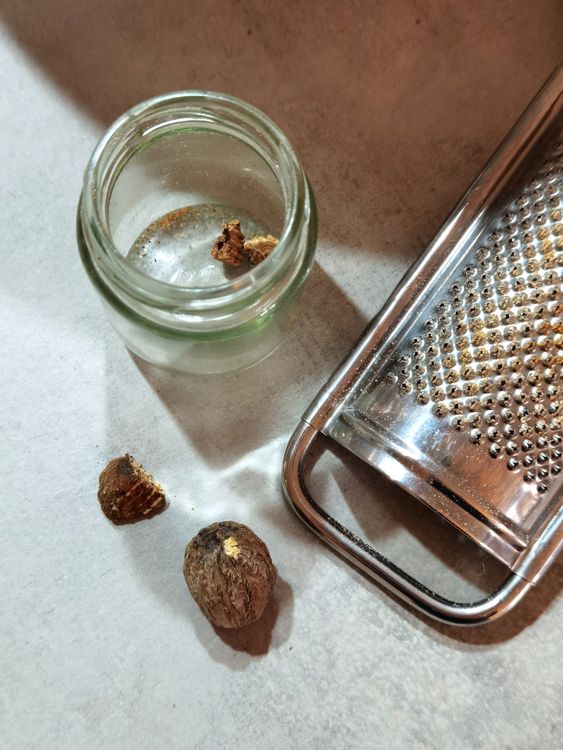 Photo by Vero Lova on Pexels. Whole nutmeg with a grater: this is the form that causes the most trouble.
How Much Nutmeg Is Toxic to Dogs?
PetMD and Chewy put the toxic threshold at as little as 1 teaspoon of ground nutmeg or two to three whole seeds, and smaller dogs can be affected by less. There is no safe dose to aim for, and no published source gives a reliable myristicin milligram figure per teaspoon, so treat any chart claiming one with suspicion.
That threshold comes from veterinary guidance, not from a neat milligram-per-pound formula. Chewy's vets put it plainly: a toxic dose can be as little as 1 teaspoon of ground nutmeg or three whole nutmegs. PetMD gives the same ground figure and says two to three whole seeds. Neither source pretends this is a precise line for every dog. Garden State Veterinary Specialists add that dogs under 20 pounds may be affected by smaller amounts than larger breeds, which is common sense: the same spoonful is a bigger dose in a smaller body.
What this means in practice:
- A pinch or a trace in food: very unlikely to cause more than mild stomach upset, per the Pet Poison Helpline.
- A teaspoon of ground nutmeg, or two to three whole seeds: enough to cause poisoning. Call your vet.
- A whole shaker, a jar, or a tray of spiced food: an emergency. Go now.
- Any amount in a puppy, a toy breed, or a dog with heart or liver disease: call your vet even if the amount looks small. These dogs have less margin.
One more honest gap: nobody has published a reliable myristicin content per teaspoon of nutmeg. You will see confident-looking dose charts on some sites. They are guessing. The veterinary sources agree on the teaspoon-level rule of thumb above, and that is the figure to use.
Nutmeg in Real Food: How Much Is Actually in a Slice of Pie?
A single slice of pie or one biscuit almost never holds a toxic dose on its own, because a whole pie or a whole batch of cookies usually contains only a fraction of a teaspoon per serving. The real danger is the spice jar, the shaker, or a dog eating a whole tray.
This is the question that actually brings most people here: my dog stole a bite of pumpkin pie, or a gingerbread biscuit, or a lap of eggnog. So here is the math, worked out from commonly published recipes. Recipes vary, so treat these as typical ranges, not exact figures for your kitchen.
| Food | Nutmeg in the whole recipe (typical) | Nutmeg per serving (typical) | What it means |
|---|---|---|---|
| Pumpkin pie, 9-inch, 8 slices | 1/4 to 1 teaspoon | About 1/32 to 1/8 teaspoon per slice | One stolen slice is far below the toxic threshold on nutmeg alone |
| Gingerbread cookies, batch of 2 to 4 dozen | 1/4 to 1 teaspoon | About 1/190 to 1/25 teaspoon per cookie | One biscuit is a trace amount of nutmeg |
| Eggnog, batch of about 6 servings | 1/2 to 1 teaspoon | About 1/12 to 1/6 teaspoon per glass | One lap or one small glass is below the threshold, but a dog that drinks a whole bowl is in a different situation |
| A whole pie, a whole tray of cookies, a whole bowl of eggnog | 1/4 to 1 teaspoon or more | The whole batch at once | Now the total matters, and so do the other ingredients |
Two warnings go with this table. First, the nutmeg is rarely the only problem in these foods. Pumpkin pie brings sugar, butter, and condensed milk, and rich fatty food can trigger pancreatitis. Eggnog brings raw egg, cream, sugar, and often alcohol, and alcohol is toxic to dogs on its own. Gingerbread can hide chocolate, raisins, or xylitol. So a dog that eats a whole pie needs a vet call even if the nutmeg alone would not be the issue.
Second, this table does not give you permission to share baked goods with your dog. It tells you how worried to be after the fact. The rule stays the same: do not feed your dog food that contains nutmeg.
Why Nutmeg Is Toxic: Myristicin
Nutmeg's trouble comes from myristicin, a compound in the seed of the Myristica fragrans tree. In dogs it overstimulates the nervous system and strains the heart, which is why the symptoms look neurological: disorientation, tremors, hallucinations, and a racing heart. The same seed also gives us mace, so mace is not a safe swap.
Nutmeg is the dried seed of a tropical evergreen. Mace is the lacy red covering (the aril) that wraps the same seed. The AKC points out that mace comes from a different part of the same seed, which is why it belongs on the same no list. Ground nutmeg is the seed grated or milled. Whole nutmeg is the seed itself, hard as a small stone, and a dog that crunches one gets the full dose at once.
Myristicin is the toxin. The AKC notes it is even used in insecticides, and in high doses it has psychotropic effects in people. In dogs it hits two systems at once: the nervous system and the cardiovascular system. That combination explains the strange symptom list, which reads more like a drug reaction than a stomach upset: hallucinations, disorientation, a racing heart, high blood pressure, and in severe cases seizures.
Nutmeg essential oil deserves its own warning. It is the concentrated form, and the Pet Poison Helpline says the risk of toxicity is highest when a pet gets into essential oils or the spices directly. Never diffuse nutmeg oil around dogs as a "natural" air freshener, and never add a drop to their food or water.
 Photo by Mark Mark on Pexels. A fresh nutmeg fruit in hand, showing the red mace wrapping the seed. Both parts are off limits for dogs.
Symptoms of Nutmeg Poisoning and When They Show Up
Symptoms usually start within 3 to 6 hours of eating nutmeg and can last up to 48 hours. Mild cases look like an upset stomach, while larger doses bring neurological signs such as disorientation, tremors, hallucinations, and seizures. Any neurological sign means the dog needs a vet now, not after a wait-and-see nap.
Garden State Veterinary Specialists put onset at roughly 3 to 6 hours after ingestion. The Pet Poison Helpline and PetMD both say symptoms can last up to 48 hours, and PetMD notes that hospitalization is often for about 48 hours, which is typically how long the toxic effects take to subside. So a dog that looks fine two hours after eating nutmeg is not necessarily in the clear. Keep watching for a full two days.
| Stage | What you may see | What to do |
|---|---|---|
| Mild, small amount | Vomiting, diarrhea, nausea, less appetite, drooling, restlessness | Call your vet for guidance. They may advise monitoring at home, but make the call. |
| Moderate | Disorientation, wobbliness, dry mouth, abdominal pain, muscle tremors or spasms, elevated body temperature | Call your vet or an emergency clinic right away. |
| Severe | Hallucinations (reacting to things that are not there), rapid or irregular heartbeat, high blood pressure, seizures, collapse, trouble breathing | Emergency. Go to a vet or emergency clinic immediately. |
A few symptoms deserve a closer look because they catch owners off guard. Hallucinations in a dog look like staring at empty corners, snapping at nothing, or sudden unprovoked fear. Disorientation looks like walking into furniture, getting stuck in corners, or not recognizing familiar people. Tremors can be mistaken for shivering or excitement. If you see any of these after a known or suspected nutmeg exposure, treat it as serious.
Also know that nutmeg poisoning is not common, per PetMD, because most exposures are traces in food. That is reassuring, but it cuts both ways: a dog that did eat a toxic amount is in unusual territory, and unusual territory is exactly when you call a professional.
What to Do If Your Dog Eats Nutmeg
Call your vet or the Pet Poison Helpline first, before you try anything at home. Tell them what your dog ate, how much, when it happened, and your dog's weight, then follow their instructions. Do not make your dog vomit unless a vet tells you to, and do not wait for symptoms if the amount was large.
Work through these steps in order:
- Remove access. Take away the nutmeg, the spice jar, or the spiced food. Check your dog's mouth and wipe away anything visible. Do not chase your dog around the house to do this; a calm approach keeps a stressed dog calmer.
- Gather the facts. How much nutmeg, in what form (ground, whole, mace, oil, baked into food)? When did it happen? How much does your dog weigh? Any symptoms yet? Bring the container, the packaging, or a photo of the recipe.
- Call your vet or the Pet Poison Helpline at (855) 764-7661. If your regular vet is closed, call an emergency clinic. The ASPCA Animal Poison Control Center at (888) 426-4435 is another option.
- Follow their instructions. They may tell you to monitor at home, or they may tell you to come in immediately. The decision depends on the amount, your dog's size, and the symptoms.
- Offer small sips of water if your dog is not actively vomiting, per Garden State Veterinary Specialists. Do not force water, and do not offer food unless the vet says to.
- Keep your dog calm and safe. A quiet, dimly lit room, away from other pets and loud noise, helps. If your dog seems disoriented or hallucinating, keep them away from stairs, pools, and anything they could fall from.
What NOT to do:
- Do not induce vomiting at home unless a vet specifically tells you to. PetMD warns that inducing vomiting often causes more problems than the toxicity itself. The AKC is just as blunt: unless your vet or Poison Control says so, this is no time for home remedies.
- Do not wait for symptoms if the amount was large. By the time neurological symptoms appear, the toxin is already well absorbed.
- Do not give milk, activated charcoal from your own cabinet, or any "detox" product. These are vet tools, given at vet doses, on vet timing.
- Do not assume a small dog will react like a big dog. Small dogs have less margin, and puppies have even less.
How Vets Treat Nutmeg Poisoning
Treatment is supportive, meaning the vet treats the symptoms while the toxin clears. If the nutmeg was eaten very recently, the vet may induce vomiting or give activated charcoal, usually only within about two hours. After that, care means IV fluids, blood pressure and heart monitoring, and often up to 48 hours in hospital.
There is no specific test for nutmeg toxicity. PetMD explains that your vet will work by elimination: a full physical exam, plus blood work and urine testing to rule out other conditions. If those come back normal and the history fits, nutmeg is the working diagnosis.
What treatment looks like, step by step:
- Decontamination, if the timing is right. If the nutmeg was eaten within roughly two hours, the vet may induce vomiting or perform a gastric lavage, which flushes the stomach with saline to remove as much toxin as possible before it is absorbed. Activated charcoal may be given to bind the toxin in the gut. These steps are vet-only decisions.
- IV fluids to support circulation and help the body clear the toxin.
- Blood pressure and heart rate monitoring, because high doses strain the cardiovascular system.
- Monitoring for mentation changes and seizures, especially if the dog is already showing neurological signs.
- Hospitalization, often about 48 hours, which matches how long the toxic effects typically take to subside.
- Treatment of whatever develops, such as anti-nausea medication or seizure control, as the case requires.
The prognosis depends on the amount, the dog's size and health, and how fast treatment started. Most dogs that get prompt care recover within about two days. High doses can be fatal, which is why speed matters more than any home remedy.
Nutmeg vs Mace vs Allspice vs Cinnamon: The Spice-Rack Confusion
Nutmeg and mace come from the same seed, so both are off limits. Allspice is a different spice but also unsafe for dogs. Cinnamon is the odd one out: small amounts are fine, and Ceylon cinnamon is the safer choice because it carries far less coumarin than common cassia cinnamon.
This is the table most spice articles skip, and it is the one that clears up the confusion that dominates the search results.
| Spice | Safe for dogs? | Why |
|---|---|---|
| Nutmeg (ground or whole) | No | Contains myristicin. Toxic at about 1 teaspoon ground or 2 to 3 whole seeds. |
| Mace | No | Comes from the same seed as nutmeg. Treat it exactly the same way. |
| Allspice | No | Contains eugenol. Chewy's vets list it as toxic to dogs and advise avoiding it. |
| Cloves | No | Also contain eugenol. Keep them out of your dog's food. |
| Cinnamon, small amount | Yes, in small amounts | Not toxic at recipe-level amounts. Ceylon ("true") cinnamon is the safer choice. |
| Cinnamon, large amount or essential oil | No | Over about 1 teaspoon of powder for most pets can cause vomiting, diarrhea, low blood sugar, liver trouble, and heart rate changes. Essential oil is dangerous even in small amounts. Inhaled powder irritates the lungs. |
| Ginger, small amount | Yes, in small amounts | The AKC notes a little ginger is safe and can soothe nausea. |
On cinnamon, a bit more detail is worth having, because it is the spice owners mix up with nutmeg most often. Pet Poison Helpline toxicologists point out that cassia cinnamon, the common supermarket kind, carries coumarin, a compound linked to vomiting, diarrhea, low blood sugar, liver damage, and abnormal heart rate. Ceylon cinnamon, also called true cinnamon, contains very little coumarin, making it the lower-risk choice. Either way, the amount matters: a pinch stirred into food is one thing, a spoonful eaten straight is another, and cinnamon essential oil is never for dogs. Inhaling cinnamon powder can cause coughing, choking, and difficulty breathing.
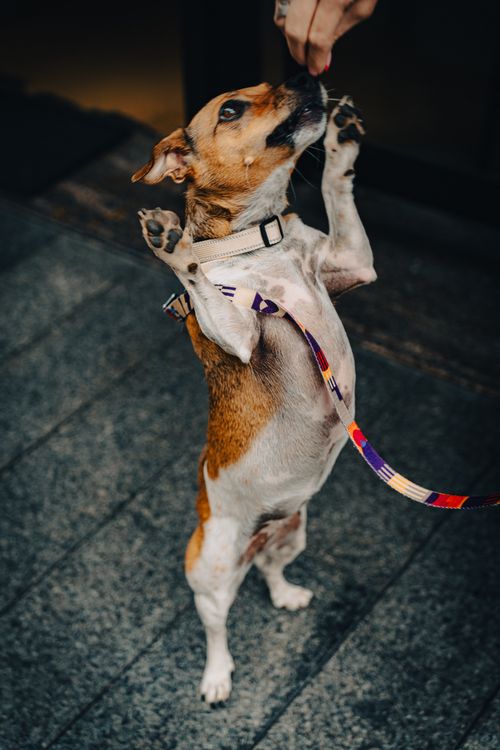 Photo by Olivia on Pexels. A dog begging for a treat. The kindest answer to those eyes is a dog-safe treat, not a bite of your spiced baking.
The One Bad Piece of Advice to Ignore
Some pages still tell owners to treat nutmeg exposure at home by withholding food and feeding bland meals. Do not follow that advice. The AKC says plainly that unless your vet or Poison Control says so, this is no time for home remedies. PetMD says never to induce vomiting at home unless a vet guides you to do so. Home treatment delays the real treatment, and with a toxin that can take hours to show its worst symptoms, delay is the enemy. If a page tells you to handle nutmeg poisoning with pantry fixes, close that page and call your vet.
Keeping Nutmeg Out of Reach
Prevention is unglamorous and it works. Most nutmeg emergencies are not deliberate feedings. They are a shaker knocked off a counter, a cooling pie left at nose height, or a guest slipping a dog a "harmless" bite.
- Store spices in an upper cabinet with a child-proof latch. Dogs are curious, and a spice jar on a low shelf is an invitation.
- Keep dogs out of the kitchen while you bake, or at least behind a baby gate. Chewy's vets specifically suggest this for food-motivated dogs.
- Push baked goods to the back of the counter, and never leave a cooling pie, a tray of cookies, or a bowl of eggnog at counter-surfing height.
- Tell guests the rule. "Do not feed the dog table scraps" covers a lot, but name the spiced desserts specifically. Guests mean well and share anyway.
- Watch the trash and compost. Discarded pie crusts, spice packets, and baking scraps are still a risk.
- Check labels on "pumpkin spice" products. Pumpkin spice blends almost always contain nutmeg. That includes lattes, yogurts, cereals, and dog treats that borrow the flavor name. If a product is called pumpkin spice, assume it has nutmeg until the label proves otherwise.
Safe Swaps: Holiday Flavor Without the Risk
Your dog does not need to miss out on the season. They just need their own version of it.
- A pinch of Ceylon cinnamon stirred into plain food, as an occasional treat, is the closest safe swap for warm spice flavor.
- A little fresh ginger, grated fine, is safe in small amounts and can settle a queasy stomach, per the AKC.
- Plain pumpkin puree, frozen in cubes, makes a great seasonal snack. PetMD suggests exactly this. Use plain puree, never canned pumpkin pie filling, which is pre-spiced and sweetened.
- Dog bakery treats made for dogs, from a pet store or dog bakery, are the safest way to share the holiday mood. They are made without the spices that cause trouble.
- Plain cooked meat or vegetables as a treat will always beat a slice of pie. A bit of plain chicken or a carrot stick is a better celebration than anything from the dessert table.
Frequently Asked Questions
What happens if a dog eats a little bit of nutmeg?
A tiny trace, such as a lick of spiced food or a bite of pie, is very unlikely to cause more than mild stomach upset, per the Pet Poison Helpline. Watch your dog for vomiting or diarrhea, and call your vet if you are unsure or if your dog is small, a puppy, or has a health condition. A teaspoon of ground nutmeg or two to three whole seeds is a different story: that is a toxic dose, and it needs a vet call right away.
Is cinnamon and nutmeg safe for dogs?
No, not as a pair. Cinnamon in small amounts is fine, but nutmeg is toxic, and the two almost always appear together in baking. A "cinnamon and nutmeg" treat, mix, or baked good should be treated as a nutmeg exposure. If your dog eats one, use the nutmeg guidance above, not the cinnamon guidance.
Can dogs eat pumpkin pie?
No. Pumpkin pie is not a dog food. The nutmeg in a single slice is usually below the toxic threshold, but the pie also brings sugar, butter, condensed milk, and sometimes other problem ingredients, and rich fatty food can trigger pancreatitis. Plain pumpkin puree is the safe way to share the pumpkin part. If your dog eats a whole pie, or a large portion of one, call your vet.
Can dogs eat gingerbread?
No. A single gingerbread biscuit holds only a trace of nutmeg, but gingerbread also carries sugar, butter, and sometimes chocolate, raisins, or xylitol, any of which can be dangerous on its own. Do not feed gingerbread to dogs, and call your vet if your dog eats a whole tray.
Can dogs eat mace or allspice?
No to both. Mace comes from the same seed as nutmeg, so it carries the same risk. Allspice contains eugenol, and Chewy's vets list it as toxic to dogs. Keep both out of your dog's food, and treat an allspice exposure the same way you would treat a nutmeg exposure: call your vet.
Does cooking reduce nutmeg toxicity?
No. Baking does not turn nutmeg into a safe ingredient. The nutmeg is still in the finished food, and PetMD advises against feeding dogs anything containing nutmeg, cooked or not. A baked good is only "safer" in the sense that the nutmeg is spread thin across many servings, which is why one slice is less risky than a spoonful from the jar.
Can a small amount of nutmeg kill a dog?
A trace amount in food is very unlikely to kill a dog. A large dose can be fatal, and PetMD states plainly that at high doses nutmeg can be fatal for dogs. The risk climbs with the amount eaten and falls with the dog's size, so a small dog that eats a large amount is in the most danger. Any large exposure is an emergency, whether or not symptoms have started.
Sources
Sources actually opened for this article:
- AKC: Can Dogs Eat Nutmeg?
- PetMD: Can Dogs Have Nutmeg?
- Pet Poison Helpline: Nutmeg and Cinnamon Toxicity
- Chewy: Can Dogs Have Nutmeg?
- Garden State Veterinary Specialists: Can Dogs Have Nutmeg?
Food-amount ranges in the "Nutmeg in Real Food" table were worked out from nutmeg quantities in commonly published pumpkin pie, gingerbread, and eggnog recipes. Recipes vary, so the ranges are typical, not exact for any single recipe.
This article is for information only and is not a substitute for veterinary advice. If your dog has eaten nutmeg, call your veterinarian or the Pet Poison Helpline at (855) 764-7661.


