

Can Dogs Eat Raspberries? Antioxidants, Portions & Safety Tips 2026
You are snacking on a bowl of fresh raspberries — those bright red, jewel-like berries — and your dog appears, curious and hopeful as always. Raspberries smell wonderful, they look appealing, and your dog would clearly like to try one. But can dogs eat raspberries? Are they safe? What about frozen raspberries, raspberry syrup, or wild raspberries found in the garden?
Raspberries are genuinely one of the more interesting fruits to cover for dog owners because they sit in a slightly nuanced position — mostly safe, nutritionally excellent, but with one specific and important concern that every dog owner should understand before making them a regular treat.
This complete guide answers every question about raspberries and dogs — every variety, every form, every related product, and the important safety detail that makes raspberries different from most other berries.
Can Dogs Eat Raspberries?
Yes — dogs can eat raspberries in moderation, and they are safe for most healthy dogs. The American Kennel Club (AKC) confirms that raspberries are a dog-safe fruit. They are low in sugar compared to many other fruits, high in fiber, and packed with vitamins, minerals, and powerful antioxidants.
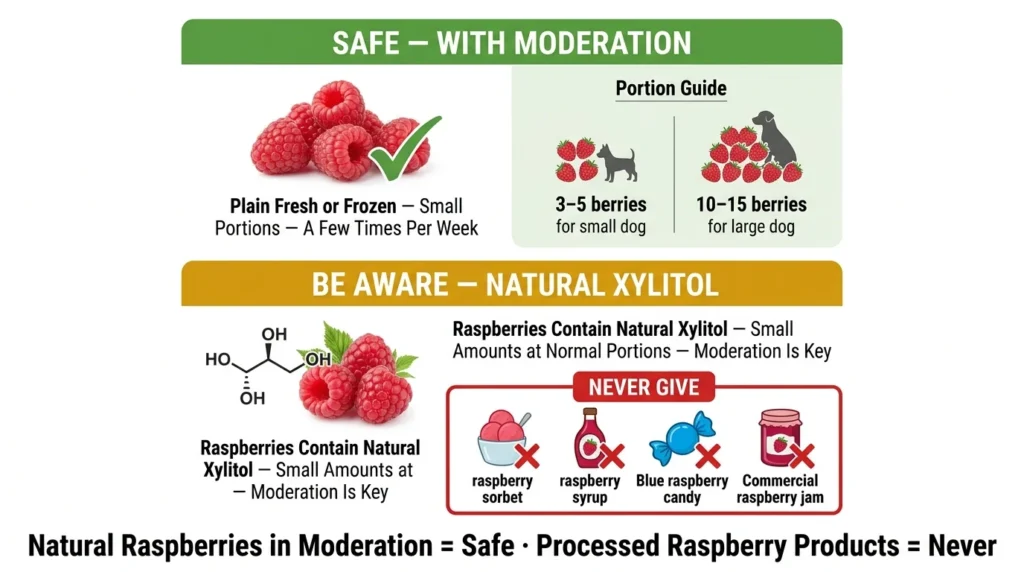
The one important caveat: raspberries contain naturally occurring xylitol — a compound that is toxic to dogs in large amounts. The amount in a few raspberries is far too small to cause toxicity, but this is why moderation matters more with raspberries than with most other berries. Keep portions appropriate for your dog’s size and do not make raspberries a daily large-volume treat.
Done correctly — a small handful a few times per week — raspberries are a genuinely excellent treat for most healthy dogs.
Can Dogs Have Raspberries?
Yes — dogs can have raspberries, and they are recognized as a dog-safe fruit by veterinary sources. Raspberries are not on any veterinary toxic food list, and their nutritional profile genuinely benefits dogs.
What makes raspberries particularly interesting as a dog treat is that they are actually lower in sugar than most other common fruits. A cup of raspberries contains only about 5 grams of natural sugar — significantly less than strawberries, blueberries, or most other berries. This lower sugar content, combined with their high fiber, makes them a useful option for dogs that need low-sugar fruit treats.
The naturally occurring xylitol in raspberries is the one consideration that requires awareness. A few raspberries contain a trivial amount of natural xylitol. However, very large daily amounts — such as a cup or more regularly — could theoretically contribute to meaningful xylitol exposure in small dogs over time. This is why the guidance is moderation rather than avoidance, but moderation genuinely matters with this fruit.
Are Raspberries Good for Dogs?
Yes — raspberries are genuinely good for dogs. They are frequently cited by veterinary nutritionists as one of the better fruit choices for dogs precisely because of their low sugar, high fiber, and exceptional antioxidant content.
The combination of very low natural sugar, high dietary fiber, Vitamin C, manganese, and one of the highest antioxidant concentrations of any common fruit makes raspberries nutritionally stand out. The deep red color of raspberries comes from anthocyanins and ellagic acid — both powerful antioxidants with anti-inflammatory, anticancer, and cellular protective properties.
For senior dogs in particular, raspberries offer targeted benefits — the anti-inflammatory compounds may help with joint pain and arthritis, the antioxidants protect aging cells from oxidative damage, and the low sugar makes them more appropriate for older dogs managing weight or blood sugar.
For dogs of all ages, raspberries are a nutrient-dense, low-calorie treat that delivers real health value in every small serving.
Are Raspberries Bad for Dogs?
Plain raspberries in appropriate amounts are not bad for dogs. However, raspberries become problematic in specific situations.
Naturally occurring xylitol: This is the most important distinguishing feature of raspberries compared to other berries. Raspberries contain trace amounts of naturally occurring xylitol — a sugar alcohol found in various plant foods. Unlike the artificial xylitol added to products like some peanut butter brands (which is acutely dangerous even in tiny amounts), the natural xylitol in raspberries is present in very small quantities. A few raspberries pose no realistic toxicity risk. But very large daily amounts — particularly for small dogs — should be avoided to prevent any meaningful cumulative xylitol exposure.
Digestive upset from overconsumption: The high fiber content of raspberries, while beneficial in moderate amounts, causes gas, bloating, and loose stools when too many are consumed at once. Start slowly and keep portions appropriate.
Raspberry-flavored products: Raspberry syrup, raspberry sorbet, raspberry candy, and commercial raspberry products contain large amounts of added sugar and artificial flavoring. These are not appropriate for dogs regardless of the raspberry base.
Health Benefits of Raspberries for Dogs
Raspberries provide an exceptional nutritional profile relative to their low calorie and low sugar content. Here are the specific benefits.
Anthocyanins — Powerful Anti-Inflammatory Antioxidants Raspberries are one of the richest food sources of anthocyanins — the dark red pigments that give raspberries their color and provide their most powerful health benefits. Anthocyanins are among the most potent natural anti-inflammatory compounds identified in food science. They reduce cellular inflammation, protect against oxidative stress, and have documented potential for reducing cancer risk. For dogs with arthritis, joint inflammation, or inflammatory conditions, regular moderate raspberry consumption provides meaningful dietary anti-inflammatory support.
Ellagic Acid — Unique Anticancer Compound Raspberries are the richest dietary source of ellagic acid — a polyphenol antioxidant with particularly impressive research behind it. Ellagic acid has demonstrated anti-tumor properties, liver-protective effects, anti-inflammatory activity, and potential to inhibit the growth of certain cancer cell lines in research studies. For dogs — which have high cancer rates compared to many other species — including ellagic acid-rich foods like raspberries in the diet provides meaningful cellular protection.
Vitamin C — Immune Support and Antioxidant Raspberries are a good source of Vitamin C — a major antioxidant that supports immune function, helps fight infection and inflammation, and contributes to collagen synthesis for healthy joints and skin. For dogs recovering from illness, senior dogs with declining immune function, or any dog under physical or environmental stress, the Vitamin C in raspberries provides useful immune support.
Manganese — Bone and Metabolic Health Raspberries are one of the better plant sources of manganese — a trace mineral that supports bone formation, fat and carbohydrate metabolism, and collagen production for joint and connective tissue health. For older dogs with joint concerns or for puppies during bone development, manganese from dietary sources like raspberries provides targeted support.
Dietary Fiber — Digestive Health and Blood Sugar Regulation Raspberries are exceptionally high in dietary fiber for a fruit — about 8 grams of fiber per cup, which is very high for any food. This fiber supports healthy digestion, feeds beneficial gut bacteria, and — importantly — slows the absorption of natural sugars. This means the low-sugar content of raspberries is further moderated by the fiber, creating a very low glycemic impact fruit that is excellent for dogs managing blood sugar.
Vitamin K — Blood and Bone Health Raspberries provide meaningful amounts of Vitamin K, essential for proper blood clotting and bone metabolism. Adequate Vitamin K supports healthy bone density and proper wound healing throughout a dog’s life.
Low Calorie — Weight Management Friendly At approximately 64 calories per cup — and with high fiber and water content — raspberries are extremely filling relative to their caloric cost. For overweight dogs, a small handful of raspberries provides satisfying sweetness and fullness with minimal caloric impact.
The Dangers of Feeding Your Dog Raspberries
While raspberries are generally safe, understanding the specific dangers allows you to feed them responsibly.
Natural Xylitol — The Key Safety Concern As mentioned in the quick answer, raspberries contain naturally occurring xylitol. This is categorically different from the artificial xylitol added to manufactured products — natural food xylitol is present in trace amounts and is not an acute danger at normal portion sizes. However, it creates a meaningful reason to practice portion control that does not apply to berries like blueberries or strawberries.
The amounts: one raspberry contains an estimated 0.002g of xylitol — a tiny amount. The recognized toxic dose of xylitol in dogs starts at approximately 0.1g per kilogram of body weight. For a 10-pound (4.5kg) dog, that toxic threshold is approximately 0.45g — equivalent to over 200 raspberries. For a 50-pound dog, the threshold would require over 1,000 raspberries. At normal treat-sized portions (a handful per serving, a few times per week), the xylitol content of raspberries is not a realistic toxicity concern.
However, feeding very large amounts regularly — particularly to small dogs — is where the cumulative concern becomes relevant. This is why portions should be kept within the guidelines in the table below, and why daily large-quantity raspberry feeding is not recommended.
Digestive Upset from High Fiber Raspberries have very high fiber content (8g per cup). While this is a benefit in moderate amounts, it can cause significant digestive upset in dogs that eat too many — gas, bloating, loose stools, and diarrhea. Introduce slowly and increase gradually.
Choking Risk for Small Dogs Raspberries are soft and not typically a significant choking hazard, but for very small toy breeds, consider halving each berry before serving to prevent any risk of the round berry lodging in a small throat.
Seeds — Minimal Concern Raspberry seeds are very small and generally not a concern for most dogs. They are fully digestible and contain no toxic compounds.
Can Dogs Eat Raspberries and Blackberries?
Yes — both raspberries and blackberries are safe for dogs and make an excellent combined berry treat. Blackberries share many of the same nutritional properties as raspberries — high in anthocyanins, rich in fiber, low in sugar, and good sources of Vitamin C and Vitamin K.
One note about blackberries: they also contain small amounts of naturally occurring xylitol, similar to raspberries. This compounds the reason for moderation when combining these two berries — if giving both together, keep the total combined amount within the raspberry portion guidelines rather than treating them as independently allowable amounts.
Combined blackberry and raspberry treats provide an exceptionally rich antioxidant profile — the complementary anthocyanins, ellagic acid, and other polyphenols from both berries together create broader antioxidant coverage than either alone. Mix a small amount of each, rinse well, and serve as a colorful mixed berry treat.
See Also: Can Dogs Eat Mushrooms? Safe Types, Wild Dangers & Full Guide
Can Dogs Eat Black Raspberries?
Yes — black raspberries (Rubus occidentalis) are safe for dogs. Black raspberries are a distinct species from red raspberries — smaller, with a deeper, more intense flavor and exceptionally high anthocyanin content. The dark black-purple color indicates very high concentrations of anthocyanins, potentially even higher than regular red raspberries.
Black raspberries have been specifically studied for their cancer-preventive properties in research, with some of the most impressive ellagic acid concentrations of any food source.
The same preparation guidelines apply — rinse thoroughly, give in appropriate amounts. Black raspberries are harder to find commercially than red raspberries (they are often seasonal and regional), but if available, they are an excellent and nutritionally superior choice. The naturally occurring xylitol concern applies equally to black raspberries — same portion guidelines.
Can Dogs Eat Red Raspberries?
Yes — red raspberries are the standard commercial raspberry variety and are completely safe for dogs when served in appropriate amounts. Red raspberries are what most people mean when they say “raspberries” — the bright red, soft, fragrant berries found year-round in grocery stores.
Red raspberries are the most studied variety for health benefits and the most extensively documented for the properties described throughout this guide. They are the reference point for nutritional data, antioxidant content, and the xylitol concentration figures mentioned in the safety section.
Fresh or frozen plain red raspberries are the ideal form for dogs — no added sugar, no syrup, no artificial flavoring. Just plain raspberries in appropriate amounts.
Can Dogs Eat Frozen Raspberries?
Yes — plain frozen raspberries are completely safe for dogs and are actually one of the most popular berry treat formats for dogs during summer. Frozen raspberries hold their nutritional value excellently — the freezing process preserves vitamins, antioxidants, and fiber very well, making frozen raspberries nutritionally equivalent to fresh.
The cold, firm texture of frozen raspberries is enjoyable for most dogs, especially on warm days. They last longer as a treat than fresh raspberries, providing more engagement and slower eating.
The critical requirement: frozen raspberries must be plain with absolutely no added sugar, no syrup, and no artificial sweeteners. Commercial frozen raspberry products sold for human consumption occasionally contain added sweeteners — always read the ingredient label before buying. The label should list one ingredient only: raspberries.
Freeze your own at home for the safest option: rinse fresh raspberries, spread on a parchment-lined tray, freeze until solid, then transfer to a sealed bag. Store for up to three months.
Can Dogs Eat Raspberries Safely?
Yes — raspberries can be given to dogs safely with simple preparation and appropriate portions.
Complete safety checklist:
- Use only fresh or plain frozen raspberries — no added sugar, syrup, or flavoring
- Rinse fresh raspberries thoroughly under cold water before serving
- Serve plain — no yogurt with sweetener, no cream, no sugar, no additions
- Give in appropriate amounts for your dog’s size (see portion table below)
- For very small dogs: consider halving each berry
- Introduce slowly the first time — 3 to 5 berries, wait 24 hours
- Never give raspberry sorbet, syrup, or candy
- Do not give large amounts daily — natural xylitol requires moderation
- Dogs with diabetes: consult vet first (still low sugar but xylitol caution applies)
- Watch for any signs of digestive upset the first few times
Can Dogs Eat Blue Raspberries?
“Blue raspberries” as a flavor does not exist in nature — it is an artificial flavor used in candy, slushies, and processed food products. No actual raspberry plant produces blue fruit.
If someone is asking about “blue raspberry” products — candy, Slurpees, ice pops, energy drinks — the answer is no, dogs should not eat these. Blue raspberry-flavored products contain artificial blue food coloring (typically Blue 1), high amounts of added sugar or artificial sweeteners, artificial flavoring compounds, and often citric acid and preservatives. None of these are appropriate for dogs, and some may contain artificial sweeteners including xylitol which is acutely toxic.
If you mean actual dark-colored raspberries (which might appear very dark purple-black), those are simply ripe raspberries or black raspberries — both are safe for dogs as described above.
Can Dogs Eat Fresh Raspberries?
Yes — fresh raspberries are the best form for dogs. Fresh raspberries retain maximum vitamin, antioxidant, and nutritional content. They also have the highest water content compared to frozen or dried, providing additional hydration with each serving.
Fresh raspberries available during peak season (typically June through October depending on region) are particularly nutritious and flavorful. When selecting fresh raspberries for your dog, choose firm, brightly colored berries with no mold, no mushiness, and no unusual smell.
Rinse under cold water immediately before serving. Fresh raspberries are perishable — refrigerate and use within a few days of purchase. If you wash them before refrigerating, pat completely dry first to prevent premature spoilage.
Can Dogs Eat Wild Raspberries?
Wild raspberries (Rubus idaeus ssp. strigosus in North America; various Rubus species elsewhere) are the same genus as commercial raspberries and are generally safe for dogs. Wild raspberries that are fully ripe carry the same nutritional benefits and the same natural xylitol considerations as cultivated varieties.
However, as with any wild-foraged food, there are environmental considerations. Wild raspberries growing near roadsides, agricultural fields, or areas that may have been treated with pesticides or herbicides should be avoided. Wild raspberries in genuinely clean, natural environments away from chemical treatment are safe.
There is also a visual identification consideration: true wild raspberries (Rubus species) are safe, but in some regions, other plants with similar-looking berries may not be. If you are not 100% certain that berries found in the wild are true raspberries, do not let your dog eat them and contact your vet if ingestion occurs.
See Also: Can Dogs Eat Peaches? Benefits, Pit Danger & Feeding Guide 2026
Can Dogs Eat Freeze-Dried Raspberries?
Yes — plain freeze-dried raspberries (with one ingredient: raspberries) are safe for dogs in very small amounts, but the concentrated nature of freeze-dried fruit requires extra caution with portions.
Freeze-drying removes virtually all water from the raspberry while preserving most nutrients and flavor. The result is highly concentrated — both in beneficial compounds and in the naturally occurring xylitol. A single freeze-dried raspberry contains the concentrated equivalent of a fresh raspberry in a much smaller piece.
The practical implication: if your normal serving is 10 fresh raspberries, the equivalent in freeze-dried form would be approximately 10 small pieces, but because freeze-dried pieces are very light and easy to eat quickly, it is easy to accidentally give too many. Portion very carefully.
Freeze-dried raspberries are excellent as training treats — very lightweight, intense raspberry flavor that dogs love, easy to handle, and portion-controllable to individual pieces.
Can Dogs Eat Raspberry Seeds?
Yes — raspberry seeds are safe for dogs. Raspberry seeds are tiny, soft, and fully digestible. They contain no toxic compounds and are simply part of the berry’s natural structure.
Unlike apple seeds or cherry pits — which contain cyanogenic compounds — or cherry stones with physical obstruction risk, raspberry seeds present no meaningful concern. They pass through the digestive system without causing any harm or irritation.
You do not need to remove seeds from raspberries before giving them to your dog. Simply rinse, and serve the whole berry as is. The seeds are part of the raspberry’s nutritional package, containing small amounts of fiber and phytochemicals that complement the rest of the berry’s benefits.
Can Dogs Eat Raspberry Sorbet?
No — raspberry sorbet is not appropriate for dogs. Sorbet is made with fruit puree or juice, refined sugar, water, and sometimes citric acid or other additives. Commercial raspberry sorbet contains large amounts of added refined sugar — typically 20 to 25 grams per serving.
This high sugar content causes rapid blood sugar spikes, contributes to weight gain and dental decay, and is completely inappropriate for diabetic dogs. Some sugar-free sorbet products contain artificial sweeteners including xylitol — which is, ironically, even more dangerous than the natural xylitol in raspberries because artificial xylitol is more concentrated and more immediately toxic.
If you want to give your dog a cold, sweet raspberry treat, make your own: blend fresh raspberries with water and freeze in silicone molds. That is the safe version — no added sugar, no artificial anything, just raspberry.
Can Dogs Eat Raspberry Syrup?
No — raspberry syrup is not appropriate for dogs. Raspberry syrup is essentially concentrated sugar with raspberry flavoring — whether it is commercial raspberry syrup, cocktail raspberry syrup, or homemade raspberry reduction. The sugar content of raspberry syrup is extreme relative to the volume.
A tablespoon of commercial raspberry syrup can contain 12 to 15 grams of added sugar. This is more sugar than in an entire cup of fresh raspberries. Sugar-free raspberry syrups replace refined sugar with artificial sweeteners — many of which, including xylitol, are toxic to dogs.
The flavoring compounds in artificial raspberry syrups bear little resemblance to the actual nutritional compounds in real raspberries. If your dog wants raspberries, give them actual raspberries — not a product made to taste like them.
Can Dogs Eat Raspberry Sticks?
“Raspberry sticks” typically refers to candy sticks, wafer sticks, or licorice-type confections with raspberry flavoring — none of which are appropriate for dogs. These are processed sugar products with artificial raspberry flavoring, refined sugar or corn syrup, artificial red coloring, and sometimes gelatin or other additives.
They contain no real raspberry nutrition and deliver only sugar, artificial flavoring, and food coloring. Some product formulations may contain xylitol as a sweetener. None of this is appropriate for dogs.
If you want to give your dog a “stick” of raspberry something — freeze a whole raspberry or two onto a thin skewer or popsicle stick for a fun summer treat presentation. That is a safe alternative that looks playful without the harmful ingredients.
Can Dogs Eat Raspberries Everyday?
Not recommended as a daily large-amount habit, specifically because of the naturally occurring xylitol content. While a few raspberries daily would not be expected to cause acute xylitol toxicity in any reasonable dog size based on the concentration calculations, daily feeding at meaningful amounts is not the ideal approach.
The better practice is to include raspberries as a regular part of the fruit treat rotation — several times per week — rather than every day in large amounts. This provides the nutritional benefits while naturally moderating any cumulative xylitol exposure.
For very small dogs (under 10 pounds), extra caution around daily feeding is warranted — keep to 2 to 5 raspberries per session and several times per week at most. For medium and large dogs, daily small amounts are unlikely to pose concern, but rotating with other fruits maintains better nutritional variety.
Can Dogs Eat Raspberries Framboises?
“Framboises” is simply the French word for raspberries — so this question is asking whether dogs can eat raspberries, which are already answered throughout this guide. Yes — plain fresh or frozen framboises (raspberries) are safe for dogs in moderate amounts following the same guidelines described here.
This keyword appears in searches primarily from French-speaking regions or from people who encountered the word in a recipe context. The safety and nutritional information is identical regardless of what language the fruit is named in.
Which Raspberries Should Dogs Not Eat?
While most raspberry forms are safe, specific forms and products should never be given to dogs.
Never give these:
- Raspberry sorbet — high added sugar, possible xylitol in sugar-free versions
- Raspberry syrup — concentrated sugar and artificial flavoring
- Raspberry candy or gummies — refined sugar, artificial coloring, possible xylitol
- Raspberry jam or jelly — very high sugar, possible xylitol in sugar-free
- Raspberry-flavored yogurt (commercially made) — added sugar, artificial flavoring, possible xylitol
- “Blue raspberry” flavored products — artificial coloring and flavoring, no real raspberry
- Dried raspberries with added sugar — concentrated sugar and preservatives
- Raspberry sauce or coulis made with sugar — high refined sugar
Raspberries to use with caution:
- Freeze-dried raspberries — safe but concentrated, use very small amounts
- Wild raspberries from unknown environments — pesticide or misidentification risk
- Any raspberry product with unlisted or complex ingredients — check for xylitol
Are Wild Raspberries Safe?
Wild raspberries that are true Rubus species in genuinely clean environments are safe for dogs — they are the same plant as cultivated raspberries with the same nutritional and safety profile. However, caution is warranted for several reasons.
First, plants growing near roadsides, farmland, or treated areas may carry pesticide or herbicide residue. Second, visual identification matters — in some regions, plants that superficially resemble raspberry canes produce different berries that may not be safe. Third, wild animals that may have touched the berries or the plant could have introduced pathogens.
For wild raspberries you are confident are true raspberries from a clean source, giving a few to your dog is generally fine. For any uncertainty, err on the side of grocery-store raspberries where the source is known and washing is straightforward.
See Also: Can Dogs Eat Cherries? Pits, Toxicity & Complete Safety Guide
How Can I Feed My Dog Raspberries?
There are several safe and enjoyable ways to incorporate raspberries into your dog’s routine.
Plain fresh raspberries: Rinse, serve whole (or halved for tiny dogs). The simplest and most nutritious approach.
Frozen raspberries: Freeze fresh plain raspberries flat on a tray. Serve 2 to 5 frozen berries as a summer cooling treat.
Raspberry and plain yogurt: Mix a tablespoon of plain, unsweetened yogurt with 5 to 10 fresh raspberries. Serve fresh or freeze in silicone molds. The probiotic yogurt complements the antioxidant berries.
Mixed berry bowl: Combine raspberries with blueberries and strawberries for a mixed antioxidant-rich berry treat. Keep total amounts within combined portion guidelines.
Raspberry lick mat: Mash or blend fresh raspberries and spread on a lick mat. Freeze for 20 to 30 minutes. A calming, slow-feeding enrichment activity.
Training treats: Single raspberries are excellent training treats — small, soft, highly aromatic, and most dogs find them very motivating. Low-calorie enough to use many during a session.
Raspberry food topper: Scatter 3 to 5 raspberries over your dog’s regular meal for added nutrition and flavor interest.
How To Safely Feed Raspberries to Dogs
Step 1: Choose fresh, ripe raspberries — firm, bright red or appropriate color for variety, no mold, no off smell.
Step 2: Rinse thoroughly under cold running water for at least 30 seconds.
Step 3: For very small dogs (under 10 lbs), consider halving each berry to reduce any round choking concern.
Step 4: Determine appropriate portion based on your dog’s size (see table below).
Step 5: First introduction — give just 3 to 5 berries and wait 24 hours before giving more.
Step 6: Serve plain. No sugar, no cream, no yogurt with sweetener, no additions.
Step 7: Store remaining raspberries in the refrigerator (unwashed) for up to 3 to 5 days, or freeze for up to 3 months.
How Many Raspberries Can a Dog Have?
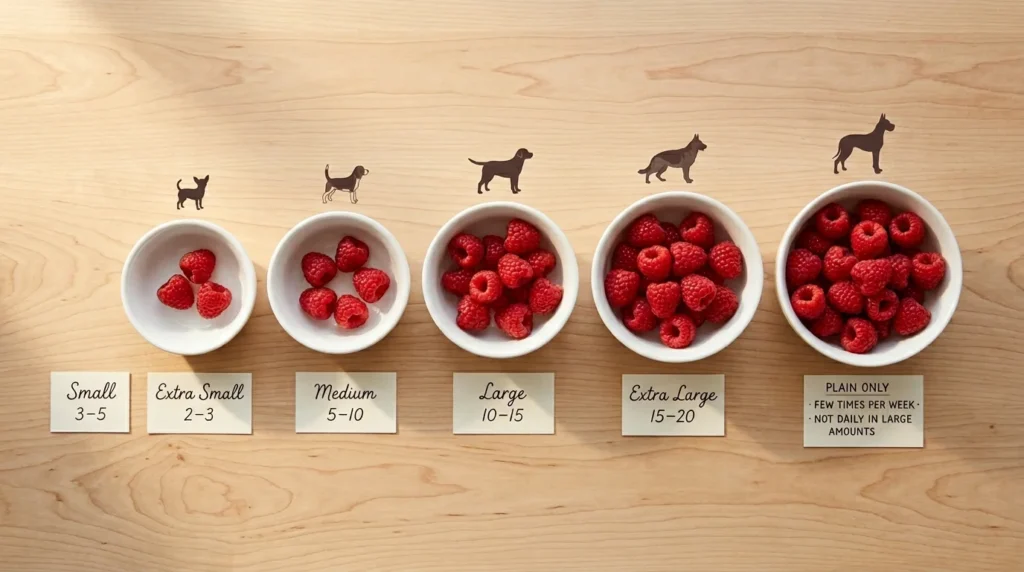
Given the naturally occurring xylitol content that makes moderation important with raspberries, portion guidelines are more specific than with some other berries. The table below reflects both the 10% treat guideline and the raspberry-specific xylitol moderation recommendation.
How Many Raspberries Can a Dog Have? — Portion Guide by Dog Size
| Dog Size | Weight Range | Raspberries Per Serving (Max) | Daily Maximum | Frequency | Notes |
|---|---|---|---|---|---|
| Extra Small | Under 10 lbs | 2–3 raspberries | 3–5 raspberries | 3–4 times per week | Halve each berry for tiny breeds |
| Small | 10–20 lbs | 3–5 raspberries | 5–8 raspberries | 3–4 times per week | Plain only, rinse well |
| Medium | 20–50 lbs | 5–10 raspberries | 10–15 raspberries | A few times per week | Fresh or plain frozen |
| Large | 50–90 lbs | 10–15 raspberries | 15–20 raspberries | A few times per week | Monitor for digestive tolerance |
| Extra Large | 90 lbs + | 15–20 raspberries | Up to ¼ cup | A few times per week | Not daily in large amounts |
Important notes on this table:
- These are maximum amounts specifically for plain fresh or plain frozen raspberries.
- The xylitol concern makes daily large-amount feeding inadvisable even for large dogs — several times per week is recommended over daily.
- For freeze-dried raspberries: reduce amounts to one-third of the fresh raspberry amounts given the concentration.
- Diabetic dogs: consult vet before giving raspberries — while low in sugar, the xylitol content warrants professional guidance.
- If combining with blackberries (which also contain natural xylitol), share the total berry amount between both fruits.
- Dogs with sensitive stomachs: start at the low end of each range given raspberries’ high fiber content.
- These are maximum amounts — less is always fine and the 3–4 times per week frequency rather than daily is the recommended approach.
Can Puppies Eat Raspberries?
Yes — puppies can eat a small number of fresh raspberries, but with extra care. The xylitol consideration is proportionally more significant for puppies given their small body size, and the high fiber content can more easily cause digestive upset in puppies whose digestive systems are still developing.
For puppies, start with literally 1 to 3 berries as a first introduction and wait 48 hours before giving more. Watch for any digestive upset — gas, loose stools — or any sign of allergic reaction.
Frozen raspberries can be particularly good for teething puppies — the cold soothes sore gums while the soft texture makes them safe for young teeth. Cut or lightly squish each frozen raspberry before giving to a very young puppy.
Primary nutrition must always come from complete, age-appropriate puppy food. Raspberries are supplemental only.
Frequently Asked Questions
Can dogs eat raspberries?
Yes — plain fresh or frozen raspberries are safe for dogs in moderate amounts. They provide antioxidants, Vitamin C, manganese, and fiber. Keep portions appropriate due to naturally occurring xylitol and do not give in large daily amounts.
Can dogs have raspberries?
Yes. Raspberries are a recognized dog-safe fruit. A small handful a few times per week provides real health benefits without meaningful risk for most healthy dogs.
Are raspberries good for dogs?
Yes. Raspberries are exceptionally rich in anthocyanins, ellagic acid, Vitamin C, manganese, Vitamin K, and fiber — a genuinely impressive nutritional profile for a low-calorie, low-sugar fruit.
Are raspberries bad for dogs?
Plain raspberries in appropriate amounts are not bad. The naturally occurring xylitol requires moderation. Large daily amounts, raspberry sorbet, syrup, candy, and flavored products are inappropriate.
Can dogs eat frozen raspberries?
Yes — plain frozen raspberries (one ingredient: raspberries) are safe and excellent. Nutritional value is well preserved through freezing.
Can dogs eat fresh raspberries?
Yes. Fresh raspberries are the best form — maximum nutrition, natural hydration, no processing. Rinse thoroughly before serving.
Can dogs eat black raspberries?
Yes. Black raspberries are safe and actually exceptionally high in anthocyanins and ellagic acid. The same xylitol moderation guidelines apply.
Can dogs eat wild raspberries?
True wild Rubus raspberries from clean environments are generally safe. Use caution regarding pesticide exposure, correct plant identification, and source environment.
Can dogs eat freeze-dried raspberries?
Yes — plain freeze-dried (one ingredient only) in very small amounts. Freeze-drying concentrates everything including natural xylitol — use approximately one-third the amount you would give fresh.
Can dogs eat raspberries and blackberries?
Yes. Both are safe and complement each other nutritionally. Both contain natural xylitol — share the total portion guideline between both fruits when giving together.
Can dogs eat raspberry sorbet?
No. Raspberry sorbet contains large amounts of refined sugar and may contain artificial sweeteners including xylitol in sugar-free versions. Never give sorbet to dogs.
Can dogs eat raspberry syrup?
No. Concentrated sugar, artificial flavoring, and possible xylitol make raspberry syrup completely inappropriate for dogs.
Can dogs eat raspberries every day?
Not recommended in large amounts daily due to natural xylitol. Several times per week in appropriate portions is the better approach. Small daily amounts for medium and large dogs are unlikely to cause concern but rotation is better practice.
How many raspberries can a small dog eat?
See the portion table above. Small dogs (10–20 lbs): 3–5 raspberries per serving, up to 5–8 per day maximum, 3–4 times per week.
Can puppies eat raspberries?
Yes, in very small amounts. Start with 1–3 berries, wait 48 hours, watch for digestive upset. Frozen raspberries are good for teething puppies. Primary nutrition from complete puppy food.
What is the xylitol concern with raspberries?
Raspberries contain naturally occurring xylitol in trace amounts. At normal portion sizes, this is not a toxicity risk. Very large daily amounts — particularly for small dogs — should be avoided as a precaution.
Are raspberry seeds safe for dogs?
Yes. Raspberry seeds are tiny, soft, fully digestible, and contain no toxic compounds. No need to remove them.
Conclusion
Raspberries are one of the most nutritionally impressive fruits you can share with your dog — exceptionally rich in anthocyanins, ellagic acid, Vitamin C, manganese, and fiber, all wrapped up in a low-calorie, low-sugar, naturally sweet berry that most dogs find absolutely delicious. The anti-inflammatory, antioxidant, and cellular protective properties of raspberries make them genuinely valuable as a dietary addition for dogs of any age, but particularly for senior dogs managing inflammation and aging-related cellular change.
The complete rules to follow every time:
- Fresh or plain frozen raspberries are the safest and best forms
- Rinse fresh raspberries thoroughly before every serving
- Keep portions within the guidelines in the table above
- Feed several times per week rather than in large daily amounts — natural xylitol moderation
- Serve completely plain — no sugar, no syrup, no cream, no additions
- Never give raspberry sorbet, syrup, candy, jam, or flavored products
- Freeze-dried: safe but concentrated — use smaller amounts
- Wild raspberries from known clean sources are safe; unknown wild berries require caution
- Introduce slowly (3 to 5 berries the first time) and watch for digestive reaction
- Very small dogs: halve each berry to prevent choking risk
- Dogs with diabetes: consult vet given xylitol content
Also Read: Can Dogs Eat Cantaloupe? Rind, Seeds & Safe Serving Guide 2026


