

Can Dogs Eat Blackberries? Top Antioxidant Berry — Full Guide 2026
You are picking blackberries on a summer walk, or you have a bowl of fresh blackberries at home, and your dog looks up with those familiar hopeful eyes. Blackberries — those dark, juicy, naturally sweet berries — seem like a wholesome treat to share. But can dogs eat blackberries? Are they actually safe? What about wild blackberries, frozen blackberries, or blackberry jam?
Great news — blackberries are one of the safest and most nutritious fruits you can share with your dog. But like any fruit, there are important details about preparation, portions, and specific forms to understand before making them a regular treat.
This complete guide answers every question dog owners ask about blackberries and dogs — every variety, every form, every related product, and everything you need to know to share this nutritious berry confidently.
Can Dogs Eat Blackberries?
Yes — dogs can eat blackberries, and they are safe for most healthy dogs. Blackberries are non-toxic, low in sugar compared to many other fruits, and packed with powerful antioxidants, vitamins, and fiber that genuinely benefit canine health.
One important note: like raspberries, blackberries contain small amounts of naturally occurring xylitol — a sugar alcohol that is dangerous to dogs in large amounts. The trace amounts in a few blackberries are not a realistic safety concern at normal portion sizes, but this is why moderation matters more with blackberries than with some other berries like blueberries.
Prepare simply — rinse fresh blackberries and serve plain in appropriate amounts. No jam, no jelly, no syrup, no added sugar. Just whole blackberries, and your dog will love them.
Are Blackberries Good for My Dog?
Yes — blackberries are genuinely good for dogs. They consistently rank among the top berry choices for dogs in veterinary nutritional guidance because of their exceptional nutritional density combined with very low sugar content.
Blackberries contain one of the highest antioxidant concentrations of any common fruit — higher even than blueberries in some analyses. The deep purple-black color comes from anthocyanins and other polyphenols that provide powerful anti-inflammatory, anticancer, and cellular protective benefits.
At roughly 62 calories per cup and only 7 grams of natural sugar per cup, blackberries are one of the most calorie-efficient nutritious treats available. For dogs of any size, the combination of high nutrition, low calories, and low sugar makes blackberries an excellent treat choice — particularly for senior dogs or those managing weight.
Are Blackberries Bad for Dogs?
Plain fresh or frozen blackberries in appropriate amounts are not bad for dogs. However, blackberries can become problematic in specific situations.
Natural xylitol — the key moderation reason: Like raspberries, blackberries contain trace amounts of naturally occurring xylitol. This is entirely different from artificial xylitol in processed products. At normal treating amounts, this is not a toxicity risk. But very large daily quantities, particularly for small dogs, should be avoided as a precaution.
Too many at once — digestive upset: The high fiber content of blackberries, while beneficial in moderation, can cause gas, bloating, and loose stools when too many are given at once. Start slowly and keep portions appropriate.
Blackberry-flavored products: Jam, jelly, syrup, candy, and commercial blackberry products contain high added sugar and artificial ingredients not appropriate for dogs. Only fresh or plain frozen blackberries are appropriate forms.
Seeds — minimal concern: Blackberry seeds are small and generally safe, but the large number of seeds per berry means they can accumulate in the digestive tract. Not toxic, but worth noting.
Benefits of Blackberries for Dogs
Blackberries deliver an impressive range of health benefits for dogs in every small serving.
Anthocyanins — Exceptional Antioxidant Protection Blackberries have one of the highest anthocyanin concentrations of any fruit. These powerful pigment compounds protect cells from free radical damage, reduce chronic inflammation, and have documented potential for reducing cancer risk. For aging dogs, dogs with inflammatory conditions like arthritis, or any dog where cellular protection is a priority, blackberries provide exceptional antioxidant support.
Vitamin C — Immune Defense Blackberries provide excellent amounts of Vitamin C — supporting immune function, aiding collagen production for healthy joints and skin, and acting as a direct antioxidant. Additional dietary Vitamin C is particularly valuable for older dogs, stressed dogs, and those in recovery.
Vitamin K — Blood and Bone Health Blackberries are one of the better fruit sources of Vitamin K, essential for proper blood clotting and bone density. This is particularly relevant for senior dogs where bone health becomes a growing concern.
Manganese — Metabolism and Joint Health Blackberries provide meaningful manganese — supporting bone formation, enzyme function, and collagen production for joint and connective tissue health.
Dietary Fiber — Digestive and Blood Sugar Health At approximately 8 grams of fiber per cup, blackberries are exceptionally fiber-rich. This fiber supports healthy digestion, feeds beneficial gut bacteria, and slows sugar absorption — meaning even the modest natural sugar in blackberries has minimal glycemic impact.
Omega-3 Fatty Acids (Alpha-Linolenic Acid) Blackberry seeds contain alpha-linolenic acid (ALA) — a plant-based omega-3 fatty acid that supports cardiovascular health and contributes to the anti-inflammatory effect of blackberries overall.
Low Sugar — Weight and Diabetes Friendly At only 7 grams of natural sugar per cup, blackberries are among the lowest-sugar fruits available. Combined with high fiber that further moderates sugar absorption, blackberries are one of the most appropriate fruit options for dogs managing weight or blood sugar.
Is There a Downside to Feeding My Dog Blackberries?
While blackberries are one of the safer fruits for dogs, there are practical downsides to understand.
Natural xylitol — requires moderation: The trace natural xylitol in blackberries means daily large-amount feeding is not recommended. Keep to a few times per week in appropriate portion sizes.
High fiber can cause digestive upset: Too many blackberries at once can overwhelm the digestive system with fiber — causing gas, bloating, loose stools, or diarrhea. This is especially true the first time a dog tries them.
Staining: Blackberries produce intense purple-black staining from their anthocyanin pigments. They stain fur, fabric, surfaces, and of course your dog’s mouth and paws temporarily after eating. This is harmless but worth being prepared for.
Seeds accumulate: Each blackberry contains multiple small seeds. While individual seeds are harmless, giving very large amounts means swallowing many seeds, which can accumulate in the digestive tract and potentially cause mild irritation in sensitive dogs.
Allergic reactions possible: While uncommon, blackberry allergies occur in dogs. Introduce slowly and watch for any skin, digestive, or respiratory reaction the first time.
See Also: Can Dogs Eat Peanuts and Peanut Butter? Full Safety Guide 2026
Risks of Feeding Blackberries to Dogs

A complete look at the specific risks for responsible feeding.
Natural Xylitol — Moderation Required Blackberries contain naturally occurring xylitol. The amounts are very small — far smaller than the artificial xylitol in manufactured products. At normal portion sizes for any dog size, this does not represent a realistic acute toxicity risk. However, regular very large daily amounts — particularly for small dogs — should be avoided. The guidance is moderation and frequency control rather than avoidance.
Digestive Upset from Excess Fiber The 8g of fiber per cup in blackberries is a significant amount. In moderation, this fiber is a benefit. In excess — a large bowl of blackberries at once — it can cause significant gastrointestinal distress. Introduce slowly and build up to appropriate portions.
Choking — Minor Concern for Tiny Breeds Blackberries are larger than raspberries and have a round-ish shape that could pose a very minor choking risk for very small toy breeds. For dogs under 5 pounds, halving each blackberry before serving is a reasonable precaution.
Pesticide Residue Commercially grown blackberries may carry pesticide residue. Always wash thoroughly under cold running water before serving. Organic blackberries are the better choice for dogs that eat them regularly.
Bramble Scratches if Foraging If your dog forages for wild blackberries, the thorny bramble canes (branches) can scratch their face, paws, and muzzle. While not a food safety concern, it is worth supervising any dog that explores blackberry bushes.
Can Dogs Eat Raspberries and Blackberries?
Yes — both raspberries and blackberries are safe for dogs and make an excellent nutritional combination. They share similar nutritional profiles — high anthocyanins, low sugar, high fiber, good Vitamin C and Vitamin K — and complement each other to create a broader antioxidant spectrum than either alone.
One consideration: both raspberries and blackberries contain naturally occurring xylitol. This means when combining the two, share the total portion allowance between them rather than treating them as independently unlimited amounts.
A mixed berry bowl of a few raspberries and a few blackberries is a genuinely excellent antioxidant-rich treat for most dogs. Rinse both fruits, combine, and serve plain. Most dogs love the combination.
Can Dogs Eat Wild Blackberries?
Wild blackberries (primarily Rubus allegheniensis in North America and Rubus fruticosus in Europe) are the same plant genus as cultivated blackberries and are safe for dogs. They are often more intensely flavored and may contain even higher antioxidant concentrations than cultivated varieties due to their naturally varying growing conditions.
The considerations with wild blackberries are environmental rather than botanical. Wild blackberries growing near roadsides, agricultural fields, or treated areas may carry pesticide, herbicide, or heavy metal contamination. In genuinely clean natural environments away from human chemical activity, wild blackberries are safe.
Supervise your dog around wild blackberry canes — the thorny stems can scratch and injure. Let your dog eat ripe berries that have fallen from the canes rather than letting them press into the thorny branches.
Can Dogs Eat Blackberries Raw?
Yes — raw fresh blackberries are the best and most nutritious form to give your dog. Raw blackberries retain their full complement of vitamins, antioxidants, and fiber at maximum potency. Vitamin C, which is heat-sensitive, is best preserved in raw fruit.
The anthocyanins that make blackberries so nutritionally valuable are also better preserved in raw versus heated preparations. Cooking blackberries (as in making jam or sauce) reduces antioxidant content compared to the fresh raw form.
Choose fully ripe blackberries — deep black, soft to gentle touch, sweet smell. Avoid unripe red or purple blackberries (still developing, more tart, potentially harder to digest). Wash thoroughly and serve plain.
Can Dogs Eat Blackberries Safely?
Yes — blackberries can be fed to dogs safely with simple preparation and appropriate portions.
Complete safety checklist:
- Choose fully ripe, black-colored blackberries — avoid unripe red or very firm ones
- Wash thoroughly under cold running water before every serving
- Serve plain — no sugar, no cream, no yogurt with sweetener, no jam
- Give in appropriate amounts for your dog’s size (see portion table)
- For very small dogs (under 5 lbs): halve each berry
- Introduce slowly the first time — 3 to 5 berries, wait 24 hours
- Do not give daily in large amounts — natural xylitol means moderation matters
- Never give blackberry jam, jelly, syrup, or flavored products
- Wild blackberries: only from clean, unsprayed environments
- Watch for any signs of digestive upset or allergic reaction first few times
Can Dogs Eat Frozen Blackberries?
Yes — plain frozen blackberries are safe for dogs and are a popular summer treat. Frozen blackberries retain excellent nutritional value — the freezing process preserves vitamins, antioxidants, and fiber very well. The cold, firm texture is enjoyable for most dogs, particularly in hot weather.
For buying frozen blackberries: Check the ingredient label — it should list only blackberries. Some commercial frozen berry products contain added sugar or preservatives. Choose single-ingredient frozen blackberries with nothing added.
For making your own: Rinse fresh blackberries, spread on a parchment-lined tray, freeze until solid, then transfer to a sealed bag. Store for up to three months. Serve 3 to 8 frozen blackberries as a summer treat depending on your dog’s size.
Frozen blackberries are particularly good for teething puppies — the cold soothes inflamed gums while the soft (once slightly thawed) texture makes them manageable.
Can Dogs Eat Fresh Blackberries?
Yes — fresh blackberries are the ideal form. Maximum nutrition, natural hydration from the berry’s water content, and the satisfying texture and flavor that most dogs love. Fresh blackberries during peak season (July through September in most regions) are at their nutritional and flavor peak.
When buying fresh blackberries, choose firm, fully black, fragrant berries with no mold and no mushiness. Avoid any container with visible mold — mold spreads quickly among the delicate berries.
Rinse under cold water immediately before serving. Fresh blackberries are perishable — refrigerate and use within 2 to 3 days. Do not wash before refrigerating to prevent premature spoilage.
See Also: Can Dogs Eat Raspberries? Antioxidants, Portions & Safety Tips 2026
Can Dogs Eat Blackberries Mures?
“Mûres” is the French word for blackberries — this question typically comes from French-speaking regions or from people who encountered this term. The safety answer is identical to plain blackberries — yes, plain fresh mûres (blackberries) are safe for dogs with the same preparation guidelines described throughout this guide.
Botanically and nutritionally, mûres are the same fruit as English “blackberries.” The safety, nutritional benefits, xylitol moderation consideration, and portion guidelines all apply equally.
Can Dogs Eat Blackberries Seeds?
Yes — blackberry seeds are safe for dogs. Each blackberry contains multiple small, hard seeds called drupelets. These seeds are not toxic and do not contain the cyanogenic compounds found in cherry or apple seeds.
The seeds are small enough that they do not typically pose a choking risk and generally pass through the digestive system without causing problems. However, the large number of seeds per blackberry — and the possibility of eating many blackberries at once — means a significant number of seeds can be ingested. This is not a toxicity concern but may cause mild digestive irritation in very sensitive dogs with large amounts.
For most dogs, blackberry seeds are a non-issue.
Can Dogs Eat Blackberries Everyday?
Not recommended in large amounts daily. As with raspberries, the naturally occurring xylitol in blackberries creates a reason to practice frequency moderation that does not apply as strongly to blueberries or strawberries.
The practical guidance: several times per week is better than large amounts every single day. A few blackberries given daily as part of a varied treat rotation are unlikely to cause concern for most medium and large dogs. But giving a full portion of blackberries daily — particularly to small dogs — accumulates more natural xylitol than is ideal.
Rotate blackberries with other berries (blueberries, strawberries) and vegetable treats (carrots, cucumber) across the week for the best dietary variety and natural xylitol moderation.
Can Dogs Eat Blackberry Jam or Jelly?
No — blackberry jam and jelly are not appropriate for dogs. Despite being made from blackberries (which are safe), jam and jelly are heavily processed with added sugar that makes them completely different products from the fresh fruit.
Commercial blackberry jam contains very large amounts of refined sugar — typically 10 to 15 grams per tablespoon. This high sugar load causes blood sugar spikes, contributes to weight gain and dental decay, and is particularly problematic for diabetic dogs. Many “light” or “sugar-free” jelly products contain xylitol as a sweetener — which is, of course, toxic to dogs.
Blackberry jam and jelly also contain pectin as a gelling agent and often citric acid as a preservative — neither is appropriate for dogs as food ingredients at the concentrations used.
Never give blackberry jam, jelly, preserves, or fruit spreads to dogs. The fresh fruit is what is safe — not any processed derivative.
What Berries Are Toxic to Dogs?
Since blackberries are safe, dog owners often want to know which berries to always avoid. Here is a clear guide.
Definitely toxic — never give these:
- Grapes and raisins — extremely toxic, cause kidney failure
- Holly berries (Ilex species) — contain theobromine and other compounds causing vomiting, diarrhea, lethargy
- Mistletoe berries — cause cardiovascular abnormalities
- Yew berries (Taxus species) — highly toxic, can be fatal
- Bittersweet nightshade (Solanum dulcamara) berries — contain solanine, toxic
- Jerusalem cherry — contains solanine, toxic
- Pokeberries (Phytolacca americana) — serious toxicity, particularly the roots and berries
Toxic or highly problematic in the wild:
- Elderberries — raw elderberries and the plant contain cyanogenic glycosides; cooked elderberries may be safe but wild foraging is risky
- Gooseberries — some varieties may cause digestive upset
Safe berries for dogs (plain, no additives):
- Blackberries — this guide
- Raspberries — see our raspberries guide
- Blueberries — one of the best berries for dogs
- Strawberries — safe and nutritious
- Cranberries — safe in small amounts, very tart
If unsure about a berry: Never let your dog eat it and contact your vet or ASPCA Animal Poison Control (888-426-4435) if ingestion occurs.
Which Blackberries Should Dogs Not Eat?
While wild and fresh cultivated blackberries are safe, specific blackberry forms and products should never be given to dogs.
Never give:
- Blackberry jam, jelly, or preserves — high sugar, possible xylitol in sugar-free
- Blackberry syrup — concentrated sugar and artificial flavoring
- Blackberry candy or gummies — refined sugar, artificial coloring, possible xylitol
- Blackberry-flavored drinks or juice — concentrated sugar, artificial additives
- Dried blackberries with added sugar — concentrated sugar, preservatives
- Blackberry-flavored yogurt (commercial) — added sugar, artificial flavoring
- Blackberries from known pesticide-sprayed areas — chemical contamination
Use with caution:
- Freeze-dried blackberries — safe but concentrated, use very small amounts
- Wild blackberries from unknown environments — pesticide or misidentification risk
- Unripe blackberries (red or very firm) — higher in tannins, potentially harder to digest
See Also: Can Dogs Eat Mushrooms? Safe Types, Wild Dangers & Full Guide
How Many Blackberries Should I Feed My Dog?
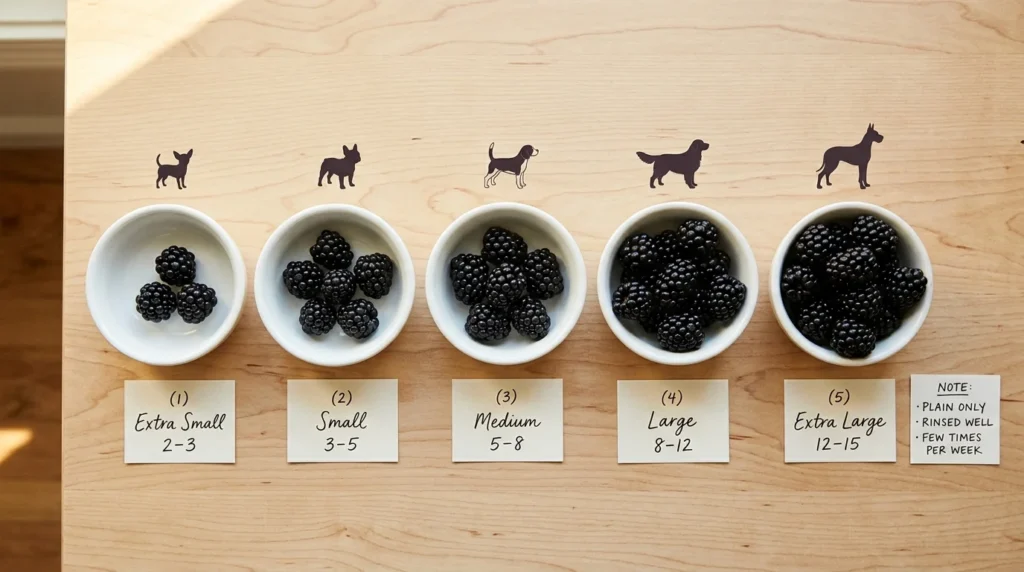
Given the naturally occurring xylitol consideration and the high fiber content, appropriate portions are important. The 10% treat guideline applies, and moderation in frequency (several times per week rather than daily in large amounts) is the key recommendation.
How Many Blackberries Should I Feed My Dog? — Portion Guide by Dog Size
| Dog Size | Weight Range | Blackberries Per Serving (Max) | Daily Maximum | Frequency |
|---|---|---|---|---|
| Extra Small | Under 10 lbs | 2–3 blackberries | 3–4 blackberries | 2–3 times per week |
| Small | 10–20 lbs | 3–5 blackberries | 5–7 blackberries | 3–4 times per week |
| Medium | 20–50 lbs | 5–8 blackberries | 8–12 blackberries | A few times per week |
| Large | 50–90 lbs | 8–12 blackberries | 12–15 blackberries | A few times per week |
| Extra Large | 90 lbs + | 12–15 blackberries | Up to ¼ cup | A few times per week |
Important notes on this table:
- These amounts apply to plain fresh or plain frozen blackberries only.
- Blackberry jam, jelly, syrup, or any processed product: zero — never appropriate.
- “A few times per week” rather than daily is recommended due to natural xylitol content.
- When combining with raspberries (which also contain natural xylitol), share the total portion between both berries.
- Diabetic dogs: consult vet first — while low in sugar, xylitol content warrants professional guidance.
- Introduce slowly: first time, give only 2 to 3 berries regardless of dog size and wait 24 hours.
- Dogs with sensitive stomachs: start at the low end of each range — high fiber can cause digestive upset.
- These are maximum amounts — less is always fine.
Can Puppies Eat Blackberries?
Yes — puppies can eat a small number of fresh blackberries as an occasional treat. Blackberries’ nutritional profile — antioxidants, vitamins, fiber — is beneficial for growing puppies. Frozen blackberries are particularly excellent for teething puppies, as the cold temperature soothes sore gums.
Extra care guidelines for puppies: start with just 1 to 3 berries the first time and wait 48 hours. The xylitol consideration is proportionally more significant for small puppies due to lower body weight. Cut or squish each berry before giving to very young puppies. Supervise closely.
Primary nutrition must always come from complete, age-appropriate puppy food. Blackberries are supplemental only — an occasional treat, never a dietary component.
Frequently Asked Questions
Can dogs eat blackberries?
Yes — plain fresh or frozen blackberries are safe for most healthy dogs. They are non-toxic, low in sugar, high in antioxidants, and genuinely nutritious. Rinse thoroughly, serve plain in appropriate amounts, and keep frequency to a few times per week rather than daily in large amounts.
Are blackberries good for my dog?
Yes. Blackberries are exceptionally rich in anthocyanins, Vitamin C, Vitamin K, manganese, fiber, and omega-3 fatty acids — a genuinely impressive nutritional profile for a low-calorie, low-sugar fruit.
Are blackberries bad for dogs?
Plain blackberries in appropriate amounts are not bad. The natural xylitol content requires moderation. Blackberry jam, jelly, syrup, or any processed blackberry product is not appropriate for dogs.
Can dogs eat wild blackberries?
Wild blackberries are safe when from clean, unsprayed environments. The concern is pesticide/herbicide contamination from treated areas, not the berry itself. Supervise around thorny bramble canes.
Can dogs eat frozen blackberries?
Yes — plain frozen blackberries with no added sugar or preservatives are safe and make a great summer treat. Check ingredient labels and choose single-ingredient products.
Can dogs eat fresh blackberries?
Yes. Fresh blackberries are the best and most nutritious form. Rinse thoroughly, serve plain. Choose fully ripe, deep black, fragrant berries.
Can dogs eat raspberries and blackberries together?
Yes. Both are safe and complement each other nutritionally. Both contain natural xylitol — share the combined portion between both berries rather than treating them as independently unlimited amounts.
Can dogs eat blackberry jam or jelly?
No. Blackberry jam and jelly contain large amounts of refined sugar and may contain xylitol in sugar-free versions. Neither is appropriate for dogs.
Can dogs eat blackberry seeds?
Yes. Blackberry seeds are small, not toxic, and generally safe. They are not a concern at normal portion sizes.
Can dogs eat blackberries every day?
Not recommended in large daily amounts due to natural xylitol. Several times per week in appropriate portions is the better approach.
What berries are toxic to dogs?
Grapes and raisins are extremely toxic. Holly berries, mistletoe berries, yew berries, nightshade berries, and pokeberries are all toxic. Safe berries include blackberries, raspberries, blueberries, and strawberries.
Can puppies eat blackberries?
Yes, in very small amounts. Start with 1 to 3 berries, wait 48 hours. Frozen blackberries are particularly good for teething. Primary nutrition from complete puppy food.
How many blackberries can a small dog eat?
See the portion table. Small dogs (10–20 lbs): 3–5 berries per serving, up to 5–7 per day, 3 to 4 times per week.
What happens if my dog eats too many blackberries?
Digestive upset — gas, loose stools, diarrhea — from the high fiber content. Ensure water access, reduce next meal, monitor for 24 hours. Contact vet if symptoms are severe or prolonged.
Conclusion
Blackberries deserve their position as one of the best berries you can share with your dog. Exceptionally high in anthocyanins and antioxidants, very low in sugar, rich in fiber, and genuinely delicious to most dogs — they tick every box for an ideal fruit treat. The naturally occurring xylitol consideration is real but manageable through simple moderation, and should not deter you from including blackberries in your dog’s treat rotation.
The complete rules:
Safe for dogs:
- Fresh plain blackberries — washed, ripe, served whole or halved for tiny dogs
- Plain frozen blackberries — single-ingredient, no added sugar
- Wild blackberries from genuinely clean environments
Never give:
- Blackberry jam or jelly — high sugar, possible xylitol
- Blackberry syrup — concentrated sugar and artificial flavoring
- Blackberry candy or flavored products — artificial coloring and sweeteners
- Unripe blackberries — more tart, harder to digest
Also Read: Can Dogs Eat Cherries? Pits, Toxicity & Complete Safety Guide